
- Table 1 Prevalence of foodborne pathogens among adults aged ≥65 years in Scotland and from global studies
- Table 2 Determinants of food safety risks, behaviours and vulnerabilities
- Table 3 Physical environment determinants upon food shopping, storage, cooking and eating practices among adults over 65 in Scotland
- Table 4 Biological determinants upon food shopping, storage, cooking and eating practices among adults over 65 in Scotland
- Table 5 Social determinants upon food shopping, storage, cooking and eating practices among adults over 65 in Scotland
- Table 6 Psychological determinants upon food shopping, storage, cooking and eating practices among adults over 65 in Scotland
- Table 7 Impact of economic determinants upon food shopping, purchase decisions, food storage and eating practices among adults over 65 in Scotland
- Table 8 Impact of economic determinants upon food shopping, storage, cooking and eating practices among adults over 65 in Scotland
- Table 9 Perceived susceptibility to foodborne illness among family-caregivers and adults over 65 in Scotland
- Table 10 Perceived severity of foodborne illness among family-caregivers and adults over 65 in Scotland
- Table 11 Perceived benefits of food safety practices among family caregivers and adults over 65 in Scotland
- Table 12 Perceived barriers to food safety practices among family caregivers and adults over 65 in Scotland
- Table 13 Perceived self-efficacy of implementing food safety practices among family-caregivers and adults over 65 in Scotland
- Table 14 Motivations of individuals aged ≥ 65 years in Scotland to implement recommended food safety practices
- Table 15 Cues to action that have resulted in adopting food safety behaviours among family-caregivers and adults over 65 in Scotland
- Table 16 Impact of being responsible for food provision of relatives upon family caregivers
- Table 17 Considerations for future Food Standards Scotland food safety messaging.
Discussion
7.2 Learning from the application of the Health Belief Model
- Threat perception: The findings highlight differences in the perceived threat of foodborne illness between individuals over 65 and their family caregivers. Many older adults did not perceive themselves as susceptible to foodborne illness, often associating it with food consumed outside the home and not recognizing the impact of age-related immune changes.
- However, when informed about these changes, some acknowledged their increased vulnerability. Family caregivers, in contrast, were more aware of the heightened risk their elderly relatives faced due to frailty or health conditions, which influenced their food safety practices. Caregivers also exhibited a stronger understanding of the potential severity of foodborne illness, recognising its serious or life-threatening consequences for older adults. These findings emphasize the need for targeted education on food safety to increase awareness and improve practices among both older adults and caregivers.
- Motivation: Some individuals were motivated by personal experiences with foodborne illness, while others, especially those with underlying health conditions, were motivated by the need to protect themselves or family members. For instance, individuals who had experienced foodborne illness were more cautious about food safety practices, whereas some participants who hadn’t had such experiences didn’t prioritize food safety as much. Additionally, family caregivers were particularly motivated to ensure food safety for their loved ones, especially if they believed their relatives were no longer capable of managing it themselves. There were also differences in the use of food safety gadgets, with some participants showing interest in tools like refrigerator thermometers and temperature probes, while others were less inclined to use them, viewing such practices as unnecessary or burdensome.
- Behavioural evaluation: The evaluation of food safety behaviours reveals that perceived benefits, such as preventing foodborne illness and increasing confidence in food safety, play a crucial role in motivating individuals to adopt food safety practices. However, these benefits are often weighed against perceived barriers, including financial constraints, lack of knowledge, complacency, and emotional resistance. Motivations for food safety behaviours vary greatly, influenced by personal experiences, such as previous foodborne illnesses, underlying health conditions, and practical considerations like the use of food safety tools (e.g., temperature probes and refrigerator thermometers). Additionally, for some individuals, cultural attitudes and misconceptions, such as disregarding use-by dates or overconfidence in cooking abilities, can act as barriers to adhering to recommended practices. Understanding these factors, particularly in groups like the elderly or family caregivers, can help inform the development of more effective food safety education campaigns that emphasize relatable experiences, practical benefits, and the accessibility of key tools.
- Cues to action: Cues to action, such as media campaigns, personal communication, and food labelling, serve as triggers that encourage individuals to adopt recommended food safety behaviours. However, responses to these cues vary based on individual perceptions and lifestyle factors. For instance, media campaigns have been effective in altering behaviours, like discouraging the washing of raw poultry to prevent contamination, while other individuals may resist changing ingrained practices. The effectiveness of cues to action can be enhanced by providing clear, relevant information tailored to specific groups, such as older adults or individuals with underlying health conditions. Additionally, future food safety education should include diverse communication methods to reach wider audiences, focusing on providing evidence-based, relatable content.
7.3 Informing the development of future Food Standards Scotland food safety messaging
The cumulative findings of this study confirm the need for Food Standards Scotland food safety educational resources for clinically vulnerable groups, such as older adults. The findings from this study can be utilised to inform the development of future food safety messaging approaches. It is clear from the body of work undertaken that there is a need to create Food Standards Scotland food safety campaign messaging to communicate who is at an increased risk of illness, why they are susceptible and how to reduce the risks.
To enable this there is a need to utilise the overarching constructs of the Health Belief Model, namely threat perceptions, motivation, behavioural evaluation and cues to action as indicated in Table 17.
Table 17
Considerations for future Food Standards Scotland food safety messaging
| Constructs of the Health Belief Model | Considerations for Food Standards Scotland food safety messaging |
|---|---|
| Threat perceptions |
|
| Motivation |
|
| Behavioural evaluation |
|
| Cues to action |
|
In addition to utilising the Health Belief Model, there is a need to incorporate the modifying variables discussed in this report. However, despite initially proposing the five separate modifying variables for the purpose of this research, analysis of the data and reflection of the findings suggest that these are not individual factors, they are in fact three factors, namely health, finance and environment that are often interconnected, individually, or combined, they can influence the perceptions that lead to food safety actions as demonstrated below in Figure 5.
This proposed model needs to be utilised to help inform the development of future Food Standards Scotland food safety information resources.
Figure 5. Proposed model to inform the development of future food safety interventions
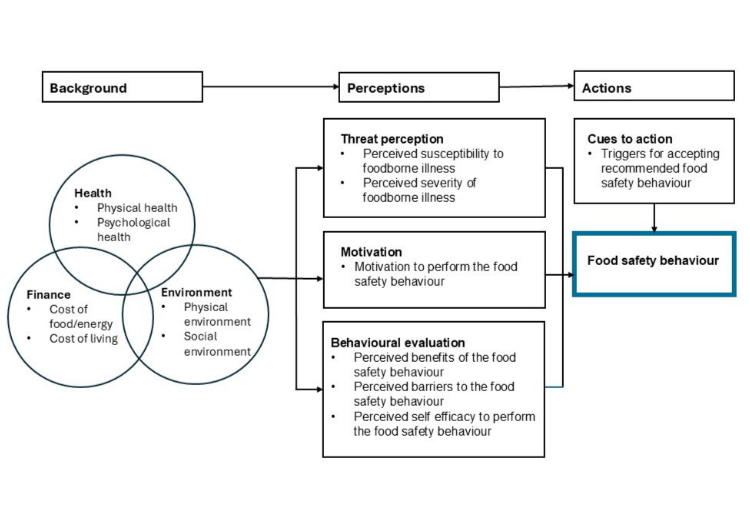
Here is a visual only chart of: Diagram of the proposed model to inform the development of future food safety interventions. The diagram shows how a persons background affects the process including health, finance, physical environment and social environment. a persons perceptions also play a role including threat perceptions, e.g. perceived susceptibility to food borne illness or perceived severity of foodborne illness. Motivation is also a consideration e.g. motivation to perform the food safety behaviours. Additionally behaviour evaluation by an individual plays a role e.g. perceived benefit of the food safety behaviour, perceived barriers to the food safety behaviour, perceived self-efficacy to perform the food safety behaviours. The 3rd category of the model is actions e.g. calls to action which can be triggers for accepting recommended food safety behaviours
Please find more information provided in the detailed description and/or table below.
Diagram of the proposed model to inform the development of future food safety interventions.
The diagram shows how a persons background affects the process including health, finance, physical environment and social environment.
A persons perceptions also play a role including threat perceptions, e.g. perceived susceptibility to food borne illness or perceived severity of foodborne illness. Motivation is also a consideration e.g. motivation to perform the food safety behaviours. Additionally behaviour evaluation by an individual plays a role e.g. perceived benefit of the food safety behaviour, perceived barriers to the food safety behaviour, perceived self-efficacy to perform the food safety behaviours.
The 3rd category of the model is actions e.g. calls to action which can be triggers for accepting recommended food safety behaviours