
- Table 1 Prevalence of foodborne pathogens among adults aged ≥65 years in Scotland and from global studies
- Table 2 Determinants of food safety risks, behaviours and vulnerabilities
- Table 3 Physical environment determinants upon food shopping, storage, cooking and eating practices among adults over 65 in Scotland
- Table 4 Biological determinants upon food shopping, storage, cooking and eating practices among adults over 65 in Scotland
- Table 5 Social determinants upon food shopping, storage, cooking and eating practices among adults over 65 in Scotland
- Table 6 Psychological determinants upon food shopping, storage, cooking and eating practices among adults over 65 in Scotland
- Table 7 Impact of economic determinants upon food shopping, purchase decisions, food storage and eating practices among adults over 65 in Scotland
- Table 8 Impact of economic determinants upon food shopping, storage, cooking and eating practices among adults over 65 in Scotland
- Table 9 Perceived susceptibility to foodborne illness among family-caregivers and adults over 65 in Scotland
- Table 10 Perceived severity of foodborne illness among family-caregivers and adults over 65 in Scotland
- Table 11 Perceived benefits of food safety practices among family caregivers and adults over 65 in Scotland
- Table 12 Perceived barriers to food safety practices among family caregivers and adults over 65 in Scotland
- Table 13 Perceived self-efficacy of implementing food safety practices among family-caregivers and adults over 65 in Scotland
- Table 14 Motivations of individuals aged ≥ 65 years in Scotland to implement recommended food safety practices
- Table 15 Cues to action that have resulted in adopting food safety behaviours among family-caregivers and adults over 65 in Scotland
- Table 16 Impact of being responsible for food provision of relatives upon family caregivers
- Table 17 Considerations for future Food Standards Scotland food safety messaging.
8. Further research: Distribution of food safety tools to facilitate behaviour change among individuals aged ≥65 years
8.1 Background
During the online and in-person group discussions, many participants discussed the importance of temperature to ensure food safety however suggested potential gaps in practices in ensuring safe refrigerator temperatures and safe cooking temperatures. In one particularly group with children that supported their parents with food related tasks, ideas for the distribution of thermometers were discussed, therefore thoughts of the thermometry study were formed:
“You know, I might be more aware of the risks and yeah, but being older, your immune system is more compromised and be more cautious about things I suppose. And I could persuade my parents to even have a fridge thermometer on the basis of there'll be less food waste. You know, if the fridge was at the right temperature, then they would waste less so. It's about appealing to something that concerns them, not necessarily what you or I might be concerned about. And if I said I'd received a free fridge thermometer through the post, then you know, even if I'd had to go out to Lakeland and buy it. But I told her I got this free thermometer she should use that.” (Participant 006)
“I think also making it sound more fun. “Here's another obligation for you” isn't maybe the way forward. But things like the food temperature of things, you know, making it sound more like curiosity “How can you find out if…” and the making them available, the thermometer type thing. You know saying about fridges operating at right temperature and meat being cooked to the right temperature, making it more engaging a curiosity thing. Rather than here's another obligation, “you've got to make sure that your parents don't get food poisoning as well”. Something else got to worry about as opposed to, you know.” (Participant 005)
“But you know, in the way that if you have a baby, you get a baby box. Maybe it's a case of when you get your pension, you get your healthy ageing box, you know, why is that not prioritised over a baby box? In a way, it's probably more important. I know that a good start in life is really important. But now that people are living longer than an old ageing well box might be a good thing with your fridge thermometer and your food probe or whatever it is and some information.” (Participant 006)
“I just wonder whether that could be part of, like, an intervention that you can pick up a free fridge thermometer or something because, you know, the really basic ones are not expensive. And if the Food Standards could somehow, I don't know how they would target it, but maybe lunching clubs, churches, that sort of thing with an iPad with a video of keeping things cool, like an advert. And then they could have a box of just those cheap-as-chips fridge thermometers and say, “you know you've watched this now so here's a fridge thermometer for you to have”.” (Participant 21)
Consequently, reinvestment funding was secured from the Cardiff School of Sport and Health Science, Dean of Enterprise and Innovation, to purchase and distribute temperature probes and refrigerator thermometers to participants. To facilitate this additional research, an amendment to the initial ethics application was approved, allowing for the implementation of a follow-up thermometry study.
8.2 Methodology
To conduct the study, an email invitation was sent to all participants (n=132) from the initial cohort, inviting them to take part in a home kitchen thermometry assessment. The email included an information sheet detailing the study objectives and procedures (Appendix 12). Participants interested in receiving a free temperature probe and refrigerator thermometer were asked to provide their postal address through an online sign-up form (Appendix 13).
Upon confirmation, temperature probes and refrigerator thermometers were posted to participants in padded envelopes, accompanied by detailed instructions on their use (Appendix 14) and guidelines on safe cooking and refrigeration practices as recommended by Food Standards Scotland (Appendix 15) (Food Standards Scotland, no date).
A specifically designed data capture platform was developed using Qualtrics, allowing participants to upload images demonstrating their use of the temperature probes and thermometers, as well as to report their food safety practices (Appendix 16). As described by Duong and colleagues, most thermometer usage studies rely upon self-reported data, which can be subject to social desirability biases (the tendency for people to present a favourable image of themselves (van de Mortel, 2008) by giving socially desirable responses instead of choosing responses that are reflective of their true feelings or behaviours (Barros et al., 2003), in a food safety context, this may take the form of over reporting positive practices and underreporting malpractices (Evans & Redmond, 2018b)), whereas by utilising citizen science methods that including the capture of pictures as a verification method the potential biases associated with self-reporting of data by research participants can be overcome (Duong et al., 2019).
The methodology utilised in this follow up study replicates those previously used by the research fellow and colleagues in prior citizen science studies (Evans & Mayho, 2024). Upon completion of data collection, quantitative data were exported to SPSS and Excel for statistical analysis, while qualitative data were analysed using NVivo software.
8.3 Results
8.3.1 Response rate
A total of 69 people signed-up to participate in the thermometry study and received temperature probes and refrigerator thermometers. In the 30 days after receiving the participant packs, 49 people uploaded images of the temperature probes and refrigerator thermometers being using in their homes and provided self-reported data. This giving a response rate of 71%, this is significantly higher than has been achieved in previous citizen science research studies undertaken by the research fellow 12 – 39% (Evans & Mayho, 2024).
8.3.2 Refrigerator thermometer usage
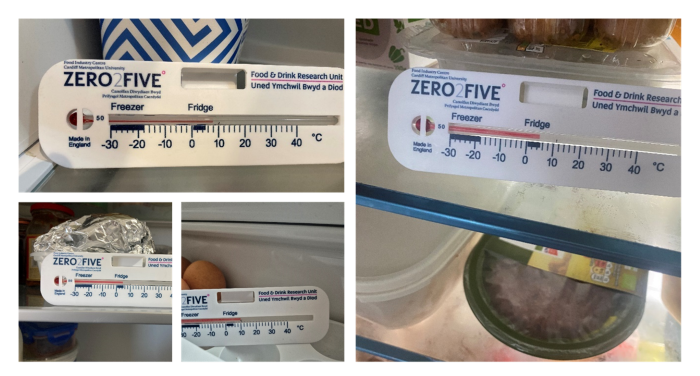
Sixty-one percent reported adjusting the temperature of their fridge since receiving the thermometer as the refrigerator was previously running above 5°C, consequently 79% had refrigerators operating at a safe temperature of 5°C or less, 21% had their refrigerator still running above temperature of 5°C or more, of these 50% were “somewhat concerned and would consider adjusting the temperature” and 50% were “very concerned and would be readjusting the fridge temperature”. Examples of the images uploaded to the platform are shown in Figure 6 below. As a result of taking part in the study 93% reported knowing the recommended operating temperature for the refrigerators and the same proportion believed that having a fridge at the recommended temperature would reduce food waste, while 100% believed it would reduce the risk of food poisoning.
Figure 6: Examples of thermometers in participant refrigerators
8.3.3 Use of temperature probe when cooking
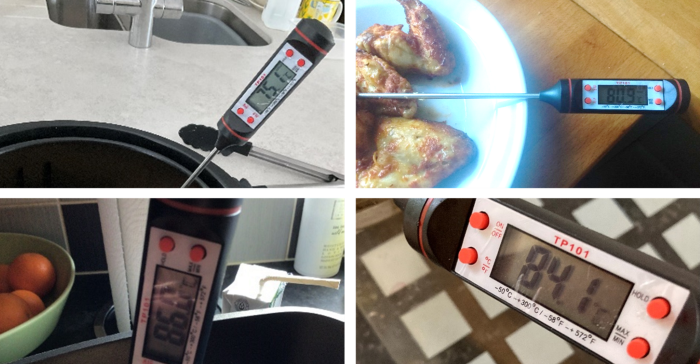
Examples of the temperature probes being used to determine cooking adequacy are show in Figure 7. It was determined that 92% knew the recommended cooking temperature because of taking part in the study and 97% believed that using the probe would reduce the risk of food poisoning. During the study 32% reported that the food had not reached 75°C when they initially checked, all these participants said they then continued cooking until the temperature was above 75°C. The majority, 95% reported that they will continue to use the probe after participating in the study.
Figure 7: Examples of temperature probes being used by participants
8.3.4 Motivation for taking part in the thermometry study
Participants were asked to state their motivation for participating in the thermometry study, the statements related to five themes, some of which was related. For example, food safety as a concern was described as motivation for some to participate:
“I want to avoid infections from food. My husband has a compromised immune system, so I need to be extra careful”
“I like to use up leftovers and avoid food waste and wanted to be sure I was doing it safely. Food poisoning is not funny”
Others described seeing the thermometry project as an educational opportunity:
“I am interested in how food affects our well-being and wanted to have more information about how to maintain a healthy lifestyle.”
“I’m interested in learning more”
Some described having a general interest in participating in research studies, and would participate in research as and when opportunities allowed:
“I am always interested in studies for future research. It’s a learning curve every time.”
“Had taken part in previous research so wanted to assist further”
The opportunity to get a free cooking probe and fridge thermometer was perceived as a benefit of taking part in the study and was the motivation for some to participate:
“To be honest it was the ‘free’ thermometer!”
“Chance to get a fridge thermometer and temp probe. For both it was the advice that came with the items”
Whereas other described their motivation to participate in the thermometry study was because they had been involved with the initial project:
“Follow on from very informative workshop held in Govanhill Glasgow. Wanted to ensure fridge was at correct temp to reduce food waste.”
“Having taken part in the discussion group, I was keen to follow up with the temps of fridge and cooking meat”
It was interesting that none of the statements referred to the opportunity to win one of four £25 vouchers as the motivation to participate.
8.4 Conclusions
Completion of this follow-up study demonstrates the receptiveness and willingness of the target audience to engage and embrace essential food safety tools to ensure domestic food safety and reduce the risk of foodborne illness.