
- Table 1 Prevalence of foodborne pathogens among adults aged ≥65 years in Scotland and from global studies
- Table 2 Determinants of food safety risks, behaviours and vulnerabilities
- Table 3 Physical environment determinants upon food shopping, storage, cooking and eating practices among adults over 65 in Scotland
- Table 4 Biological determinants upon food shopping, storage, cooking and eating practices among adults over 65 in Scotland
- Table 5 Social determinants upon food shopping, storage, cooking and eating practices among adults over 65 in Scotland
- Table 6 Psychological determinants upon food shopping, storage, cooking and eating practices among adults over 65 in Scotland
- Table 7 Impact of economic determinants upon food shopping, purchase decisions, food storage and eating practices among adults over 65 in Scotland
- Table 8 Impact of economic determinants upon food shopping, storage, cooking and eating practices among adults over 65 in Scotland
- Table 9 Perceived susceptibility to foodborne illness among family-caregivers and adults over 65 in Scotland
- Table 10 Perceived severity of foodborne illness among family-caregivers and adults over 65 in Scotland
- Table 11 Perceived benefits of food safety practices among family caregivers and adults over 65 in Scotland
- Table 12 Perceived barriers to food safety practices among family caregivers and adults over 65 in Scotland
- Table 13 Perceived self-efficacy of implementing food safety practices among family-caregivers and adults over 65 in Scotland
- Table 14 Motivations of individuals aged ≥ 65 years in Scotland to implement recommended food safety practices
- Table 15 Cues to action that have resulted in adopting food safety behaviours among family-caregivers and adults over 65 in Scotland
- Table 16 Impact of being responsible for food provision of relatives upon family caregivers
- Table 17 Considerations for future Food Standards Scotland food safety messaging.
5. Methodology
5.1 Development of a framework for the research
To provide structure for the data collection tool and the analysis planned for this study a model was developed that utilised the constructs of the Health Belief Model and the eight Dimensions of Wellness as the modifying factors within the Health Belief Model (physical, intellectual, emotional, social, spiritual, vocational, environmental and financial).
To assess the appropriateness of the model the proposed model was utilised to create an NVivo codebook, to analyse in-depth interviews undertaken by the researcher with adults over the age of 60 in Wales. Further information can be seen in Evans; E. W. (2026) unpublished. It was concluded that utilising the Dimensions of Wellness as the modifying factors of the Health Belief model were beneficial to explore why certain food-related behaviours may exist among older adults. As indicated in Evans; E. W. (2026) Unpublished, when considering the risk of foodborne illness to a specific vulnerable population, we consider the food safety cognition, behaviour, and susceptibility of the target audience. However, it is also important to consider the modifying factors that impact these cognitions and behaviours. Having utilised the Dimensions of Wellness on a dataset that was previously captured, meaningful insight has been obtained. However, most importantly it identified methods to update the proposed model for application in this SEFARI fellowship project to explore the factors that influence food related behaviours and food safety practices, these included:
- Renaming the original “physical dimensions” as the “biological factors”, which would allow factors such as access to personal or public transportation and proximity to shops, time restraints and cooking skills and abilities to be classed as physical environment determinants.
- There may be a need to group the “intellectual dimensions” and “psychological dimensions” together for future research looking at the factors that influence older adult food related behaviours and food safety risks.
- “Financial dimensions” are easily identified and grouped, however, given that the occupational factors impact upon time and finance, it is best to avoid having a separate “occupational dimension”, therefore having “financial factors” would be appropriate.
- Perhaps elements of the “spiritual dimension” could be grouped with the “social dimensions” as “social environment factors”.
The suggested approach for classification of factors that influence food safety behaviour includes the five determinants of food safety risks, behaviours, and vulnerabilities, namely: Biological determinants, Physical determinants (e.g., the physical environment), Psychological determinants, Economical determinants, and Social determinants (e.g., the social environment).
Therefore, for the purpose of this SEFARI fellowship, a data collection tool based on the Health Belief Model with the five determinants of food safety risks, behaviours and vulnerabilities (as outlined in Table 2) to explore the modifying factors of behaviour will be utilised.
Table 2
Determinants of food safety risks, behaviours and vulnerabilities
| Determinant | Examples and areas that require exploration |
|---|---|
| Biological determinants |
|
| Physical determinants (e.g., the physical environment) |
|
| Psychological determinants |
|
| Economical determinants |
|
| Social determinants (e.g., the social environment) |
|
Utilising the five determinants of food safety risks, behaviours and vulnerabilities as outlined, would give a holistic understand of the factors that influence potential food safety malpractices and ensure that food safety interventions are targeted, appropriate and sensitive. Figure 1 demonstrates the model created for this study which incorporates the Determinants of food safety risks, behaviours and vulnerabilities as modifying factors in the Health Belief Model which incorporates perceptions of threat, motivation and expectations of the behaviour in addition to the cues to action that result in a food safety behaviour.
Figure 1. Determinants of food safety risks, behaviours and vulnerabilities as modifying factors in the Health Belief Model
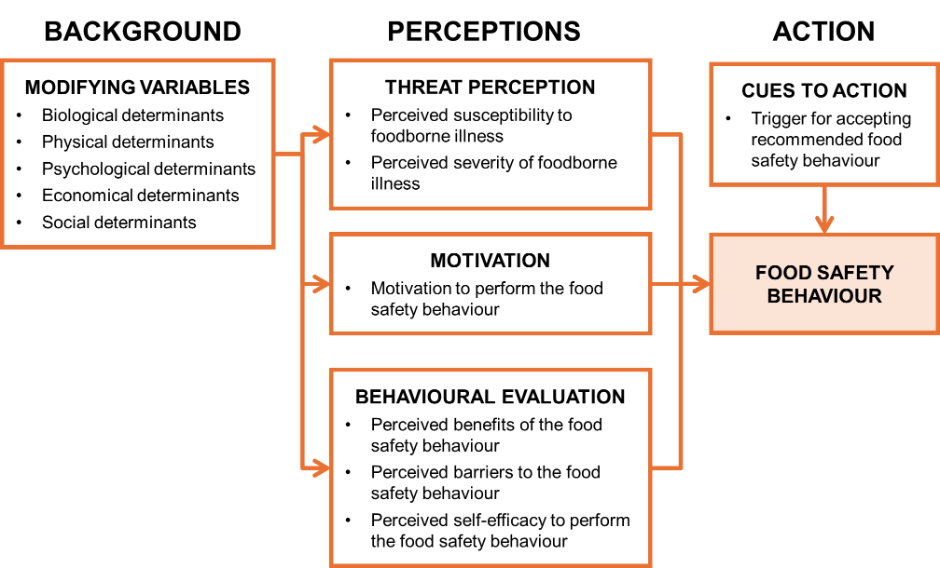
Here is a visual only chart of: The diagram represents a conceptual framework based on the Health Belief Model to explain food safety behaviour. It highlights how different factors influence individuals’ adoption of safe food practices. Modifying Factors: These include determinants of food safety risks, behaviours, and vulnerabilities, categorised as biological, physical, psychological, economic, and social factors. These factors shape an individual’s perception of food safety risks and influence decision-making. Threat Perception: Encompasses perceived susceptibility to foodborne illness and perceived severity of its consequences, which affect risk assessment. Motivation: Represents the individual’s willingness and drive to engage in food safety behaviours. Behavioural Evaluation: Includes three key aspects namely perceived benefits of engaging in food safety practices, perceived barriers that may hinder their adoption, and perceived self-efficacy, or confidence in one’s ability to perform food safety behaviours. Cues to Action: External or internal triggers that prompt individuals to engage in safe food handling practices. Food Safety Behaviour: The ultimate outcome, where individuals adopt recommended food safety practices based on their perceptions and influencing factors. The diagram’s arrows indicate how modifying factors influence threat perception, motivation, and behavioural evaluation, which collectively determine food safety behaviour when activated by cues to action.
5.2 Focus group discussion schedule
The constructs of the Health Belief Model and the “Determinants of food safety risks, behaviours and vulnerabilities” as described in Table 2 were utilised to inform the development of the focus group discussion guide.
Open ended questions for use in a group discussion scenario were devised to focus on key domestic food safety practices recommended by Food Standards Scotland such as cooking food, refrigerating and storage of food, cleaning and avoiding cross contamination (Food Standards Scotland, no date).
5.2.1 Preferences for communicating
To support the development of future food safety messaging interventions it is of importance to consider the preexisting perceptions and the communication preferences of the specific target audience (Evans & Redmond, 2022). Involvement of the target audience in intervention development is believed to increase potential effectiveness of interventions (Green et al., 1996). A review of previous consumer food safety education interventions established that clinically vulnerable groups are under-represented as targets of interventions (Sivaramalingam et al., 2015); furthermore, less than half of consumer food safety education interventions have engaged with the target audience in the development, delivery, and evaluation of interventions (Sivaramalingam et al., 2015). Inclusion of the intended audience in the development of targeted interventions is essential (O'Cathain et al., 2019); tailored interventions based upon a target audience’s circumstances can be developed through co-creation with stakeholders (Leask et al., 2017). The co-creation of intervention development needs to consider the current practices, preferences and experiences of the intended audience (Ohern & Rindfleisch, 2010).
Three statements defining clinically vulnerable groups were developed. A standardised semi-structured interview schedule was created to explore preferences for wording and information. The interview schedule aimed to gather insights into the participants' communication preferences and perceptions regarding food safety messaging. To facilitate discussion and explore preferences for risk communication, three different risk statements regarding clinically vulnerable groups to listeriosis were developed:
- Simple YOPI classification: A short, straightforward statement based on the standard YOPI (Young, Old, Pregnant, Immunocompromised) categories.
- Extended YOPI classification: This statement included specific chronic illnesses and treatments/medications identified in this report that result in reduced immune function.
- Detailed vulnerability explanation: An extended statement that specifically defined why the listed groups are clinically vulnerable to foodborne illness, providing the most comprehensive information.
These statements were colour-coded and presented to participants in ascending order of complexity during the discussion groups.
5.3 Recruitment of participants
5.3.1 Advertising the project
To ensure information regarding the project was distributed as wide as possible, recruitment activities were carried out both online and in the community.
An online advert was posted on the Food Standards Scotland Facebook page on 15th March 2024 (Appendix 1). The advert gave a brief description of the project, the inclusion criteria, details of the incentive and details on how to sign-up or how to get more information. The advert was live for 6 weeks. There was an option to boost visibility of the advert by means of sponsored posts specifically targeting specific areas and communities in Scotland to facilitate recruitment for the in-person focus groups. However sufficient sign-ups were achieved without the boost.
To ensure the project was visible to people who do not use social media, posters were displayed on community notice boards in shops, community centres, leisure centres and libraries in the areas surrounding the selected venues for data collection. The colour A4 posters (Appendix 2) included a brief description of the project, the inclusion criteria, details of the incentive, the date, location and duration of the in-person focus groups alongside details on how to sign-up or how to get more information. Pull-off tabs were included at the bottom of the posters which provided the study name, email and telephone number of the researcher along with the web address for the online sign-up page.
In addition to posters, A5 leaflets (Appendix 3) were displayed at the community venues where data collection would take place. The time of the focus groups were excluded from the community posters and leaflets to prevent individuals turning up on the day without registering.
Invitation letters (Appendix 4) and participant information sheets (Appendix 5) detailing the purpose of the study were sent out to Aberdeen City Voice panellists (n=90) with the quarterly Aberdeen City Voice newsletter to individuals who had previously indicated an interest in taking part in community research projects.
5.3.2 Participant sign-up
As a result of seeing the online or community adverts, those interested in participating followed the link to a Qualtrics page (Appendix 6) that provided information regarding the study by means of a participant information sheet (Appendix 5) and provided the contact details of the researcher in case of any questions.
The Qualtrics page received a total of 777 views. Those interested in taking part, signed-up by completing the online form which captured consent to participate (Appendix 7), basic demographic characteristics and allowed individuals to select a preferred date for participating. Individuals that did not have access to email and/or internet, contacted the researcher via telephone and the online form was completed over the telephone with the participant.
The dedicated Qualtrics page received 274 sign-ups. Eight of which were removed due to duplicate sign-ups (n=2), incorrect email addresses to send an invitation to the online discussion group and no response to telephone calls to obtain correct email (n=2) and fake participants, e.g. individuals not meeting the recruitment criteria and attempting to participate in the study to obtain the incentive offered to participants (n=4).
Of the eligible sign-ups (n=266), a suitable date or location prevented some from participating (n=90), nevertheless, they indicated an interest in participating in future research and completed the short online questionnaire.
A total of 176 people selected to participate in the study. After selecting their preferred time and location for participating, a confirmation email was sent confirming the arrangements, outlining participants should login or arrive 15 minutes prior to the start time and that if they were no longer able to participate, they were requested to inform the researcher at their earliest convenience to allow the space to be made available for others to participate.
Sign-up to online discussion groups were capped at 10 participants, while in-person discussion groups were capped at 12 participants.
Of those who signed up to participate, 14 cancelled in advance and 29 failed to show up on the day either online (n=19) or in-person (n=10). One person was not permitted to enter an online focus group due to them not logging-in during the specified 15-minute window. The focus group had commenced, housekeep rules had been discussed, all participants had introduced themselves and the recording had commenced. A total of 132 people participated in the study either online (n=78), via telephone (n=4), or in-person (n=50), giving a 75% turn-up rate.
5.4 Conducting discussion groups
5.4.1 Online discussion groups
Online focus groups with individuals over the age of 65 and those who support relatives over 65 years (n=80) were undertaken on Microsoft Teams. Participants were invited to log-in 15 minutes prior to the scheduled start time and were aware that late logins would not be permitted to participate or be eligible for the incentive.
To ensure participants were able to login to Microsoft teams, they were asked to check they could access the link in advance, and to notify the researcher if problems were experienced. In such instances the researcher would schedule a telephone call with the participant and talk them through the process of how to log-in to Microsoft Teams and checking they were able to hear and see the researcher on Microsoft Teams ahead of time.
Once the online focus groups started, the researcher shared a series of slides with the participants and followed a script, this included a welcome and outlining important information such as housekeeping information, consent, etiquette, and an opportunity to ask any questions prior to commencing data collection.
During data collection slides were not shared to enable participants to see each other in a gallery view, each session started with the participants providing a brief introduction about their normal food shopping, cooking and eating habits. Participants were given a 5-minute comfort break after completion of the first topic, which normally occurred within 45 – 60 minutes of the start time. Online discussion group durations ranged from 1h 49m to 2h 15m.
5.4.2 Telephone individual discussions
A small number of individuals expressed a preference for contributing to the research via a telephone interview rather than participating in an online discussion group. In response to these requests, individual telephone discussions were arranged at mutually convenient times.
At the agreed time, the researcher contacted each participant via telephone and conducted the discussion following the focus group discussion to ensure consistency across interviews and with the points discussed in the discussion group. With the participant’s consent, a Dictaphone was used to record the conversation to enable a transcript to be generated for analysis. Each telephone discussion lasted between 41 and 47 minutes.
5.4.3 In-person discussion groups
Six discussion groups were scheduled in various locations across Scotland, including Stranraer, Glasgow (n=2), Aberdeen (n=2), and Inverness during May 2024 with a total of 50 participants.
Confirmation emails and letters sent ahead of the in-person discussion groups invited participants to arrive 15 minutes ahead of the scheduled start time, during this time, the researcher kept a register of the participants who arrived, and participants were provided with refreshments and light snacks before starting the discussion group.
As equipment varied in each location, no slides were used to provide background information or to guide the discussion. The researcher utilised a paper-based script (Appendix 9) to provide important information such as housekeeping information, location of toilets and emergency exits, consent, etiquette and gave participants the opportunity to ask questions before commencing data collection. As with the online discussion groups, each session was audio recorded using two digital Dictaphones and multiple microphones and started with the participants providing a brief introduction about their normal food shopping, cooking and eating habits.
Participants were given a 10-minute break after completion of the first topic, which normally occurred within 45 – 60 minutes of the start time. In-person discussion group durations ranged from 1h 46m to 2h 01m.
5.4.4 Participant incentives
Following completion of the discussion group sessions, participants were provided with £25 vouchers for Amazon or a supermarket of their choice.
5.5 Data collection and analysis
All in-person discussion group sessions and telephone discussions were audio recorded using Dictaphones and subsequently transcribed. The online discussion groups were recorded on Microsoft Teams, the automated transcription was downloaded, checked and amended using the original recording.
Once transcription was complete, each transcript was carefully reviewed and cross-checked against the original audio or video recordings to verify accuracy. The researcher then conducted a systematic thematic analysis using NVivo, a qualitative data analysis software. Participant statements were coded according to a predefined codebook, with additional sub-nodes created where necessary to capture emerging themes and nuances in the data. NVivo facilitated the organization, retrieval, and comparison of coded data, enabling a structured approach to identifying patterns and key insights across the dataset.
5.6 Ethical approval
Prior to commencing data collection all project documentation were discussed with SEFARI and Food Standards Scotland colleagues. Documentation was reviewed and approved by the Healthcare and Food Ethics Committee at Cardiff Metropolitan University (Sta 8405) and social research approval was obtained from the Scottish Government Rural and Environment Science and Analytical Services Division (RESAS).
5.7 Participant demographic characteristics
A total of 132 people participated in the discussion groups, 50 participated in the in-person discussion groups while 82 participated in online or telephone discussions. The vast majority of participants (83%) were female (n=109) with 23 males participating. Of those that participated, only 1.5% described themselves as belonging to an ethnic group other than white.
The majority (86%) signed up to participate as a person over the age of 65, however many of these were also responsible for supporting the food related tasks of other individuals over the age of 65. The age range of the over 65 cohort were aged 65-69 years old (42%), 70-74 years old (30%), 75-79 years old (13%), 80-84 years old (2%) and 1 person was over the age of 90 years. The majority (73%) described themselves as being retired, while 8% reported being in full-time or part-time employment or education, and the remainder indicated being a carer or a volunteer. Half (54%) were married.
Eighteen participants signed-up as individuals who support a person over 65 with their food shopping and cooking; of these, 28% were aged 35 – 44 years, 28% were 45 – 54 years, and 44% were aged 55 – 64 years. Seventeen percent reported being retired, while 83% of these indicated being employed (part-time or full-time), being on maternity leave, being a stay-at home parent or carer. Two-thirds (67%) reported that they supported a parent, stepparent or a parent-in law, others supported their spouse or partner (11%), other relatives such as aunts and uncles, or neighbours. The frequency of support varied from multiple times a day to 2-3 times per month, and the types of support included driving them to/from the shop to do their food shopping, accompanying them in the shop whilst they do their food shopping, helping them to store the food after doing the shopping, assisting them with cleaning the kitchen, doing the food shopping for them, preparing and cooking the food for them, cleaning the kitchen for them, supporting them with eating, and providing company while they ate.