
- Table 1 Prevalence of foodborne pathogens among adults aged ≥65 years in Scotland and from global studies
- Table 2 Determinants of food safety risks, behaviours and vulnerabilities
- Table 3 Physical environment determinants upon food shopping, storage, cooking and eating practices among adults over 65 in Scotland
- Table 4 Biological determinants upon food shopping, storage, cooking and eating practices among adults over 65 in Scotland
- Table 5 Social determinants upon food shopping, storage, cooking and eating practices among adults over 65 in Scotland
- Table 6 Psychological determinants upon food shopping, storage, cooking and eating practices among adults over 65 in Scotland
- Table 7 Impact of economic determinants upon food shopping, purchase decisions, food storage and eating practices among adults over 65 in Scotland
- Table 8 Impact of economic determinants upon food shopping, storage, cooking and eating practices among adults over 65 in Scotland
- Table 9 Perceived susceptibility to foodborne illness among family-caregivers and adults over 65 in Scotland
- Table 10 Perceived severity of foodborne illness among family-caregivers and adults over 65 in Scotland
- Table 11 Perceived benefits of food safety practices among family caregivers and adults over 65 in Scotland
- Table 12 Perceived barriers to food safety practices among family caregivers and adults over 65 in Scotland
- Table 13 Perceived self-efficacy of implementing food safety practices among family-caregivers and adults over 65 in Scotland
- Table 14 Motivations of individuals aged ≥ 65 years in Scotland to implement recommended food safety practices
- Table 15 Cues to action that have resulted in adopting food safety behaviours among family-caregivers and adults over 65 in Scotland
- Table 16 Impact of being responsible for food provision of relatives upon family caregivers
- Table 17 Considerations for future Food Standards Scotland food safety messaging.
Appendoces 8-14
Appendix 8 - Online discussion script
Welcome
Welcome to our online group discussion. My name is Ellen, and I’ll be facilitating this group discussion today. On behalf of the researcher funders the Scottish Environment, Food and Agriculture Research Institutions we appreciate your participation and valuable insights that you will provides us with today.
Today we are going to discuss some of the lifestyle factors that impact upon your food choices.
Housekeeping
Please ensure that you keep your camera on throughout the discussion group, but please ensure that you are in a quite space so that background noise doesn’t disturb the other participants. We will have a short comfort break in about 40 minutes, however, if you need a break, please feel free to step away from the online discussion group whenever necessary.
I appreciate that some topics may be emotionally sensitive for some participants therefore if anyone needs to take a little break from the discussion group for whatever reason please step away or mute your microphone and switch off your camera and rejoin if you are comfortable to do so.
Consent
You all received a copy of the participant information sheet and have completed the online consent form.
Please be assured that participation in this online group discussion is entirely voluntary. All information collected during this study will be kept confidential, and any data reported will be anonymised. You will be assigned a unique participant ID number, ensuring that your name and personal information remain confidential.
The focus group will take around 90 minutes and will be audio recorded to ensure accuracy. Please understand that due to the nature of a group discussion, withdrawal of individual data may not be possible after completing the group discussion as it may not be possible for us to distinguish your voice from others on the audio recording or to identify you in the anonymised transcript once analysis has started.
Anonymous quotes may be used for presenting research findings, no names or identifiable information will be attributed to these quotes. After the study's completion, all participant information will be securely disposed of. A copy of the research findings will be available upon request.
Etiquette
To ensure that we have a productive and respectful discussion, please keep the following ground rules in mind:
- Be respectful and courteous to one another.
- Listen actively and avoid interrupting others.
- Share your honest opinions and experiences, if you disagree with a point that has been made, please discuss this – there are no wrong or right answers.
- Stay on topic and let me guide the discussion.
- Please don’t worry if I move the discussion along, it is important that we try and cover all the topics today, there will be time at the end to discuss anything that you didn’t have the opportunity to mention, so make a note.
Does anyone have any questions before we begin?
Start of recording
I will now start the audio recording. [Start recording].
Appendix 9 - In person discussion script
Welcome
Welcome to our group discussion. My name is Ellen, and I’ll be facilitating this group discussion today. On behalf of the researcher funders the Scottish Environment, Food and Agriculture Research Institutions we appreciate your participation and valuable insights that you will provides us with today.
We are here to discuss some of the lifestyle factors that impact upon the food choices of people over the age of 65 in Scotland.
Housekeeping
The toilets are located [mention the location]. We will have a short comfort break in about 40 minutes, however, please feel free to leave the room whenever necessary. Please remember to maintain confidentiality during breaks. Avoid discussing the discussion group topics or other participants with anyone outside of this room, if you think of anything relevant when you are outside of the room, please feel free to share upon your return.
We have refreshments available, please help yourself whenever you'd like.
As far as I’m aware, there isn’t a fire drill planned. Therefore, in the unlikely event of a fire alarm or emergency situation. Please follow my instructions promptly. Please leave your belongings in the room, we will evacuate the building immediately following the emergency exit route. Once outside, we will gather at the designated assembly point, which is [mention the specific location for your focus group]. We will only re-enter the building when permitted by the fire wardens to do so.
I appreciate that some topics may be emotionally sensitive for some participants therefore if anyone needs to take a little break from the focus group for whatever reason there are a couple of chairs outside of the room where you can have a breather before returning in.
Consent
You have all completed the online consent form or agreed to the audio recording when signing up on the phone. As I mentioned on your arrival, please ensure that you have read and understand the information sheet and have completed the consent form, did anyone have any questions about today’s group discussion?
Please be assured that participation in this group discussion is entirely voluntary. All information collected during this study will be kept confidential, and any data reported will be anonymised. You will be assigned a unique participant ID number, ensuring that your name and personal information remain confidential.
The focus group will take up to 2 hours and will be audio recorded to ensure accuracy; the audio file will be saved on a password protected computer. Please understand that due to the nature of a group discussion, withdrawal of individual data may not be possible once the audio recording of the discussion has started as it may not be possible for us to distinguish your voice from others on the audio recording or to identify you in the anonymised transcript once analysis has started.
Anonymous quotes may be used for presenting research findings, no names or identifiable information will be attributed to these quotes. After the study's completion, all participant information will be securely disposed of. A copy of the research findings will be available upon request.
Etiquette
To ensure that we have a productive and respectful discussion, please keep the following ground rules in mind:
- Be respectful and courteous to one another.
- Listen actively and avoid interrupting others.
- Share your honest opinions and experiences - there are no wrong or right answers.
- Stay on topic and let me guide the discussion.
- Please don’t worry if I move the discussion along, it is important that we try and cover all the topics today, there will be time at the end to discuss anything that you didn’t have the opportunity to mention, so make a note on your note pad.
- Does anyone have any questions before we begin?
Start of recording
I will now start the audio recording. [Start recording].
To get started, let's go around in a clockwise direction starting with me and introduce ourselves. Let's keep our introductions concise to our name and how we normally shop, cook, and eat.
Appendix 10 - Examples of feedback on Facebook fro participants
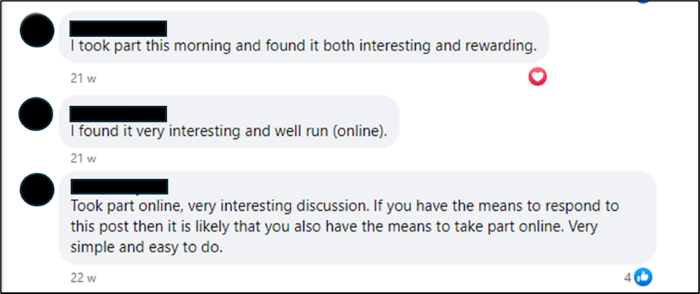
Feedback shows participants found the study interesting, rewarding and well run.
"I took part this morning and found it both interesting and rewarding"
"I found it very interesting and well run (online)"
"Took part online, very interesting discussion. If you have the means to respond to this post then it is likely that you also have the means to take part online. Very simple and easy to do."
Appendix 11 - Examples of feedback provided by participant via email
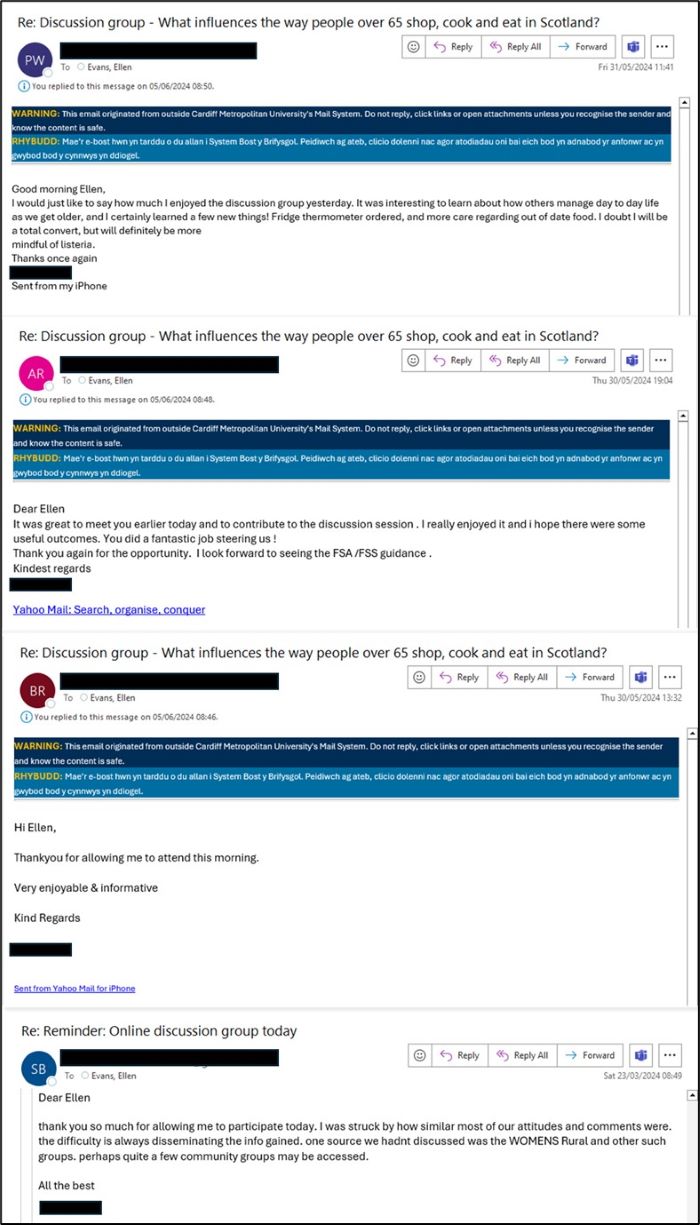
Some participants provided feedback directly to the researcher and found it interesting and informative. Some praised the running of the sessions and 1 participant detailed how they would change their own behaviour.
"Good morning Ellen, I would just like to say how much I enjoyed the discussion group yesterday. It was interesting to learn about how others manage day to day like as we get older, and I certainly learned a few new things! Fridge thermometer ordered, and more care regarding out of date food. I double I will be a total convert but will definitely be more mindful of listeria. Thanks once again"
"It was great to meet you earlier today and to contribute to the discussion session. I really enjoyed it and I hope there were some useful outcomes. You did a fantastic job steering us! Thank you for the opportunity. I look forward to seeing the FSA/FSS guidance."
"Thank you for allowing me to attend this morning. Very enjoyable and informative."
Appendix 12 - Thermometry study participant information sheet
Project Title
Home kitchen thermometry study
Project aim
The goal of this study is to help people ensure their home fridges are running at a safe temperature and that food is cooked to a safe temperature.
Invitation to participate
We are looking for volunteers to take part in our research study. Before you decide whether you want to take part or not, it is important for you to understand why the research is being done and what it will involve. Please therefore take time to read the following information carefully.
What is the purpose of the study?
Our previous research found that many people over 65 in Scotland are concerned about fridge and cooking temperatures. This study aims to provide tools to check fridge and cooking temperatures, helping people ensure food safety at home.
Who can take part?
- People over the age 65 years in Scotland
- Individuals who assist people over 65 with food-related activities
What does the study involve?
- Sign-up to participate: Provide your postal address after agreeing to participate.
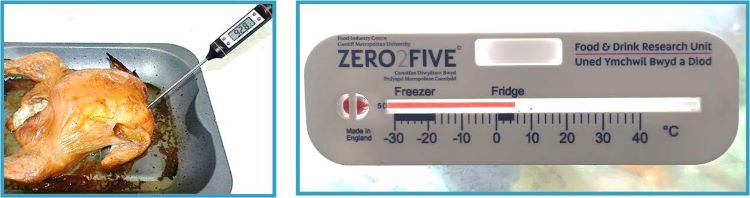
- Receive the participant pack: A participant pack containing a temperature probe, a fridge thermometer and instructions for use will be sent to you in the post in early August 2024.
- Taking part in the study: To participate in this study you will need access to a smart phone.
- Take a picture of the temperature probe in your cooked food (e.g., meat or poultry) showing the temperature.
- Take a picture of the fridge thermometer in your fridge door storage area showing the temperature.
- Upload the pictures to an online portal (link will be provided in the participant pack). Portal closes on September 30, 2024. Submissions imply your consent to participate.
- Incentives for taking part: Four participants will be randomly selected to win £25 vouchers. You can keep the temperature probe and fridge thermometer after the study.
How will my data and my privacy be protected?
Taking part is entirely voluntary. All information gathered from this study will remain confidential and any data reported will be anonymous. Submitting the image and answering the accompanying questions implies your consent to participate in the study. Any images that make you identifiable will be excluded from the study. The information you share will be given a participant ID number. All participant information will be securely disposed of following completion of the work; a copy of the research findings will be available by informing the researcher that you are interested in receiving the research findings. Participants have a right to withdraw from the project at any time, a Participant Withdrawal Form is available and includes more details of what actions the University will take following a request to withdraw. However, please be aware that once your data have been anonymised and analysed, it is often not possible to extract a specific participant’s data.
Are there any advantages to taking part?
You will receive a free temperature probe and a free fridge thermometer which you can keep after participating in the study. As a token of thanks for participating in the study all participants will be entered into a prize draw to win one of four £25 vouchers. Your participation will be informing future food safety education activities and research. Being able to check cooking adequacy of meat and poultry products and check fridge operating temperatures will help you to reduce the risk of foodborne illness.
Are there any risks associated with taking part? A risk assessment has been undertaken and the study has been reviewed and approved by the research and ethics committee. There are no physical risks anticipated from your participation in this study. We recommend that the temperature probe and fridge thermometer are kept out of the reach of children.
Has the study been approved?
The project has been assessed and approved by the Research and Ethics Committee at Cardiff Metropolitan University. A copy of the approval is available from the research team.
What will happen to the results of the research project? The results of the research will be used to inform the development of a journal article and will inform the development of future research.
How do I take part or get more information about the study? If you want to take part or have any questions regarding the study, please contact the researchers, Dr Ellen Evans at elevans@cardiffmet.ac.uk
Appendix 13 - Online sign-up form
Website page giving background to the research and requesting contact details to take part.
Appendix 14 and 15 - Study instruction sheet
Instruction sheet on how to use the temperature probe and fridge thermometers.
Appendix 16 - Online data capture form
Form for participants to use to upload images of the fridge thermometer or cooking probe showing the temperature.