
Testing definitions
A large part of the group discussion time was dedicated to testing two versions each of two different approaches to defining vulnerable groups. This section reports on which approach tested well and why that was the case. The order of showing the different propositions was randomised as a way of mitigating against order bias.
Options tested
One approach defined groups by condition such as: ‘age/lifestyle’, ‘underlying health conditions’ and ‘medication and treatments’. The other approach defined groups by population type such as: young children, people with underlying health issues, people prescribed medications, those who are pregnant and older adults.
Both approaches were given a simple version with no explanation of why as well as a more detailed version that explained reasons for vulnerability.
| Option | Population or condition | Simple or detailed definition |
|---|---|---|
| Option 1A | Population type | Simple definition |
| Option 2B | Population type | Detailed definition |
| Option 2A | Condition-based | Simple definition |
| Option 2B | Condition-based | Detailed definition |
Overall preference was for the detailed versions that explained reasons for vulnerability. We have reported on the results in order of preference which show findings from the detailed condition-based versions first, followed by the detailed population type version. Commentary on the simple versions follows this.
The preferred option
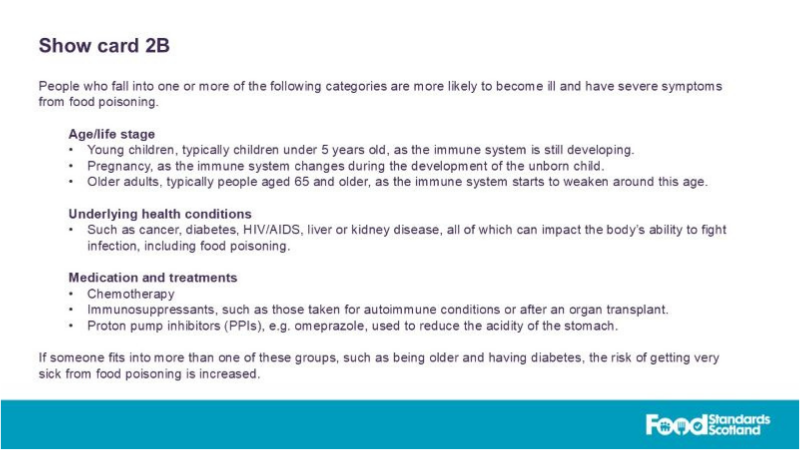
The detailed, condition-based definition (Option 2B, Figure 3) was preferred by five of the seven focus groups (all except for General Population ABC1 and one group of Immunocompromised respondents) and demonstrated broad appeal across all respondent types. Respondents reported that defining vulnerability by condition rather than by population group made it easier for them to recognise and self-identify with relevant categories.
Figure 3: Detailed definition by condition
Here is a visual only chart of: Show card 2B Showcard on Food Standards Scotland template which has the following text: People who fall into one or more of the following categories are more likely to become ill and have severe symptoms from food poisoning. Age/life stage - Young children, typically children under 5 years old, as the immune system is still developing. - Pregnancy, as the immune system changes during the development of the unborn child. - Older adults, typically people aged 65 and older, as the immune system starts to weaken around this age. Underlying health conditions - Such as cancer, diabetes, HIV/AIDS, liver or kidney disease, all of which can impact the body’s ability to fight infection, including food poisoning. Medication and treatments - Chemotherapy - Immunosuppressants, such as those taken for autoimmune conditions or after an organ transplant. - Proton pump inhibitors (PPIs), e.g. omeprazole, used to reduce the acidity of the stomach. If someone fits into more than one of these groups, such as being older and having diabetes, the risk of getting very sick from food poisoning is increased.
Please find more information provided in the detailed description and/or table below.
Showcard on Food Standards Scotland template which has the following text:
People who fall into one or more of the following categories are more likely to become ill and have severe symptoms from food poisoning.
Age/life stage
- Young children, typically children under 5 years old, as the immune system is still developing.
- Pregnancy, as the immune system changes during the development of the unborn child.
- Older adults, typically people aged 65 and older, as the immune system starts to weaken around this age.
Underlying health conditions
- Such as cancer, diabetes, HIV/AIDS, liver or kidney disease, all of which can impact the body’s ability to fight infection, including food poisoning.
Medication and treatments
- Chemotherapy
- Immunosuppressants, such as those taken for autoimmune conditions or after an organ transplant.
- Proton pump inhibitors (PPIs), e.g. omeprazole, used to reduce the acidity of the stomach.
If someone fits into more than one of these groups, such as being older and having diabetes, the risk of getting very sick from food poisoning is increased.
The level of detail provided in this version was considered appropriate and sufficient to support understanding without being overwhelming.
“I kind of understand that one rather than the other one as its too general. I wasn’t keen on it. I like seeing the categories. I like this one better.” General Population ABC1
The opening sentence was regarded as particularly effective, as it prompted respondents to consider whether they might fall into multiple categories, thereby supporting more accurate assessment of personal risk. In addition, the concluding statement was seen as clear and unambiguous, reinforcing the idea that vulnerability may be cumulative and encouraging respondents to reflect on overlapping risk factors.
“This is the first one that says likely to become ill and have severe symptoms from food poisoning. That’s a wee bit more clearer than the first two, this one’s showing you the effects.” Immunocompromised
“I like the bit at the bottom, if you fit into more than one of these groups, the risk of getting very sick is increased. I like that.” General Population C2DE
One of the major benefits of this version is that it provides more explanation, especially around why certain groups are at higher risk and how the immune system plays a role. Many found the use of bullet points helpful, saying they were easier to read and remember. Clear headings and categorisation supported understanding, and the additional level of detail was seen as informative rather than overwhelming.
“I like the fact that underlying health conditions are lumped together. The age and life stage is nice having the young, pregnancy and older people. It feels nice, it’s just explaining why all those stages apply.” Immunocompromised
Respondents appreciated that the definition explained why certain groups are vulnerable, which made it easier for them to recognise personal risk. Many felt that the structure helped them identify themselves across more than one category. The tone was described as clear and respectful, and the inclusion of examples of conditions and medications helped respondents recognise their own situation. The language was seen as straightforward, accessible, friendly and not over technical.
“There’s just a wee bit more information and it mentions your immune system quite a lot, which I think is obviously the key to everything. That’s the whole point of us doing this and us being the target for this because we’re either on medication or we have a disease that is impacting on our immune system. So if you contract food poisoning, you’re likely to probably contract it a bit easier and take longer to get over it. I think this one kind of explains that in a bit more detail. Talking about the body’s ability to fight infection. That’s putting it in quite plain terms for me.“ Immunocompromised
“You’ve got a young child, under five, because of the immune system...you’re not left in any doubt about your health conditions, you’re not left in any doubt about your medication. So it’s quite clear that if any of those apply to you, then obviously you need to be very, very wary of any infection, including food poisoning. So I like that one the best.” Carer
“I like this one. It’s quite clear, you know, the different...the life stages, your health conditions, medication. It makes it clearer, you know, people that fall into these categories and if you’re in more than one category, obviously your risks will increase by quite a lot. I like that one. Yeah. I think that’s...tells us what we need to know.” Carer
“I often think about how are people that I’m supporting going to receive this information. As somebody who’s in a caring role, I think that slightly more information is really useful to me actually, to understand some of the reasons behind it.” Carer
Age/life stage
It clearly defines the age of younger children which was an element of confusion for all sub-groups of respondents. Respondents found it useful to have the reasons behind pregnancy explained as this was not a category of people that spontaneously was mentioned and some were quite confused as to why those who are pregnant would be at risk of food poisoning.
After discussion and sharing of the different versions of the vulnerable groups definitions the majority of respondents accepted the definition: Older adults, typically people aged 65 and older, as the immune system starts to weaken around this age. Older adults category was readily accepted because the inclusion of the qualifier “typically” was viewed positively, as it acknowledged individual variation and reduced resistance to the label. Moreover, it gave an explanation that the immune system starts to weaken around this age. This also reduced resistance from those who were older and feel fit as well as those whose friends and family are known to be fit and well after the age of 65 years old.
“My mum wouldn’t class herself as getting older, but I think having that age bracket and then saying that the immune system starts to weaken, it’s, like, giving them facts, this is what happens. You might not feel it, you might be 65, but your immune system will start to weaken.” Carer
“I like the extra information that’s been put in it, but it’s made me understand it rather than be confused at it. I’m happy with that one for sure. The extra explanations in there are good. I’m fine with typically people aged 65 or older, not everybody is the same. So typically, you know, somebody at 65, their immune system might weaken, somebody at 65 might not as much.” Immunocompromised
“I like this one because, you know, we’re all not medically trained and sometimes you’d read it and you think, oh, is that why younger children under 5 have to be careful of food poisoning? I didn’t know the immune system wasn’t properly developed and things like this. And I like it all because it adds information.” Immunocompromised
Underlying health conditions
Providing examples made this much easier to understand and the explanation that poor health conditions can impact the body’s ability to fight infection, including food poisoning was widely accepted.
Medications and treatments
The inclusion of chemotherapy was intuitive but reassuring to have it listed. The inclusions of immunosuppressants was thought to be informative and reassuring, especially for people who were immunocompromised. Giving examples of what they are also aided understanding. Many respondents were surprised to see proton pump inhibitors (PPIs) on the list and this built awareness. Many valued having the example of omeprazole listed as this was widely understood.
“I feel the mention of omeprazole’s very useful because omeprazole’s such a common medication for people and I think that’s really useful actually for...not only for them, but for people perhaps, you know, advising on food preparing or helping with food preparation. It’s just so common.” Carer
“You know, and I never knew that, you know, or never thought about it, you know, the stomach acid and all that kind of stuff, you know, not give it a thought that’s like opens up your eyes.” Immunocompromised
Second option
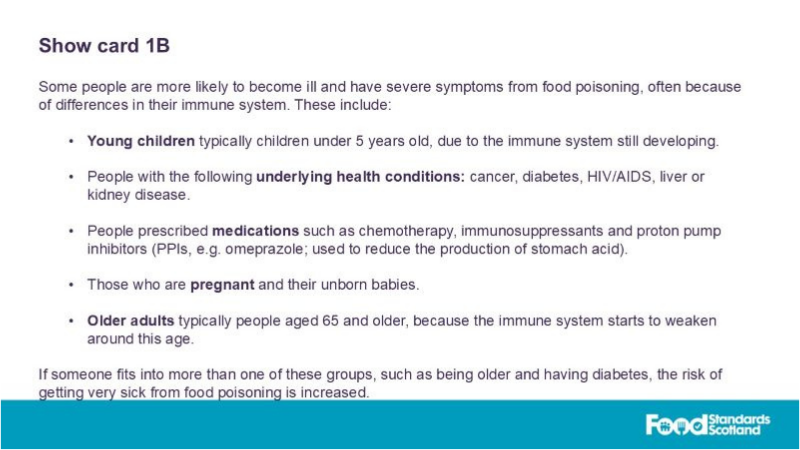
The detailed definition by population type Option 1B; Figure 4 was preferred by two of the seven groups (General population ABC1 and Immunocompromised respondents), as respondents felt they could easily locate themselves within the correct category. The structure helped individuals recognise where they fit without needing to interpret complex criteria.
Respondents described the definition as easy to read, straight to the point and not overwhelming. The wording was seen as informative and accessible, striking a balance between clarity and conciseness.
The use of plain English, rather than medical or technical language, was valued by the few who chose this version. Compared with the definition by condition (Option 2B), this version was perceived as less clinical and therefore more approachable for them.
Figure 4: Detailed definition by population type
Here is a visual only chart of: Show card 1B Showcard on Food Standards Scotland template which has the following text: Some people are more likely to become ill and have severe symptoms from food poisoning, often because of differences in their immune system. These include: - Young children typically children under 5 years old, due to the immune system still developing. - People with the following underlying health conditions: cancer, diabetes, HIV/AIDS, liver or kidney disease. - People prescribed medications such as chemotherapy, immunosuppressants and proton pump inhibitors (PPIs, e.g. omeprazole; used to reduce the production of stomach acid). - Those who are pregnant and their unborn babies. - Older adults typically people aged 65 and older, because the immune system starts to weaken around this age. If someone fits into more than one of these groups, such as being older and having diabetes, the risk of getting very sick from food poisoning is increased.
Please find more information provided in the detailed description and/or table below.
Showcard on Food Standards Scotland template which has the following text:
Some people are more likely to become ill and have severe symptoms from food poisoning, often because of differences in their immune system. These include:
- Young children typically children under 5 years old, due to the immune system still developing.
- People with the following underlying health conditions: cancer, diabetes, HIV/AIDS, liver or kidney disease.
- People prescribed medications such as chemotherapy, immunosuppressants and proton pump inhibitors (PPIs, e.g. omeprazole; used to reduce the production of stomach acid).
- Those who are pregnant and their unborn babies.
- Older adults typically people aged 65 and older, because the immune system starts to weaken around this age.
If someone fits into more than one of these groups, such as being older and having diabetes, the risk of getting very sick from food poisoning is increased.
Some respondents also appreciated that the definition explained the ‘why’ behind vulnerability without going into excessive detail. This explanatory element helped soften the emotional impact of being categorised as an older adult and increased overall trust in the message.
“I think it's better because it's given the reasons why they put these young children, older adults, things like that. I think it's because it gives an explanation as to why.” Older Adult ABC1
Key valued elements included the use of concrete examples of health conditions, the inclusion of the word ‘typically’, which was seen as allowing for variation and avoiding rigid labels and the specific reference to omeprazole rather than the more technical term ‘proton pump inhibitors’.
“I like it because I like to understand things and they're put to me simply. That's what it is. It is what it is. It's explained to me, you know, answered it.” Immunocompromised
“I kind of think when it's your health, you should be reading stuff like that. You should have a wee bit more information so that you know what's going on.” Immunocompromised
Those who didn’t chose this version claimed the opening sentence is less likely to encourage them to search for multiple conditions. They also preferred the additional detail given in Option 2B because it gave more details about why a person might be vulnerable such as: the explanation behind pregnancy, why underlying health conditions impact on the ability to fight infection and additional information about medication such as examples of immunosuppressants. Those aged 65 years and older especially resisted self-identification as older adult as a category but were more accepting when it was presented as a category under life stage.
Simple definitions that lack explanation of why
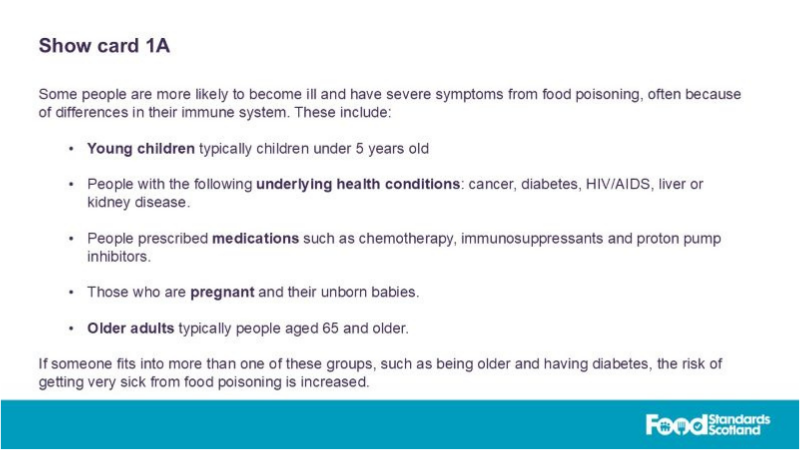
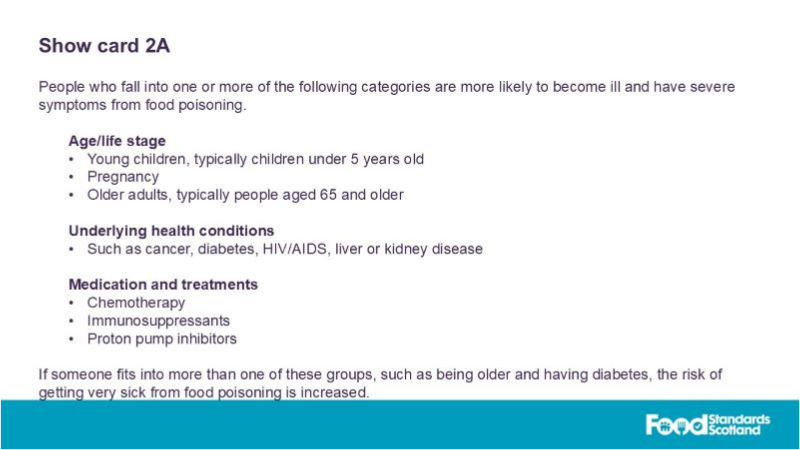
The simple definitions for both population type and condition (Options 1A and 2A, respectively) lacked explanation of why certain categories were vulnerable (Figures 5 and 6). These didn’t test as well as the more detailed versions. The content presented was thought by many to be overly simplistic and lacking in sufficient detail to be considered adequately informative.
Figure 5: Simple definition by population type
Here is a visual only chart of: Show Card 1A Showcard on Food Standards Scotland template which has the following text: Some people are more likely to become ill and have severe symptoms from food poisoning, often because of differences in their immune system. These include: -Young children typically children under 5 years old - People with the following underlying health conditions: cancer, diabetes, HIV/AIDS, liver or kidney disease. - People prescribed medications such as chemotherapy, immunosuppressants and proton pump inhibitors. - Those who are pregnant and their unborn babies. - Older adults typically people aged 65 and older. If someone fits into more than one of these groups, such as being older and having diabetes, the risk of getting very sick from food poisoning is increased.
Please find more information provided in the detailed description and/or table below.
Showcard on Food Standards Scotland template which has the following text:
Some people are more likely to become ill and have severe symptoms from food poisoning, often because of differences in their immune system. These include:
- Young children typically children under 5 years old
- People with the following underlying health conditions: cancer, diabetes, HIV/AIDS, liver or kidney disease.
- People prescribed medications such as chemotherapy, immunosuppressants and proton pump inhibitors.
- Those who are pregnant and their unborn babies.
- Older adults typically people aged 65 and older.
If someone fits into more than one of these groups, such as being older and having diabetes, the risk of getting very sick from food poisoning is increased.
Figure 6: Simple definition by condition
Here is a visual only chart of: Show card 2A Showcard on Food Standards Scotland template which has the following text: People who fall into one or more of the following categories are more likely to become ill and have severe symptoms from food poisoning. Age/life stage - Young children, typically children under 5 years old - Pregnancy - Older adults, typically people aged 65 and older Underlying health conditions - Such as cancer, diabetes, HIV/AIDS, liver or kidney disease Medication and treatments - Chemotherapy - Immunosuppressants - Proton pump inhibitors If someone fits into more than one of these groups, such as being older and having diabetes, the risk of getting very sick from food poisoning is increased.
Please find more information provided in the detailed description and/or table below.
Show card 2A
Showcard on Food Standards Scotland template which has the following text:
People who fall into one or more of the following categories are more likely to become ill and have severe symptoms from food poisoning.
Age/life stage
- Young children, typically children under 5 years old
- Pregnancy
- Older adults, typically people aged 65 and older
Underlying health conditions
- Such as cancer, diabetes, HIV/AIDS, liver or kidney disease
Medication and treatments
- Chemotherapy
- Immunosuppressants
- Proton pump inhibitors
If someone fits into more than one of these groups, such as being older and having diabetes, the risk of getting very sick from food poisoning is increased.
Furthermore, the text fails to explain the underlying rationale for the categories used, omitting essential contextual information. This absence of explanation hindered respondents from accurately self-identifying with the appropriate category. Explaining why certain groups are vulnerable is important, as it helps people generalise the risk and recognise their own susceptibility, rather than associating food poisoning only with specific illnesses. Moreover, this added information often prompted respondents to self-identify in more than one category.
“So the underlying health conditions that they've picked out there [showcard 1A] are those ones that they know people have become ill when they've had severe symptoms from food poisoning because they've got those conditions.” General Population ABC1
For reasons explained in the previous section many people resisted the phrase ‘older adult typically people aged 65 and older’ without the explanation of why.
“Certainly the older adults, but it was a bit, it's a bit too big, because as soon as you turn 65, you then suddenly get ill quite quickly. It's just, I think it depends on the individual.” Older Adult C2DE
“I take it that age 65 and older was taken before they changed all these pension ages and that was when we were, as men, we used to retire at 65.” Older Adult C2DE
“I think that's a bit offensive to people over 65.” Immunocompromised
In addition, the use of technical terminology, such as proton pump inhibitors and immunosuppressants, was not accompanied by clear definitions; as a result, these terms were not widely understood by many respondents.
“The only thing I would say is the proton pump inhibitor, I’ve not got a clue what that is. Whereas if you said omeprazole/lansoprazole, I’d know exactly where you were.” Carer
“The only one I'm a wee bit unsure about I think could be improved is the medication and treatments, because they come up with this immune suppressants and proton pump. Is there a way of putting that into a layman's term of what they actually are so that people would more likely, oh, I know that I've got that kind of tablet or I've got this.” Older Adult ABC1