
Understanding of vulnerable groups
Once a general understanding of food poisoning had been established, the discussion focused on understanding of vulnerable groups with a particular emphasis on defining understandings of ‘older adults’. The aim of this was to establish a spontaneous understanding across different groups and to determine if respondents instinctively identified themselves as being in a vulnerable group. Once spontaneous thoughts on which groups are vulnerable were collected, moderators probed further into respondents understanding of who falls into certain groups. A showcard was used to aid discussion (Figure 2).
Figure 2: Show card X - categories of vulnerable people
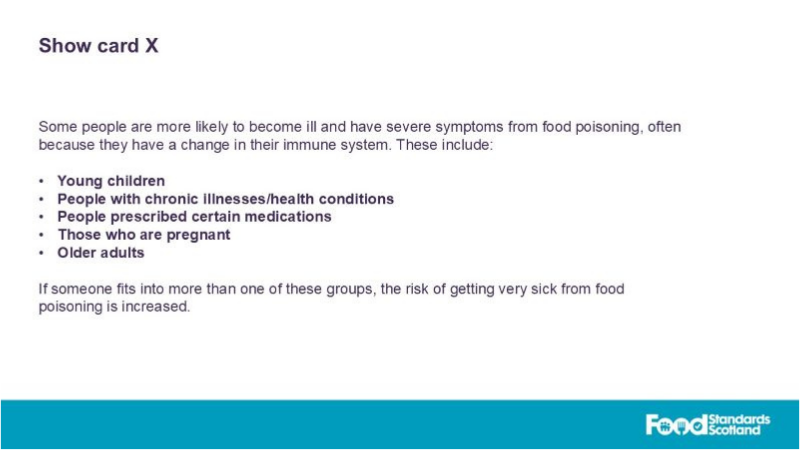
Here is a visual only chart of: Showcard on Food Standards Scotland template which has the following text: Some people are more likely to become ill and have severe symptoms from food poisoning, often because they have a change in their immune system. These include: - Young children - People with chronic illnesses or health conditions - People prescribed certain medications - Those who are pregnant - older adults If someone fits into more than one of these groups, the risk of getting very sick from food poisoning is increased.
Please find more information provided in the detailed description and/or table below.
Showcard on Food Standards Scotland template which has the following text:
Some people are more likely to become ill and have severe symptoms from food poisoning, often because they have a change in their immune system. These include:
- Young children
- People with chronic illnesses or health conditions
- People prescribed certain medications
- Those who are pregnant
- Older adults
If someone fits into more than one of these groups, the risk of getting very sick from food poisoning is increased.
This section of the report reports on respondents’ understanding of who fits these categories with the exception of “older adults” category. This category was of specific interest to FSS, and it was a core objective to understand this terminology in detail. Findings relating to the definition and understanding of older adults are fully reported in the section that follows this.
Overview
Respondents expressed a strong belief that people with poor health, younger age children, and weakened immune systems increase susceptibility to food poisoning, and they welcomed explanations that clarified why these factors heighten risk. Across all groups, respondents demonstrated an intuitive understanding of vulnerability; however, this understanding was often based on general perceptions rather than detailed knowledge of the underlying medical or physiological mechanisms.
Q: “So turning to [name redacted] and [name redacted], why would particularly young people be vulnerable?”
A: “Because they probably have not built up a resilience to like different foods and that.” General Population ABC1
There was a high level of consistency across groups regarding which populations were considered vulnerable. These commonly included young children, older adults with compromised health, individuals with weakened immune systems, people taking certain medications such as chemotherapy or treatments such as radiotherapy and those living with underlying or chronic health conditions. Pregnancy was mentioned very rarely as a condition that could increase susceptibility to food poisoning. It was a surprise to a few who saw it listed on the showcard. A few identified people with learning difficulties and dementia as being vulnerable to food poisoning and saw that as an omission from the list on showcard X.
“If there's only one that I would question maybe those who are pregnant, because I'd like to think they'd be seeing the doctor and the midwife more often and been given advice and, you know, their blood would be checked more often and might be given supplements. I'm not saying they shouldn't be in that list.” Immunocompromised
“I think very young children, very susceptible, much older adults, very susceptible as well and anyone who's got things like coeliac disease, colitis, that kind of thing probably. But definitely the young and the older.” General Population ABC1
“I think it's the same as whenever you get the warnings about flu. Young children and older people, I would have thought, are much more susceptible to food poisoning.” Immunocompromised
“And we were talking about vulnerable people as well, and there'll be lots of people with learning disabilities. Because there's real issues around accessibility and availability of information for people with learning disabilities. Any information that goes out and is trying to appeal to the general population needs to be inclusive.” General Population ABC1
While respondents were generally confident in identifying who might be vulnerable, they were often uncertain about why these groups face increased risk. Providing clear explanations of the reasons for vulnerability substantially improved respondents’ understanding, and enabled individuals across all audiences to better recognise their own susceptibility to foodborne illness. In particular, explanations linking compromised immunity to increased risk helped bridge the gap between intuitive knowledge and informed self identification.
Views from across the different groups were largely consistent with no notable differences across different types of respondent.
Definition of young children
Definitions of younger children were less consistent with the majority saying up to the age of 5 and many saying up to 11 and a few saying older and up to 16 years old. A few respondents questioned whether this included babies. All groups were mixed in their interpretation of what comprises young children. Respondents were mixed in their views of why young children can be vulnerable. Some thought because the immune system is still developing, others because young children are just “bags of germs”, a few because young children will eat anything. Findings suggest it is necessary to define the age of young children and explain why they are vulnerable.
“Well my granddaughter was premature. She was born at 25 weeks, so we had to be super clean, you know, as far as she was concerned for feeding and things like that when she came home to make sure that, you know, as far as possible she wouldn't contract anything.” Carer
“I would think of up to, like, mid primary or just perhaps including primary age. Yeah. I mean, mid primary I would think of as young children.” Carer
“They're [young people] very much in the development stage. So they kind of become young teenage, maybe into their teens is when they stop being young children.” General Population ABC1
“I would say probably a bit older up to their early teens. You know what I mean, because when they're getting older, when they get into their teenager, I think they've got a bit more common sense about them.” Older Adult C2DE
Definition of people with health conditions
People mentioned a wide range of underlying health conditions and illnesses such as: kidney or liver disease, diabetes, reflux, irritable bowel syndrome, gallbladder removal, fibromyalgia, asthma, or chronic obstructive pulmonary disease. The list was long and varied and people chose these conditions based on instinct rather than a clear understanding of why they might matter. Some simply said poor health can make people more vulnerable in general, a few thought dehydration can be dangerous and some said impaired immune systems are a result of ill health.
“But I can see if he had food poisoning, he would be extremely unwell because of the pressure that would put on his heart and his heart medication regime and then the effects that that would have on his system.” General Population ABC1
“That comes with vomiting and diarrhoea, that's dangerous for people that are either older or younger or immunosuppressed or something like that. I think dehydration and weakness are both dangerous states to be in.” Immunocompromised
Definition of prescribed medications
While illness was readily identified as making someone susceptible, medication wasn’t often spontaneously mentioned as making a person vulnerable. Seeing it on the showcard as a potential indicator of vulnerability was a surprise to some. It confused and worried some to see it listed without further qualification of what types of medication can leave you vulnerable.
“I never thought about certain medications but I'm presuming they're meaning things like chemotherapy maybe.” Carer
“I never thought about it with people with prescribed certain medications that never came into my head. My brother doesn't keep good health and I can imagine if he got it, he would take it very badly because he does have poor health. But I wouldn't have associated that with certain medications. I wouldn't have thought about that.” Older Adult ABC1
“But to me, I read sort of cancer medications into that because they are, you know, compromised but I don't know what other medications would be included that would affect your immune system.” Older Adult ABC1
“I wouldn't say it was the medications it was causing it. It's just the people's health. After our immune systems low, through ill health, to me they're obviously going to be susceptible to catching different things a lot easier.” Older Adult C2DE
“I take medication but I would never have thought that any medication I'm taking would make me more prone to food poisoning. I've never, sort of, read anything to say...you're diabetic type 2, don't eat certain foods but I’ve never actually read anything that says, well you're more prone to...I've not had food poisoning for years and years and years but I've never realised that. That would be of interest, you know, from that point.” Carer