
Methodology
To enable a comprehensive review of the current definition of “clinically vulnerable groups”, the research consisted of six distinct phases:
- Literature review of physiological background to susceptibility.
- Consolidation of Scottish prevalence data.
- Systematic review of foodborne illness prevalence among clinically vulnerable groups.
- Review of clinically vulnerable group definitions.
- Expert panel consultation to consider clinically vulnerable groups.
- Discussion groups with consumers to consider food safety messaging to clinically vulnerable groups.
Prior to undertaking the research, ethical approval was obtained from the Healthcare and Food Ethics Committee at Cardiff Metropolitan University (Reference: Sta-8006).
Literature review of physiological background to susceptibility
A narrative review was conducted to identify the physiological conditions underlying the clinical vulnerabilities and determine the causes of increased susceptibility to foodborne infections among clinically vulnerable groups. This approach was chosen because of the necessity to integrate several concepts relevant to foodborne infections including the changes in immunity over lifespan, stages of life, chronic disease, and temporary or prolonged pharmacological therapies.
The review was conducted in the following steps:
- identification of physiological conditions leading to vulnerability,
- search and identification of studies describing the physiological aspects related to infections and immunological responses, and
- summary of the synthesised information.
Consolidation of Scottish prevalence data
To enable identification of the groups who are getting ill with the five foodborne pathogens of interest in Scotland, published data from Public Health Scotland and Food Standards Scotland were accessed. Unpublished reports and datasets were obtained from Public Health Scotland. In Scotland, notifiable foodborne pathogens include L. monocytogenes, Salmonella, Campylobacter and STEC. Cumulatively, data from Scotland included:
- L. monocytogenes: 166 confirmed cases between 2012 – 2022
- Salmonella: 3,726 confirmed cases between 2013 – 2017
- Campylobacter: 30,196 confirmed cases between 2013 – 2017
- STEC: 3,358 confirmed cases between 2012 – 2023
- Norovirus: 15,725 confirmed cases between 2012 – 2023
Where specific gaps in data existed, personal communications with Public Health Scotland were utilised. Data were reviewed and analysed to provide a breakdown according to the five pathogens and specific clinically vulnerable groups.
Systematic review of foodborne illness prevalence among clinically vulnerable groups
A systematic review approach was used to identify and analyse the existing empirical evidence on the prevalence of foodborne illness among clinically vulnerable groups. Pre-determined inclusion criteria were used to explore the extent, range, and nature of the available evidence on the topic (Tricco et al., 2018). The review was conducted in a transparent, multi-step process and the reporting guidelines for systematic scoping reviews, PRISMA-ScR, were followed (Arksey & O'Malley, 2005; Tricco et al., 2018).
The following steps were included:
- the review of the study justification,
- definition of the research question,
- identification of relevant studies,
- study selection,
- extraction and charting of the data, and collation, summary, and reporting of the results (Arksey & O'Malley, 2005; Tricco et al., 2018).
The following terms were defined to conceptualise the review.
- Population: The review targeted clinically vulnerable population groups. Any conditions or life stages that may impact the immune system were considered including pregnancy, neonates, children, ageing population, cancer, diabetes, rheumatoid arthritis, multiple sclerosis, inflammatory bowel disease, other autoimmune disorders, eating disorders, HIV/AIDS, transplant recipients, persons receiving treatments, medications, and other conditions that suppress immunity. These groups were determined based on researcher discussions and a review of key publications (e.g., ACMSF, 2009; Lund, 2015; Lund & O'Brien, 2011)
- Setting/geographic scope: The review included relevant literature on the prevalence of foodborne human pathogens in the UK, EU, USA, Canada, Australia, and New Zealand.
- Outcomes: The review considered cross-sectional or longitudinal prevalence surveys, surveillance reports, or risk factor studies but excluded outbreak investigations, nosocomial outbreaks, and case reports.
The PRISMA flow diagram showing the steps in the review process and the number of identified studies is presented in Figure 1.
Search Strategy
To identify the published articles reporting the prevalence of foodborne illness among clinically vulnerable groups, a comprehensive search strategy was developed in consultation with a research librarian. The search strategy was comprised of three major thematic blocks using keywords and subject headings to identify articles covering vulnerable populations, foodborne pathogens, and relevant outcomes. The search terms were determined based on researcher discussion and a review of key publications (e.g., ACMSF, 2009; Lund, 2015; Lund & O'Brien, 2011) that describe food safety risks in clinically vulnerable groups and the consensus of the research team. The search was limited to studies from countries within the geographic scope of the review. The search terms were tested iteratively, and a final search string was developed using database-specific syntax. For consistency, the same search terms were used in all searched databases. Table 1 presents a summary of the final set of search terms.
Table 1
| Filter | Search terms |
|---|---|
| Population | “vulnerable populations” OR “vulnerable people” OR “clinically vulnerable groups” OR “vulnerable groups” OR underserved OR disadvantaged OR marginalized OR minorit* OR underprivileged OR at-risk OR poverty OR poor OR “social status” OR “social class” OR “low-income population” OR inequality* OR “socioeconomic status” OR “socioeconomic factor*” OR deprivation elderly OR geriatric* OR senior OR gerontolog* OR (((age OR aged) NEAR/3 (over OR older) NEAR/2 (60 or 65 or 70 or 75 or 80 or 85 or 90 or 95))) OR (older NEAR/1 (adult$ OR m?n OR wom?n OR person$ OR people)) OR “middle age” OR (((Age OR aged) NEAR/3 (under OR younger) NEAR/2 (5 OR 4 OR 3 OR 2 OR 1))) OR kindergarten OR “child day care” OR “child care” OR preschool OR “nursery school” OR infancy OR newborn*OR new-born OR infan* OR neonate* OR baby OR babies OR toddler* OR preschool* OR child* OR young* OR youth* diabet* OR “liver disease*” OR cirrhosis OR “kidney disease*” OR alcohol* OR hiv OR “human immunodeficiency virus” OR aids OR “autoimmune diseases” OR cancer* OR transplant* OR stress OR “gastrointestinal disease*” OR “crohn disease” OR “crohn’s disease” OR hyperlipoproteinemia OR “bowel disease” OR “bowel syndrome” OR “bowel disorder” OR malnutrition OR “nutritional deficienc*” OR undernutrition OR malnourish* OR “food insecurity” OR pregnancy OR smoking OR vaping OR “protein-pump inhibitor*” OR ppi OR “gastro-oesophageal reflux” OR immunosuppress* OR immunocompromised OR hypogammaglobulinemia OR immunodeficient* OR immunosuppressant* OR neoplasm OR ulcer* OR coeliac OR gastritis OR arthritis OR “immunologic factors”
|
| Foodborne human pathogen | (food OR foodborn* OR food-born* OR “foodborn* disease*” OR “food contamination*” OR “food poisoning*”) AND (campylobacter* OR “campylobacter infection*” OR salmonell* OR “salmonella infections*” OR escherichia OR “e. coli” OR stec OR o157 OR non-o157 OR “escherichia coli infections” OR listeria OR listerios* OR norovirus OR caliciviridae OR “norwalk virus” OR “norovirus infections” OR toxoplasm*) |
| Outcome | incidence* OR prevalence OR outbreak* OR endemic* OR rate* OR occurrence* OR epidemic* OR epidemiolog*OR frequenc* OR case* OR infection* OR hospitali* |
| Country | australia OR austria OR “baltic states” OR belgium OR canada OR “czech republic” OR denmark OR estonia OR finland OR france OR germany OR greece OR hungary OR iceland OR ireland OR italy OR latvia OR luxembourg OR netherlands OR “new zealand” OR norway OR poland OR portugal OR scandinavia OR “slovak republic” OR slovenia OR spain OR sweden OR switzerland OR “united states” OR “western europe” OR “european union” OR “united kingdom” OR britain OR england OR scotland OR wales |
The searches were conducted in three bibliographic databases considered most relevant to the review: Web of Science Core Collection, CAB Abstracts and Global Health (via Web of Science), and MEDLINE (via Web of Science) using institutional subscriptions at The Ohio State University. The search was limited to journal articles. The search strategy for each database, is in Appendix 1.
The final searches in all bibliographic databases were performed on October 10, 2023, and upon completion, 4,756 records with a publication date of 2000 or later were retrieved (publications prior to this date were excluded due to relevance and changes in surveillance methods). All records found in the search were imported into the reference management software EndNote™ (® Clarivate, Version 21.2) and de-duplicated to remove redundant citations identified from multiple databases. After de-duplication, 2,794 unique records were uploaded to the web-based software platform Covidence (Veritas Health Innovation, Melbourne, Australia) which was used to facilitate article screening and data extraction.
Articles were screened based on titles and abstracts using the inclusion criteria described below. While any uncertainties during the screening process were discussed and reconciled, due to the time constraints, only one reviewer performed the screening of each article. Full texts of all articles identified as potentially relevant were retrieved (n=315, n=2479 excluded), and each full-text article was reviewed by one reviewer. Based on the full-text screening, another 180 studies were excluded, and the reasons for exclusion documented. A total of 135 studies were confirmed to be relevant and included in the final review. Based on suggestions from the expert panel consultations, three additional studies from sources other than the bibliographic databases searched were added, for a total of 138 studies included in the final map (Figure 1).
Inclusion/exclusion criteria
For studies to be included in the review of empirical evidence on the prevalence of foodborne illness among clinically vulnerable groups, they must meet all the following inclusion criteria:
- Focus on clinically vulnerable population groups (e.g., pregnant persons, neonates, children, ageing population, cancer, diabetes, rheumatoid arthritis, multiple sclerosis, inflammatory bowel disease, other autoimmune disorders, eating disorders, HIV/AIDS, transplant recipients, persons receiving treatments, medications, and other conditions that suppress immunity).
- Focus on foodborne human pathogens Salmonella, Campylobacter, E. coli (STEC and other), L. monocytogenes, or norovirus.
- Focus on the UK, EU, USA, Canada, Australia, or New Zealand (these countries list Salmonella, Campylobacter, STEC and L. monocytogenes as notifiable pathogens).
- Original research describing the prevalence of foodborne human pathogens, including any raw prevalence (numerator/denominator), incidence data per population, or effect estimates (OR, RR) in any of the clinically vulnerable groups.
- Study designs were peer-reviewed cross-sectional or longitudinal prevalence surveys, surveillance reports, or risk factor studies testing the vulnerabilities as risk factors for foodborne illness prevalence.
- Date of publication is 2000 to present.
- Language of publication is English.
Consequently, studies that were excluded met at least one of the following exclusion criteria:
- The study did not report on any vulnerable population group as defined above.
- The study did not focus on relevant foodborne human pathogen listed above.
- The study focus was geographically outside of the scope of the review.
- The study focus was on outbreak investigations, nosocomial outbreaks, and case reports.
- The study did not contain original data from 2000 to present.
- The study has the main body of text written in a language other than English.
Data extraction
To facilitate the data extraction process for the 138 studies that met the eligibility criteria, a data extraction template was created in Covidence. Due to time limitations, only one reviewer performed the data extraction, as with the screening process. In addition to the bibliographic information, the following data variables were extracted for each study:
- foodborne human pathogen
- incidence date
- study type
- country of study
- clinically vulnerable group (physiological), and
- clinically vulnerable group (demographic).
Figure 1. PRISMA flow diagram for review of prevalence data
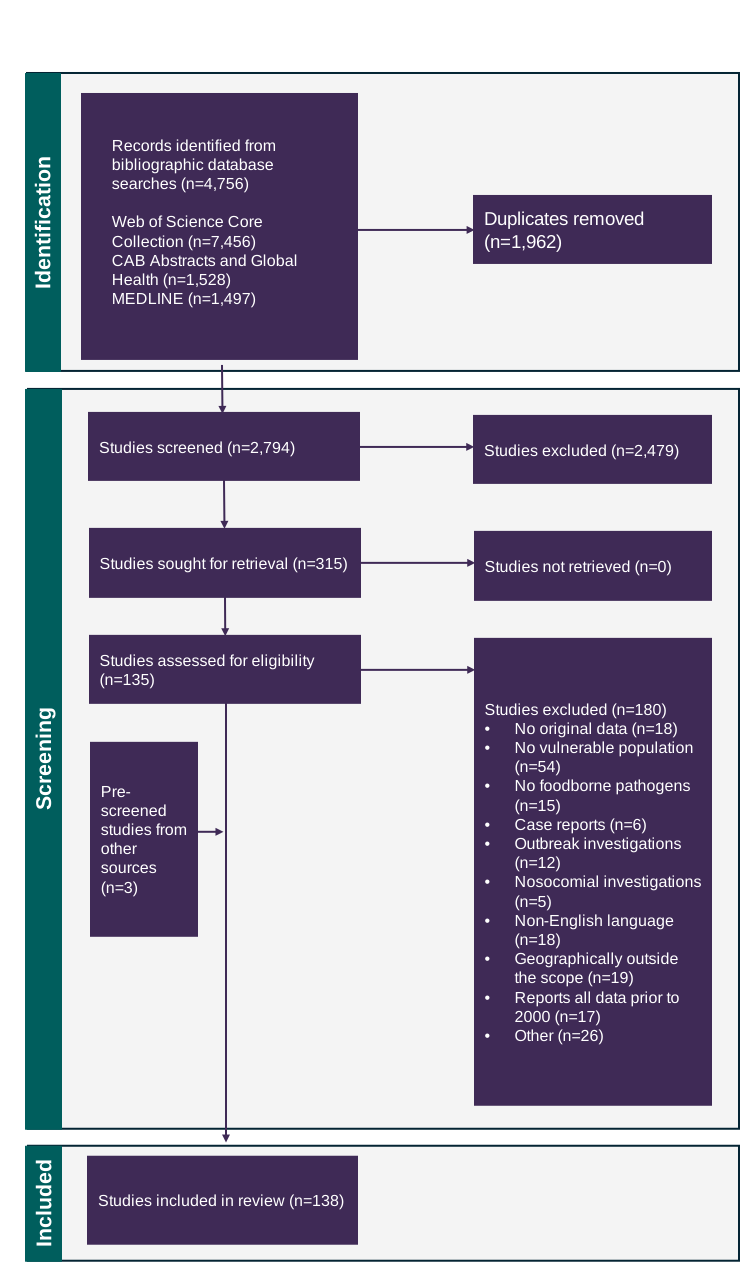
Here is a visual only chart of: Flow diagram showing for the review of prevalence data, fro the identification stage through to screening and the studies included in the review.
Please find more information provided in the detailed description and/or table below.
Identification stage:
- Records identified from bibliographic database searches (n=4,756)
- Web of Science Core Collection (n=7,456)
- CAB Abstracts and Global Health (n=1,528)
- MEDLINE (n=1,497)
- Duplicates removed n=1,962
Screening stage:
- Studies screened (n=2,794)
- Studies excluded (n=2,479)
- Studies sought for retrieval (n=315)
- Studies not retrieved (n=0)
- Studies assessed for eligibility (n=135)
- Studies excluded (n=180)
- No original data (n=18)
- No vulnerable population (n=54)
- No foodborne pathogens (n=15)
- Case reports (n=6)
- Outbreak investigations (n=12)
- Nosocomial investigations (n=5)
- Non-English language (n=18)
- Geographically outside the scope (n=19)
- Reports all data prior to 2000 (n=17)
- Other (n=26)
- Pre-screened studies from other sources (n=3)
Studies included in the review: (n=138)
Review of clinically vulnerable group definitions
In addition to collating evidence to determine who is getting ill from foodborne illness, the research aimed to identify the current definitions of clinically vulnerable consumers used by other food safety organisations worldwide.
Grey literature search strategy
As part of the review process for clinically vulnerable groups definitions, a grey literature search was conducted to gather information from publications and websites produced by various global and national food safety organisations, as much of this information is expected to exist outside of peer-reviewed publications. For this purpose, the research team compiled a list of 31 food safety organisations located in the UK, EU, USA, Canada, Australia, and New Zealand to be included in this review.
Because most of the grey literature sources did not support advanced search features, a simplified search strategy was developed based on the search terms and concepts used for the bibliographic database searches. To ensure consistency, the searches were conducted in Google, limiting the results to the website of the organisation being searched. Each organisation's website was searched using the same set of search strings: site: [organisational domain] AND [human pathogen] AND (risk OR vulnerable OR susceptible) AND (foodborne OR "food poisoning" OR "food contamination" OR "food safety"). For the complete search strategy for each organisation, please see Appendix 2.
The searches were conducted between November 16, 2023, and February 23, 2024. The estimated number of hits for each search string was recorded. The first 60 hits were screened for relevance by one of three reviewers. Each reviewer was trained, and reviewer consistency was checked. Relevance was determined by assessing whether the retrieved document referred to any clinically vulnerable group in the context of foodborne illness. Peer-reviewed publications and journal articles were excluded from this review. Ten consecutive non-relevant or duplicated search hits were used as termination cut-off. All relevant documents were saved as PDF files, and data were extracted.
Data extraction
Data extraction was performed using Qualtrics software Version XM (Qualtrics, Provo, UT, USA;). Document titles, publication years, and authors were recorded. Extracted data included document types, intended audiences, clinically vulnerable groups, and foodborne pathogens. Specific age cut-offs for children and older adults were documented. Documents were assessed for inclusion of the explanations of vulnerabilities, and for citing the references to support the vulnerability statements. Complete definitions were recorded, and PDF copies of the documents were saved. The data extraction tool can be seen in Appendix 3.
Expert panel consultation to consider clinically vulnerable groups
Expert panels are a useful method for offering valuable insight into scientific evidence and to explore what experts believe about its application to a given situation (Coulter et al., 2016).
Given the complexity of the work undertaken, and to enable meaningful recommendations for Food Standards Scotland regarding future definitions of clinically vulnerable groups, expert panel consultations were undertaken.
Identification and recruitment of experts
The researchers identified experts in relevant fields including representatives from global food safety organisations and experts in areas including food safety education, microbiology, medicine, nutrition, immunology, physiology, psychology, pharmacology, and epidemiology.
Of the identified experts (n=30) contacted by the researchers, 26 agreed to be involved in the expert consultation. Three expert panels were conducted during February 2024 with the consolidated panel of experts (n=21) based on availability and time-zone restrictions. The experts who were not able to participate in the panel discussions reviewed the report and recommendations arising from the expert panels and provided further feedback (n=5). A list of the experts who wished to be named in the report can be found in Appendix 4.
Conducting expert panel consultations
In total three expert panel consultation session were undertaken, each taking 2 hours to complete. The sessions consisted of two distinct parts, during the first part, the researchers presented key findings relating to:
- The physiological background to susceptibility for various clinically vulnerable groups.
- The prevalence of foodborne illnesses among clinically vulnerable groups in Scotland and comparable countries.
- Findings from the review of clinically vulnerable group definitions.
During the second part, structured discussion was facilitated and moderated by the researchers using predetermined prompts to guide discussion which consisted of four distinct sections:
- appropriateness of clinically vulnerable groupings
- definitions of vulnerability
- recommendations for communicating with clinically vulnerable groups
- open discussion regarding any other relevant points
All panel discussions were undertaken and recorded using Microsoft Teams, which was utilised to generate transcripts of the discussion sessions, and a research assistant attended all panel discussions to take detailed notes.
Expert panel data consolidation and analysis
Following completion of the expert panel consultations, the transcripts were downloaded and reviewed independently by the researchers. The research team convened to consolidate the transcripts and detailed session notes and categories the points of discussion from each meeting into key themes relating to the predetermined prompts and any additional discussion points brought up by the expert panels to formulate recommendations for Food Standards Scotland.
Discussion groups with consumers to consider food safety messaging for clinically vulnerable groups
To support the development of future food safety messaging interventions it is of importance to consider the preexisting perceptions and the communication preferences of the specific target audience (Evans & Redmond, 2022). Involvement of the target audience in intervention development is believed to increase potential effectiveness of interventions (Green et al., 1996). A review of previous consumer food safety education interventions established that clinically vulnerable groups are under-represented as targets of interventions (Sivaramalingam et al., 2015); furthermore, less than half of consumer food safety education interventions have engaged with the target audience in the development, delivery, and evaluation of interventions (Sivaramalingam et al., 2015). Inclusion of the intended audience in the development of targeted interventions is essential (O'Cathain et al., 2019); tailored interventions based upon a target audience’s circumstances can be developed through co-creation with stakeholders (Leask et al., 2017). The co-creation of intervention development needs to consider the current practices, preferences and experiences of the intended audience (Ohern & Rindfleisch, 2010).
To give Food Standards Scotland meaningful insight to appropriate food safety messaging for clinically vulnerable groups, there is a need to engage with this group. It was agreed upon with Food Standards Scotland that a complementary research fellowship would be utilised to capture meaningful data for this report.
Complementary Food Standards Scotland research
Currently, Food Standards Scotland have a Fellowship project with the Scottish Environment, Food and Agriculture Research Institutions (SEFARI) to explore the lifestyle factors which cause members of the older population to become ill with foodborne disease, the recipient of the Fellowship is the principal investigator for this report on clinically vulnerable groups.
The first phase of the SEFARI fellowship project conducted in-depth telephone interviews and online focus groups with individuals over the age of 65 and those who support relatives over 65 years (n=80). These sessions explored factors influencing food shopping, storage, cooking, and eating behaviours, as well as food safety perceptions and practices (Evans, 2024). To benefit this report on clinically vulnerable groups, additional questions were incorporated into the second phase of data collection for the SEFARI fellowship.
Although the Fellowship focuses on one clinically vulnerable group, namely people over the age of 65, the group often includes other clinically vulnerable groups due to prevalence of disease or medication. Therefore, it was deemed appropriate to utilise this group to complement the findings of this report.
Recruitment of participants
Recruitment was carried out through an online advert on the Food Standards Scotland Facebook page and posters displayed on community notice boards in shops, community centre, leisure centres and libraries in the areas surrounding the selected venues for data collection. Interested participants signed up by completing an online form or by contacting the research team via telephone or email.
Development of discussion group interview schedule
Three statements defining clinically vulnerable groups were developed. A standardised semi-structured interview schedule was created to explore preferences for wording and information. The interview schedule aimed to gather insights into the participants' communication preferences and perceptions regarding food safety messaging. To facilitate discussion and explore preferences for risk communication, three different risk statements regarding clinically vulnerable groups to listeriosis were developed:
- Simple YOPI classification: A short, straightforward statement based on the standard YOPI (Young, Old, Pregnant, Immunocompromised) categories.
- Extended YOPI classification: This statement included specific chronic illnesses and treatments/medications identified in this report that result in reduced immune function.
- Detailed vulnerability explanation: An extended statement that specifically defined why the listed groups are clinically vulnerable to foodborne illness, providing the most comprehensive information.
These statements were colour-coded and presented to participants in ascending order of complexity during the discussion groups.
Data collection and analysis
All discussion group sessions were audio recorded and subsequently transcribed. After transcription and checking the transcripts against the original audio recordings, the researcher reviewed the transcripts and coded participant statements according to the predefined codebook using NVivo, adding sub-nodes where necessary.
The research team reviewed the coded themes to summarise the responses regarding the preferences for food safety messaging for clinically vulnerable groups. Recommendations for future communication strategies were based on these findings.
Full details regarding the methodology utilised in this phase of work, can be found in the SEFARI report (SEFARI, 2023).