
5. Exemptions to approval
5.1. The exemptions to approval are:
- Direct supply of POAO to the final consumer
- Direct supply of small quantities of primary products
- Direct supply of small quantities of meat from poultry and lagomorphs slaughtered on the farm
- Direct supply of small quantities of wild game or wild game meat
- Slaughter for private domestic consumption
- Composite products
- Satellite operations
- Supply to farmers markets
- Supply of small quantities of POAO from retailers to other retailers
- Storage and Transport Undertakings
Establishments would generally require approval in order to supply to other approved establishments
5.2. ‘Direct supply’ to a final consumer can be via mail order or online sales as well as by delivery or collection. The final consumer does not have to be local to the establishment.
Direct supply of POAO to the final consumer (Regulation (EC) 853/2004 Article 1(5))
5.3. Regulation (EC) 853/2004 does not apply to establishments where supply is limited to retail (including catering operations) to the final consumer. The Regulation does, however, apply to retail if food of animal origin is supplied to another food business establishment (wholesale) unless the activities in Article 1(5) (b) (i) or (ii) are undertaken. Although a ‘wholesale outlet’ may be considered to be ‘retail’ as defined, approval may nonetheless be required depending on the specific activities undertaken.
Direct Supply of Small Quantities of Primary Products (Regulation (EC) 853/2004 Article 1(3)(c))
5.4. ‘The direct supply, by the producer, of small quantities of primary products to the final consumer or to local retail establishments directly supplying the final consumer’.
5.5. In general terms, the notion of ‘small quantities’ should be broad enough to allow amongst other things:
- Farmers to sell primary products directly to the final consumer e.g. farm gate sales or sales at local markets, sales to local retail shops directly supplying the final consumer and sales to local restaurants.
- Fishermen who harvest live shellfish products and fishery products such as crabs and lobsters to deliver directly to the final consumer or to local retail shops for direct sale to the final consumer and to local restaurants.
5.6. The expression ‘small quantities’ is not defined in Regulations, FSS therefore, suggest maximum amounts in Table 2 in Annex 1 of this document, which could be considered as small quantities for individual products of animal origin:
5.7. As well as being exempt under Regulation (EC) 853/2004, the direct supply of small quantities of primary products is exempt under Regulation (EC) 852/2004. The only food law that applies to these situations is the obligations under Regulation (EC) 178/2002.
Direct Supply of Small Quantities of meat from poultry and lagomorphs slaughtered on the farm (Article 1(3)(d)(also refer to Schedule 5 of the Food Hygiene Regulations))
5.8. ‘The direct supply, by the producer, of small quantities of meat from poultry and lagomorphs slaughtered on the farm to the final consumer or to local retail establishments directly supplying such meat to the final consumer as fresh meat.’
5.9. The exemption applies to producers of poultry i.e. farmed birds (except ratites (ostriches and emus)) or lagomorphs (i.e. rabbits, hares and rodents) who slaughter their own animals on the farm of production, as long as only small quantities of meat are supplied. Only birds or lagomorphs that have been reared on that site can be included within this exemption. No birds or lagomorphs can be brought to site for slaughter.
5.10. Small quantities is not defined in the legislation, but FSS’s interpretation is that producers such as the following should benefit from the exemption:
- producers annually slaughtering under 10,000 birds or lagomorphs; or
- producers annually slaughtering over 10,000 birds or lagomorphs who are members of an appropriate assurance scheme and who either:
o dry pluck by hand; or
o Slaughter for 40 days per year or less.
5.11. The limit of 10,000 birds or lagomorphs in the first category should not be applied absolutely. Annual fluctuations in slaughtering around the 10,000 level are acceptable provided that annual slaughtering are typically no more than 10,000, however, in the first year, the 10,000 should be applied. The limit of 10,000 should be applied to the total number of poultry or lagomorphs slaughtered. For example, a producer slaughtering 6,000 chickens and 2,000 turkeys would be exempt, while another slaughtering 6,000 chickens and 6,000 turkeys or slaughtering 6,000 chickens and 6,000 rabbits would not be exempt.
5.12. Although there is no limit to the number of birds or lagomorphs that producers in the second category may slaughter, FSS anticipates that the restrictions will limit production to relatively small quantities. The purpose of the restrictions on those slaughtering over 10,000 is to allow the exemption to apply only to those producers where the assessed public health risk is likely to be low.
5.13. In judging whether an assurance scheme is appropriate, regard should be had as to whether the scheme has requirements that at least meet the minimum legal requirements in relation to food safety and hygiene and whether it has independent verification arrangements.
5.14. Meat produced under this exemption may be supplied:
Direct to the final consumer; or
Direct to local retail establishments directly supplying such meat to the final consumer.
5.15. In the first category, direct supply to the final consumer would include mail order, online sales, farmers markets, as long as the supply is direct to the consumer. Such supplies are not necessarily limited to meat in the form of fresh meat. They could be in the form of minced meat and, meat products or meat preparations.
5.16. In the second category, the supply must be direct to local retail establishments (in the form of fresh meat, minced meat, meat preparations or meat products) and could include the supply by the producer to restaurants or other catering establishments. The retail establishments supplied must be ‘local’ except for the two weeks preceding Christmas and Easter and (for geese) Michaelmas (late September). 1
5.17. Establishments benefiting from this exception remain subject to the requirements of Regulation (EC) 852/2004 and the additional requirements contained in Regulation 31 and Schedule 5 to the Food Hygiene (Scotland) Regulations 2006, as amended.
Direct Supply of Small Quantities of wild game or wild game meat (Regulation (EC)853/2004
Article 1(3)(e))
5.18. ‘Hunters who supply small quantities of wild game or wild game meat directly to the final consumer or to local retail establishments directly supplying the final consumer.’
This exemption does not apply to farmed game which falls within remit of FSS.
Wild Game Carcases in Fur or Feather;
5.19. There is an exemption from Regulation (EC) No 852/2004 for primary producers (individual hunters and/ or shooting estates) to supply small quantities of primary products (i.e. wild game carcases in fur/feather) directly to the final consumer or to local retail establishments directly supplying the final consumer. This supply is not subject to the requirements of the Food Hygiene Regulations. However, the hunter/shooting estate is responsible for supplying safe food under The Food Safety Act 1990 and Regulation (EC) No 178/2002.
Wild Game Meat;
5.20. There is also an exemption from Regulation (EC) No 853/2004 for hunters and active members of a hunting party supplying small quantities of wild game or wild game meat directly to the final consumer or to local retailers directly supplying the final consumer. The meat must be prepared by an individual who has played an active part in the shoot, such as a beater, so the exemption is available to shooting estates. Operations under this exemption are required to be registered with the LA as a food business under Regulation (EC) No. 852/2004.
5.21. Persons who hunt wild game with a view to placing it on the market for human consumption must have sufficient knowledge of the pathology of wild game, and of the production and handling of wild game and wild game meat after hunting, to undertake an initial examination of wild game on the spot. In addition, large wild game intended for supply to an approved game handling establishment (AGHE) must be accompanied by a declaration stating that no abnormalities were observed either before or after shooting.
For more information: see the separate Wild Game Guide here.
Slaughter that is carried out for private domestic consumption
5.22. Keepers of animals who slaughter livestock on farm for their own personal consumption or that of members of their household living there fall out of the scope of both Regulation (EC) No. 852/2004 and Regulation (EC) No. 853/2004.
Composite Products
(i.e foods containing processed products of animal origin and products of
plant origin)
5.23. Article 1(2) of Regulation (EC) 853/2004: Unless expressly indicated to the contrary, this Regulation shall not apply to food containing both products of plant origin and processed products of animal origin. However, processed products of animal origin used to prepare such food shall be obtained and handled in accordance with the requirements of this Regulation. Guidance to determine whether a product is classed as a composite product can be found here.
5.24. Thus a food business operator who:
- Merely assembles processed products of animal origin with products of plant origin does not require approval as it is a composite product, even if that product is then further processed – e.g. sandwich assembly. Regulation (EC) 852/2004 would be appropriate to that operation or those operations.
- Processing of a POAO prior to combining it with food of plant origin would require approval under Regulation (EC) 853/2004 for that processing activity.
- Assembles food of plant origin with unprocessed food of animal origin which is further processed together would need approval under Regulation (EC) 853/2004 as it is not considered to be a composite product e.g. manufacture of a steak pie from raw steak.
5.25. The addition of a product of plant origin to a processed product of animal origin does not automatically mean that the resulting food would be a composite product. For example, cheese to which herbs are added or sausages to which garlic or soya are added would fall within Regulation (EC) 853/2004.
5.26. The EC Guidance document on the implementation of the provision of Regulation (EC) 853/2004 gives an overview of the scope of this Regulation. However the list is not exhaustive and therefore purely indicative.
Satellite Operations
5.27. Where the only supply of relevant POAO is from the establishment to other local retail outlets under the same ownership, operating under a combined Food Safety Management System, it may be appropriate to consider these as satellite operations. These can be regarded as an extension of the producer’s establishment. Therefore such supply should be treated as other sales to the final consumer.
5.28. This flexibility is mainly to remove the need for the approval of smaller food businesses where the processing of POAO and the retail element (i.e. the place or point of supply to the consumer) are not at the same ‘site’ but there is a strong association between sites and a natural or legal person or persons overseeing the activities. They would have effective control of the HACCP based procedures from the production site through their own retail outlet/s to the final consumer.
5.29. Where supply changes to include other establishments not under the same ownership, these operations would need to be considered as ‘supply to other establishments’, especially when considering the marginal requirement of the retail to retail exemption.
5.30. The interpretation of local in this context is intended to be more restrictive than applied elsewhere. It is intended to indicate that establishments are sufficiently local to be under the direct supervision of an individual or group of individuals.
Supply to Farmers Markets
5.31. This exemption can be considered to be an extension of the Satellite Operations exemption, but without the local restriction.
5.32. Establishments producing POAO for supply to the final consumer at farmers’ markets, or at other markets supplying the final consumer, are not subject to approval under Regulation 853/2004.
5.33. This is subject to the following conditions:
- There is no change of control of the POAO (e.g. FBO A cannot cut meat and supply it to FBO B to sell at the market);
- It does not involve supply to other than the final consumer.
5.34. FBOs supplying POAO at farmers’ markets or other markets supplying the final consumer should be regarded as if they were supplying the final consumer directly, on the basis that the market can be regarded as an extension of the originating establishment. Furthermore, such sales should be treated as other sales to the final consumer and are not limited to the ‘localised’ sale criteria.
Supply of Small Quantities from Retailers to other Retailers (Regulation (EC) 853/2004, Article 1(5)(ii))
5.35. Article 1 (5)(ii) provides for the supply of POAO from a retail establishment to another retail establishment to be exempt from approval where the supply to other retail establishments is marginal, restricted and localised as defined below. All three criteria must apply in order for an establishment to be exempt.
5.36. In order to be considered a retailer, there must be genuine retail sales to the final consumer from the establishment, including via mail order or online sales as well as by delivery or collection.
‘Marginal’:
5.37. Where supply of POAO to other retail establishments is up to a 25% of all the food supplied by the establishment. This should be calculated by measuring the amount (either by weight or volume) of relevant food of animal origin supplied to other food business establishments (including caterers) against the entire supply of food (this includes food of any type, e.g. drink, biscuits etc.).
5.38. Where the only relevant POAO supplied is meat (fresh or processed, excluding wild game meat) up to 2 tonnes a week. This can be averaged over a 12 month period.
5.39. Both the above criteria must not be used simultaneously at an establishment. It is either the 25% or the 2 tonne rule for establishments that supply only meat.
'Localised’
5.40. Supply to other retail establishments must be limited to sales within the establishment’s own LA plus the greater of either: the neighbouring LA or LAs; or 30 miles/50km from the boundary of the supplying establishment LA.
5.41. In relation to LAs bordering England, localised should be interpreted as supply to other retail establishment must be limited to sales within the establishment’s own LA plus the greater of either: the neighbouring LAs or English Counties; or 30 miles/50km from the boundary of the supplying establishment LA.
5.42. In exceptional circumstances, the interpretation of ‘localised’ may be extended to the whole of the UK, in cases where the geographical distribution of certain farmed or game animals would otherwise significantly restrict the national supply (e.g. rare breed meats, grouse), or where a traditional, or rare product could not find a sufficient and/or specialist market on a local basis as defined above.
‘Restricted’
5.43. Recital 13 of Regulation (EC) 853/2004 describes ‘restricted’ as concerning only certain types of products or establishments. Having to list establishments and products is seen as bureaucratic and a potential barrier to trade and there are, in any case, other legal requirements for the traceability of food products.
5.44. Officers should interpret ‘restricted’ as whether the supply is in some way restricted in relation to either:
- the products being supplied i.e. by product category as referenced in Regulation (EC) 853/2004 (e.g. dairy products, fishery products etc.), or;
- The type of retail establishment supplying the products, and/or;
- The type of retail establishment(s) being supplied with the products.
Storage and Transport Undertakings (Regulation (EC) 853/2004 Article 1(5) (b) (i))
5.45. ‘However, this Regulation, Article 1(5) (b) (i), shall apply to retail when operations are carried out with a view to the supply of food of animal origin to another establishment, unless: (i) The operations consist only of storage or transport, in which case the specific temperature requirements laid down in Annex III shall nevertheless apply;’
5.46. Therefore establishments where operations are limited to non-temperature controlled storage and transport are exempt from approval. These establishments should be registered and considered in relation to Regulation (EC) 852/2004. Establishments involved in temperature controlled storage may need to be considered for approval as ‘Cold Stores’(see section 11.1).
5.47. Cold stores engaged in the following activities require registration under Regulation 852/2004:
- Cold stores engaged exclusively in retail operations (i.e. establishments, or as part of establishments, supplying only the final consumer);
- Cold stores engaged in retail operations and also supplying other retail food business establishments (including caterers) on a “marginal, localised and restricted” basis;
- Cold stores that are part of the logistical chain for distributing, to a single retailer who has a single or multiple outlets, finished POAO which is packaged for retail sale to the final consumer and whose activities are physically limited to transport or storage. This does not apply to cold stores that store finished POAO which is packaged for retail sale and supply to other establishments not as part of a logistical distribution chain (i.e cold stores supplying multiple retailers). (Explanatory note :- this provides for an extension of the retail exemption and thus is considering the storage to be an extension of an individual retailer’s activity. If however, a cold store is facilitating multiple retailers, this will not be covered by that exemption and accordingly those establishments would require approval.)
- Cold stores that exclusively handle “composite products” as per Article 1(2) of Regulation 853/2004.
Cold stores undertaking other activities require to be approved by the relevant CA.
5.48. Determination if Approval is Required – Decision Tree
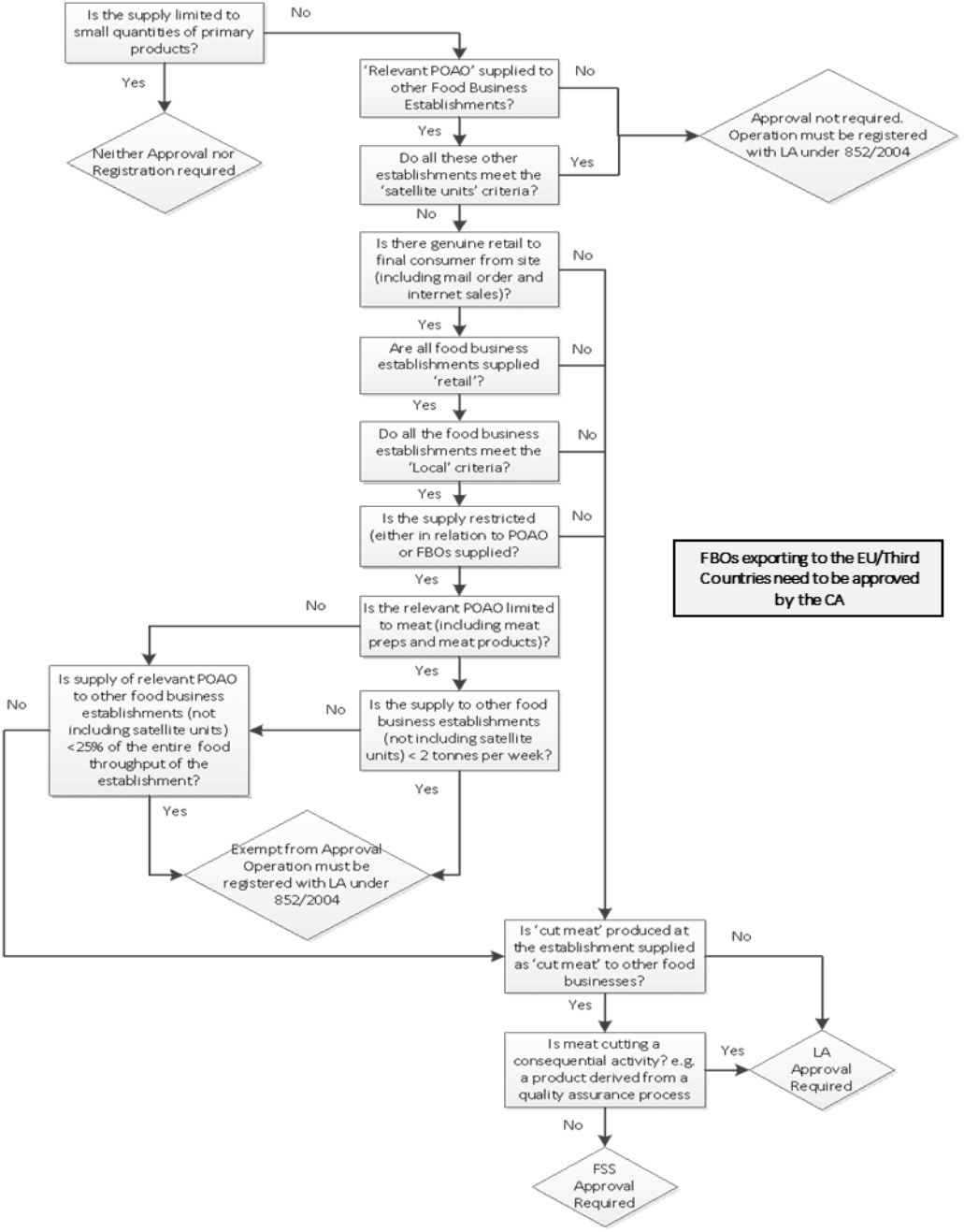
Here is a visual only chart of: 1. Is the supply limited to small quantities of primary products: If yes, neither approval or registration is required. If no, proceed to question 2. 2. ‘Relevant POAO supplied to other Food Business Establishments? If yes, proceed to question 3. If no, approval not required. Operations must be registered with LA under Regulation (EC) 852/2004. 3. Do all these other establishments meet the ‘satellite’ criteria? If yes, approval not required. Operations must be registered with LA under Regulation (EC) 852/2004. If no, proceed to question 4 4. Is there genuine retail to final consumer from site (including mail order and internet sales)? If yes, proceed to question 5 If no, proceed to question 11 5. Are all food business establishments supplied ‘retail? If yes, proceed to question 6 If no, proceed to question 11 6. Do all the food business establishments meet the ‘local’ criteria? If yes, proceed to question 7 If no, proceed to question 11 7. Is the supply restricted (either in relation to POAO or FBO’s supplied)? If yes, proceed to question 8 If no, proceed to question 11 8. Is the relevant POAO limited to meat (including meat preps and meat products)? If yes, proceed to question 9 If no:,proceed to question 10 9. Is the supply to other business establishments (not including satellite units) less than 2 tonnes per week? If yes, exempt from approval. Operation must be registered with LA under Regulation (EC) 852/2004 If no, proceed to question 10. 10. Is the supply of relevant POAO to other food business establishments (not including satellite units) less than 25% of the entire food throughput of the establishment? If yes, exempt from approval. Operation must be registered with LA under Regulation (EC) 852/2004 If no, proceed to question 11 11. Is ‘cut meat’ produced at the establishment supplied as ‘cut meat’ to other food businesses? If yes, proceed to question 12 If no, LA approval required 12. Is meat cutting a consequential activity? e.g. a product derived from a quality assurance process. If yes, LA approval required If no, FSS approval required 13. FBO exporting to the EU/Third Countries need to be approved by the CA.
Please find more information provided in the detailed description and/or table below.
- Is the supply limited to small quantities of primary products:
If yes, neither approval or registration is required.
If no, proceed to question 2.
- ‘Relevant POAO supplied to other Food Business Establishments?
If yes, proceed to question 3.
If no, approval not required. Operations must be registered with LA under Regulation (EC) 852/2004.
- Do all these other establishments meet the ‘satellite’ criteria?
If yes, approval not required. Operations must be registered with LA under Regulation (EC) 852/2004.
If no, proceed to question 4
- Is there genuine retail to final consumer from site (including mail order and internet sales)?
If yes, proceed to question 5
If no, proceed to question 11
- Are all food business establishments supplied ‘retail?
If yes, proceed to question 6
If no, proceed to question 11
- Do all the food business establishments meet the ‘local’ criteria?
If yes, proceed to question 7
If no, proceed to question 11
- Is the supply restricted (either in relation to POAO or FBO’s supplied)?
If yes, proceed to question 8
If no, proceed to question 11
- Is the relevant POAO limited to meat (including meat preps and meat products)?
If yes, proceed to question 9
If no:,proceed to question 10
- Is the supply to other business establishments (not including satellite units) less than 2 tonnes per week?
If yes, exempt from approval. Operation must be registered with LA under Regulation (EC) 852/2004
If no, proceed to question 10.
- Is the supply of relevant POAO to other food business establishments (not including satellite units) less than 25% of the entire food throughput of the establishment?
If yes, exempt from approval. Operation must be registered with LA under Regulation (EC) 852/2004
If no, proceed to question 11
- Is ‘cut meat’ produced at the establishment supplied as ‘cut meat’ to other food businesses?
If yes, proceed to question 12
If no, LA approval required
- Is meat cutting a consequential activity? e.g. a product derived from a quality assurance process.
If yes, LA approval required
If no, FSS approval required
- FBO exporting to the EU/Third Countries need to be approved by the CA.