
13. Enforcement
Review with a view to suspension or withdrawal of an approval
13.1. Article 148(5) of Regulation (EU) 2017/625 requires the competent authority (CA) to keep the approval of establishments under review when carrying out official controls. If the CA identifies serious deficiencies or has to stop production at an establishment repeatedly and the food business operator is not able to provide adequate guarantees regarding future production, the CA shall initiate procedures to withdraw the establishment’s approval, in accordance with Article 138(2)(j) of Regulation (EU) 2017/625. However, the CA may suspend an establishment’s approval if the food business operator can guarantee that it will resolve deficiencies within a reasonable time.
13.2. An interpretation of the term serious deficiency that provides the basis for withdrawal of approval has not been specified in the regulations. For consistency of approach, a working definition has been developed by FSS detailed below:
13.3. General indicator of serious deficiency and/or actual or potential risk to public health;
Likely Issues (this is not an exhaustive listing and some or all elements may be present and to a varying degree):
Structure
- Major structural deficiency
- Poor maintenance preventing effective cleaning
Contamination
- Contamination of products
- Failure to control contamination from any source
- Visibly contaminated product without action from FBO
- Inadequate separation between products of different risk categories
Temperature control
- Inadequate temperature control
Pest control
- Serious rodent or insect infestation
Water
- Inadequate supply of potable water
Food safety management system
- Poor management attitude and commitment
- Inadequate HACCP based food safety management system or good hygiene practices (commonly known as pre-requisite programme)
- Failure of HACCP based controls
- Inadequate traceability procedures and observance
13.4. In the case of a wholesale market, Article 138(2)(j) of Regulation (EU) 2017/625 allows the withdrawal or suspension of an approval in respect of certain units or groups within the market. In the event that the common parts of a wholesale market have the approval withdrawn or suspended, the individually approved units are not able to operate as the approval of the common parts facilities is a prerequisite to their approval. Where the individual units within the market are able to become self-sufficient in their own right, separate approval as an individual establishment can be sought.
13.5. Review of approval may be triggered as a result of carrying out routine official controls (compliance and enforcement) or as a result of local intelligence for example where the establishment has been non-operational (long-term), major curtilage change/rebuild or acts of God (e.g. flooding) and/or where there is a strong likelihood that serious deficiencies will have developed. Obstruction by the FBO may also trigger a review of approval.
Note: - the CA should monitor establishments which have ceased operating and not informed them of their future plans. If the FBO does not confirm the surrender of their approval in writing within six months of the establishment ceasing operations and the CA cannot verify the implementation of the FSMS in relation to the approvable activity, the CA should consider appropriate action. In cases where the FBO is not contactable, the CA should issue any correspondence to the FBO’s address as well as last known email address.
13.6. Where the preliminary evidence suggests that there may be serious deficiencies the officer should:
- Carry out an unannounced inspection of the establishment when production is taking place (this will not be possible where the establishment is not operating due to enforcement action or where the operator has voluntarily ceased to operate); and
- Undertake an assessment of the FBO’s history of compliance with regulatory requirements at the approved establishment, the relevant history of enforcement and any reports to the Procurator Fiscal involving the FBO.
13.7. Where the officer undertaking the review decides serious deficiency exists, the following process should be followed.
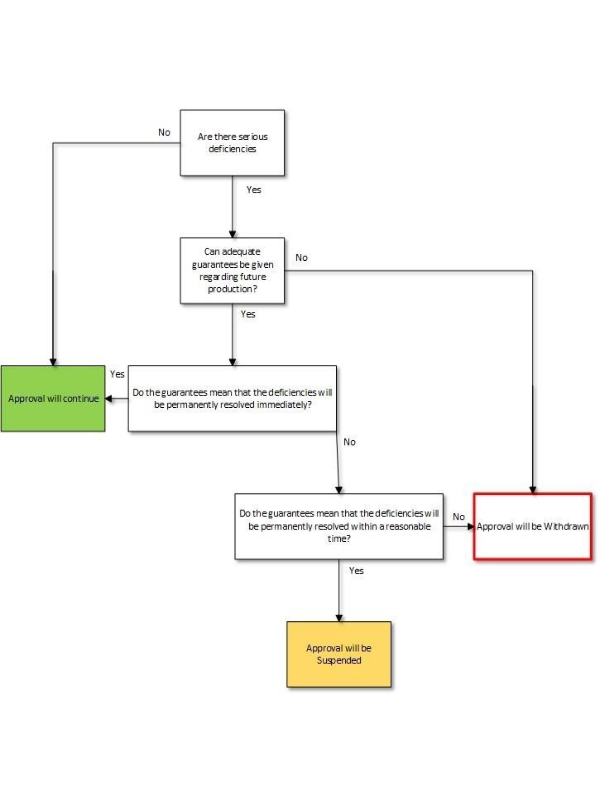
Here is a visual only chart of: 1. Are there any deficiencies? If yes, go to question 2 If no, approval will continue 2. Can adequate guarantees be given regarding future production? If yes go to question 3 If no, approval will be withdrawn 3. Do the guarantees mean that the deficiencies will be permanently resolved? If yes, approval will continue If no, go to question 4 4. Do the guarantees mean that the deficiencies will be permanently resolved within a reasonable time? If yes, suspend the approval If no, approval will be withdrawn.
Please find more information provided in the detailed description and/or table below.
1. Are there any deficiencies?
If yes, go to question 2
If no, approval will continue
2. Can adequate guarantees be given regarding future production?
If yes go to question 3
If no, approval will be withdrawn
3. Do the guarantees mean that the deficiencies will be permanently resolved?
If yes, approval will continue
If no, go to question 4
4. Do the guarantees mean that the deficiencies will be permanently resolved within a reasonable time?
If yes, suspend the approval
If no, approval will be withdrawn.
13.8. The provisional decision to review the approval must be communicated in writing to the FBO. The FBO must provide the CA (within 14 calendar days from the date of letter) with any guarantees that it will resolve the deficiencies within a reasonable time.
13.9. The process for consideration of guarantees is described below:
- Where the FBOs guarantees regarding future production are not accepted the approval will be withdrawn;
- Where the CA does accept that the FBOs guarantees mean that serious deficiencies will be permanently resolved immediately and that there will be no foreseeable future stoppages of production approval will continue;
- Where the CA accepts that the guarantees mean that the serious deficiencies will be permanently resolved within a reasonable time and the situation will be such that, once the serious deficiencies have been resolved, there will be no foreseeable future deficiencies serious enough to warrant stoppages of production, the approval will be suspended.
- Where the FBO does not provide guarantees approval will be withdrawn.
13.10. Suspension of approval will be lifted in writing by the CA, once the serious deficiencies are permanently resolved and the situation is such that there will be no foreseeable cause for future stoppages of production. If this has not been undertaken within a reasonable time the approval will be withdrawn.
13.11. The FBO has the right to appeal to the Sheriff Court against the decision to withdraw or suspend an approval or conditional approval. Rights of appeal are governed by the Official Feed and Food Controls (Scotland) Regulations 2009 (as amended). From the date on which the notice of the decision is served on the relevant person the establishment cannot continue operating whilst the appeal is being determined. Model forms for the suspension and withdrawal of approvals can be found on the FSS website here. The forms should be completed by the CA and sent to the FBO. For LA approved establishments, a copy should also be sent to LAapprovals@fss.scot.
Transfer of establishment to LA following refusal, suspension, or withdrawal by FSS
13.12. There will be occasions when FSS decides to refuse, suspend or withdraw approval of an establishment under Regulation (EC) 853/2004 or identifies establishments undertaking activities for which approval from FSS is required but, has not been granted. Although FSS is the CA responsible for the approval of certain categories of establishments, where approval is refused, suspended or withdrawn, or activities are carried out without the necessary approval, enforcement responsibility immediately falls to the relevant LA. The Food Law Code of Practice (Scotland) gives the LA enforcement responsibility in establishments engaged in activities that require approval, but that are not approved. Therefore the offence of carrying out an activity that requires approval without first obtaining approval is enforced by the LA.
13.13. In cases concerning refusal, suspension or withdrawal of approval, FSS will forward a copy of the refusal, suspension or withdrawal letter to the relevant LA. The LA will also be provided with any supporting documents, which would have been taken into account when the decision to refuse, suspend or withdraw the establishment’s approval was being considered:
- summary of deficiencies;
- [if applicable] enforcement programme at the establishment;
- photographic evidence of deficiencies found;
- [if available] summary report of any meeting with the FBO;
- [if available], plan detailing the boundaries and extent of the approved establishment.
13.14. Following the notification of refusal, suspension or withdrawal by FSS, and as the establishment now falls within the remit of the LA, it will need to ensure that the FBO either ceases the activity requiring approval or limits operations to meet the exemption criteria and operates under Regulation (EC) 852/2004. LAs are requested to arrange a visit to such establishments as soon as possible to confirm that the establishment has indeed stopped carrying out any activity or activities that require approval under Regulation 853/2004, or that their current operation is restricted to only meet the requirement of an exempt activity (by nature or scale). LAs should consider organising a joint visit with FSS staff where appropriate to facilitate an effective transfer. LAs should continue to monitor such establishments to ensure on-going compliance with the exemption criteria.
13.15 If, at the visit to check that the FBO has ceased activities that require approval, there is evidence that the business has not ceased these activities or reduced throughput below the exemption threshold, LAs should consider taking the following enforcement actions, in line with the LAs own enforcement policy:
- all products that have been produced without approval on the premises could be certified using Regulation 27 of the Food Hygiene (Scotland) Regulations 2006 as not being produced, processed or distributed in accordance with the Regulations. Food certified in this way is then treated for the purposes of Section 9 of the Food Safety Act 1990 as failing to comply with food safety requirements and should be dealt with accordingly;
- serve a Remedial Action Notice under Regulation 9 of the Food Hygiene (Scotland) Regulations 2006;
- Consideration should also be given to reporting this as an incident to the FSS Scottish Food Crime and Incidents Unit (incidents@fss.scot), for example where there is a serious hazard or wide distribution of food.
13.16. If the FBO still continues to carry out activities that require approval without approval, after the LA has taken action detailed above, the FBO will be guilty of an offence and could be reported to the Procurator Fiscal. Irrespective of the above enforcement actions, the operator has one month to appeal against FSS’s decision to refuse, withdraw or suspend its approval from the date that decision is made.
13.17. If the operator wishes to submit a new application for approval, it should be made clear that until such an approval is granted, the establishment cannot carry out the activity requiring approval above the exemption threshold.
Establishments subject to approval operating without approval
13.18. Where an FBO is operating and carrying out activities subject to approval but is not approved, the enforcement responsibility lies with the LA. This includes FBOs carrying out activities which are subject to FSS approval (e.g. slaughter, cutting) but where conditional or full approval has not been granted by FSS. Until such a time as they are approved, FSS has no jurisdiction for enforcement.
13.19. LAs can consider the use of a Remedial Action Notice, under Regulation 9 of the Food Hygiene (Scotland) Regulations 2006, for establishments which are subject to approval, but which are not yet approved.
Enforcement responsibilities in establishments approved by FSS
13.20. Local Authorities and Food Standards Scotland both have an enforcement role in establishments approved by Food Standards Scotland, as detailed in Table 4 Annex 1. However, where an establishment is operating without approval, or where approval has been withdrawn, refused or suspended, enforcement falls to the relevant LA.
13.21 Whilst in most cases it will not be necessary to co-ordinate interventions at such establishments, there is benefit in ensuing clear lines of communication between the relevant enforcing authorities. This is particularly important in the event that matters of evident concern under the responsibility of the other enforcing authority are noted.
The FSS point of contact in relation to FSS Approved Establishments is approvals@fss.scot.
The Local Authority point of contact would be as outlined for each Local Authority in the current Food and Feed Enforcement Contact Directory, maintained by FSS.
Table 4 with Enforcement Responsibilities in FSS Approved Establishments can be found in Annex 1