
11. Specific classes/types of approved establishments
Cold stores (see also 5.45-5.47)
11.1. EU guidance advises that cold stores require approval in so far as they are used in relation to activities for which Annex III of Regulation (EC) 853/2004 lays down requirements. However, Article 1, paragraph 5(b), exempts colds stores which supply single retailer outlets and cold stores that are involved in wholesale operations which are physically limited to transport or storage, these do not need to be approved but remain subject to the temperature requirements in Regulation (EC)853/2004. This means that unless they are exempt, stand-alone cold stores used for the storage of POAO must be approved.
11.2. Cold stores which are not engaged in any form of retail activity to the final consumer themselves should not be considered as exempt under a retail exemption. Guidance from the EU Commission states: In the context of food hygiene, retail [as defined in Regulation (EC) 178/2002] should generally have a more limited meaning as follows: ‘activities involving direct sale or supply of food of animal origin to the final consumer’. The activity of selling POAO to other establishments (approved establishments, retail establishments, catering establishments) means that the activities undertaken by FBOs which do this are not limited to storage and transport. Activities limited to storage or transport refer to the cold storage by an FBO of their own products.
11.3. POAO should be handled in approved establishments up to the point it reaches a genuine retail establishment with supply to the final consumer, or a point at which an exemption applies (e.g. no specific temperature requirements, composite products see below).
11.4. Unless any of the exemptions from approval are applicable, cold stores engaged in the following activities would need approval under Regulation 853/2004, rather than registration under Regulation 852/2004:
- Cold stores engaged in the storage of raw POAO which has been brought in from other establishments for the supply to a further establishment;
- Cold stores engaged in the storage of processed, or partly processed “intermediate” POAO brought in from other establishments to be supplied to other establishments for use as an ingredient in other products;
- Cold stores which store finished POAO but which supply to retail or to other food businesses but not as part of a logistical distribution chain.
11.5. The Registration of a cold store (Article 6 of Regulation (EC) 852/2004) is required if that cold store is exempt from approval. Stand-alone cold stores supplying the final consumer exclusively (i.e. retail) or supplying the final consumer and, on a ‘marginal, localised and restricted’ basis, other retail establishments (including caterers) are exempt from approval.
11.6 .Under no circumstances must a cold store undertake any other activity for which it is not approved. It should, however, be noted that the freezing of POAO is not a processing action and, therefore, cold stores undertaking blast freezing of foods can carry out this activity under their cold store approval.
11.7. There is no requirement to apply a new ID mark on product unless its packaging and/or wrapping is removed or it is further processed in another establishment, in which case the new mark must indicate the approval number of the establishment where these operations take place (Regulation (EC) 853/2004, Annex II, Section I, A, 2). Therefore cold stores that only keep product for storage purposes need not apply their ID mark onto the product. The FBO could consider including their ID mark on paperwork associated with POAO that they supply to other establishments to assist traceability and in this case, the ID mark should be in the appropriate format (see 11.3).
11.8. If a cold store intends to undertake re-wrapping (see 11.10), then it must be additionally approved as a re-wrapping centre and apply its own ID mark to any POAO it rewraps and/or repacks. Cold stores that do not have additional approval as a re-wrapping centre must not undertake re-wrapping of damaged products. Under no circumstances can the manufacturer’s identification mark be applied. If products are found to be damaged upon delivery or during handling, they should either be returned to the manufacturer or disposed of as food waste as per Chapter VI of Regulation (EC) 852/2004. Where cold stores wish to operate with a view to carrying out additional activities which are subject to approval (for example re-wrapping) or are registered but wish to be able to carry out activities subject to approval part of the time, they should discuss an application for approval with the CA.
11.9. Approved establishments, that are approved for other commodities or processes but which as part of their operations receive and supply other relevant POAO without directly handling it (i.e. cold store operations) must explicitly be approved as a cold store on the approval documentation.
Rewrapping and repackaging establishments
11.10. Regulation (EC) 853/2004 Annex II Section I: A. 2: when a product's packaging and/or wrapping is removed or it is further processed in another establishment, a new mark must be applied to the product. In such cases, the new mark must indicate the approval number of the establishment where these operations take place.
11.11. Re-wrapping establishments unwrap POAO that were wrapped in another establishment and further handle them before rewrapping them. Since rewrapping establishments handle exposed POAO that are covered by Annex III of Regulation (EC) 853/2004, they fall within the scope of Article 4, paragraph 2 of the Regulation. Approval is therefore required.
11.12. Re-packaging, where the outer packaging (including approval number) of bulk packaging is removed also requires approval. FBOs must have full traceability systems in place in accordance with the requirements in Regulation (EC) 178/2002 and Regulation (EC) 931/2011.
11.13. In order to ensure traceability, an identification mark must be applied before POAO leaves the establishment of production. However, when the product’s packaging and/or wrapping is removed or it is further processed in another establishment, a new mark must be applied to the product. In such cases, the new mark must indicate the approval number of the establishment where these consequent operations take place.
11.14. Establishments limited to re-packaging of foods, without re-wrapping activity should have their approval restricted to re-packaging only.
NOTE: rewrapping and re-packaging of composite products does not require approval.
Wholesale Markets
11.15. Wholesale markets must be approved in relation to the common parts, and the separate units within the market must be approved separately. For clarity, the wholesale market should be allocated an approval number and the individual units have the same number combined with a suffix. Separate approval documents must be issued for the market as a whole and for individual units within the market, which are approved establishments in their own right.
11.16. Responsibility for complying with the Hygiene Regulations rests with the landlord of the market for the general areas within the market and individual food business operators for the unit(s) which they operate. However, FBOs for individual approved units have a duty to ensure that adequate common parts facilities are in place as a prerequisite to them operating, e.g. waste disposal, potable water supply, hot water etc.
11.17. Where the approval of the market is withdrawn, suspended or surrendered, it will be necessary to consider the approval of the individual units that rely on common areas under the market’s approval.
Multiple FBOs in one premises
11.18. Where more than one FBO intends to use a single premises to operate separate food businesses at different times, for example FBO A operates 09:00-17:00 and FBO B operates 17:00-09:00, approval may still be permitted but these situations should be assessed on a case by case basis. In this case both the FBOs will require separate approvals.
11.19. The FBO/s for the individual businesses requiring approval using one premises will need to demonstrate how they plan to manage any food safety risks adequately including traceability. When undertaking the assessment, the CA must satisfy themselves that infrastructure, equipment and the FBO/s controls are acceptable before the approvals can be granted. The arrangements regarding the operating pattern and joint use of the premises will be included in the approval documents as a precondition to the approval.
11.20. Where this is achieved, approval or conditional approval will be granted to each FBO individually with each FBO receiving their own approval number.
11.21. In the event that the CA, when carrying out official controls, needs to take enforcement action, for example due to non-hygienic operations or equipment deficiencies, this may need to be taken against both parties until the issues are resolved. This is owing to the joint use of the premises being a precondition to the individual approval, regardless of which party caused the problem in the first place.
11.22. Where different FBOs are approved by the LA and FSS, it will be necessary to ensure cooperation and sharing of relevant information.
Shared Facilities
11.23. In the event that an FBO requiring approval to operate an establishment can only fully meet the requirements of the regulations by sharing certain facilities with a neighbouring FBO, approval may still be possible. These situations should be treated on a case by case basis but examples would include sharing facilities such as changing rooms, toilets, loading bays and chiller capacity.
11.24. The FBO requiring approval using shared facilities will need to demonstrate how food safety risks are managed. When undertaking the assessment, the CA must satisfy themselves that infrastructure, equipment and the FBO controls are acceptable before approval can be granted. Shared facilities will be identified in the approval document and marked on the site plan. Where different FBOs are approved by the LA and FSS, it will be necessary to ensure cooperation and sharing of relevant information.
11.25. An example site plan identifying the shared facilities:
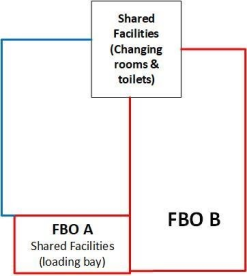
Here is a visual only chart of: FBO A and FBO B share changing rooms, toilets and loading bay.
Please find more information provided in the detailed description and/or table below.
FBO A and FBO B share changing rooms, toilets and loading bay.
Co-located Approval Activities establishments
11.26. Where an approved meat establishment subject to veterinary control is also handling other POAO, FSS after discussion and agreement with the relevant LA will consider approving all operations requiring approval under Regulation (EC) 853/2004 that are co-located.
Co-located 852/2004 Activities within FSS Approved Establishment
11.27. For FSS approved establishments also undertaking operations that fall within Regulation
(EC) 852/2004 only, such as butcher’s shops and where the establishment is also handling non- POAOs. The parts of the establishment where these operations are carried out will be under the control of the LA.
11.28. The LA must reach agreement with the FSS Approving Officer as to the split of enforcement responsibilities and refer to this in their approval recommendation for inclusion in the approval document.
11.29. The term ‘co-located establishments’ should only be applied to establishments that require approval under 853/2004 within a common curtilage, e.g. a slaughterhouse and processing plant. Any business subject only to the requirements of Regulation (EC) 852/2004 fall to the LA e.g. a retail butcher’s shop attached to a slaughterhouse and where the establishment is also handling non-POAOs.