
3. pRMP & sanitary survey process
3.1 FSS completes Sanitary surveys in a 2 stage process. An initial pRMP desktop assessment as described below, followed by the longer and more in depth sanitary survey which is carried out as soon as practically possible.
3.2 After receipt of a shellfish classification application and completion of the consultation process, FSS will initially carry out a pRMP assessment and will determine whether a full sanitary survey is required to be carried out for the production area at a later date.
3.3 The pRMP assessment consists of a desktop survey of the area, designed to inform the classification process and allow sampling towards classification to commence at the earliest opportunity.
3.4 In assessing each area, as much relevant information as possible is obtained from existing sources of publicly available information. Records from the Scottish Environmental Protection Agency (SEPA), Scottish Water (SW), Scottish Government (SG) and relevant LA are utilised, as well as any historic OC E. coli results.
3.5 The key difference between a pRMP assessment and the results from a full desk top survey provided by a Sanitary Survey report, is that the data used for pRMP purposes will not have been independently validated.
3.6 The pRMP assessment report will:
- detail provisional co-ordinates for the production area boundary;
- detail provisional E. coli RMP(s) for the production area;
- detail the number of samples to be taken from each E. coli RMP, as part of a provisional sampling plan;
- be reviewed as part of the sanitary survey process, taking into account any additional information that becomes available.
3.7 Harvesters and LA officers should ideally be part of the initial pRMP process, but contact should be made to FSS if there are any concerns around the boundary recommendations and/or RMP placement as soon as practicably possible.
The recommendations to FSS will be based on scientific data available, but there are also accessibility, shellfish stock and health and safety considerations to be taken into account when ensuring sampling in the area is both achievable and representative.
3.8 Following completion of the pRMP, the harvester and LA will be notified of the sampling plan, including sampling frequency required to work towards either provisional, part-year, or standard classification.
3.9 Although FSS carries out an initial pRMP assessment of each new area, sanitary surveys are a regulatory requirement for new shellfish production areas. The surveys provide a more thorough assessment of microbiological pollution sources that may affect the production area.
3.10 Read more on sanitary surveys.
3.11 Read the sanitary surveys carried out between 2007-2012
3.12 Sanitary surveys carried out post 2012 can be accessed on request to FSS via shellfish@fss.scot.
3.13 Areas requiring a sanitary survey are reviewed annually and a risk assessed priority list is used to plan FSS’s programme of sanitary survey work each year. This workplan is agreed at the start of each financial year.
3.14 Sanitary surveys consist of a desk study, a shoreline survey, a bacteriological survey and consultation to produce the report.
3.15 To note - sanitary surveys carried out for long-line mussel production areas will incorporate sampling at multiple depths to assess variation in contamination throughout the water column. The outcomes of this sampling will be used to identify and justify the most representative sampling depth within each survey report.
3.16 Once a sanitary survey is carried out, it will be added to the review programme after a period of 6 years. The list of areas for review will be considered on a risk basis.
3.17 Figure 2. Flow diagram of the process for sanitary surveys
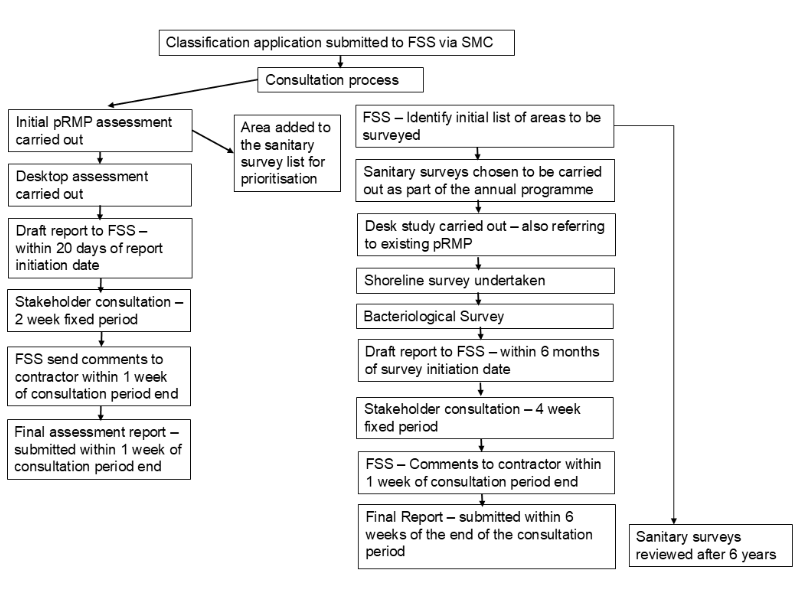
Here is a visual only chart of: 3.17 Figure 2. Flow diagram of the process for sanitary surveys
Please find more information provided in the detailed description and/or table below.
- Classification application submitted to FSS via SMC
- Consultation process
- Initial pRMP assessment carried out then Area added to the sanitary survey list for prioritisation
- Desktop assessment carried out
- Draft report to FSS – within 20 days of report initiation date
- Stakeholder consultation – 2 week fixed period
- FSS send comments to contractor within 1 week of consultation period end
- Final assessment report – submitted within 1 week of consultation period end
Alongside this the following steps also take place:
- FSS – Identify initial list of areas to be surveyed
- Sanitary surveys chosen to be carried out as part of the annual programme
- Desk study carried out – also referring to existing pRMP
- Shoreline survey undertaken
- Bacteriological Survey
- Draft report to FSS – within 6 months of survey initiation date
- Stakeholder consultation – 4 week fixed period
- FSS – Comments to contractor within 1 week of consultation period end
- Final report – submitted within 6 weeks of the end of the consultation period
- Sanitary surveys are reviewed after 6 years