
2. Attaining classification
2.1 For the production area to be considered for classification, an application form must be completed by the applicant and submitted to FSS via the Shellfish Monitoring and Classification (SMC) system.
Please note that you will have to register on the system to be able to access and submit an application.
2.2 SMC only provides the ability to apply for provisional and standard classifications at the initial application stage. If you wish to enquire about part-year classification, please contact shellfish@fss.scot to highlight this request as part of your application process.
2.3 For any other enquires regarding the application process, please contact shellfish@fss.scot.
2.4 On receipt of an application, all relevant stakeholders will be consulted automatically via SMC to verify that the classification application can be processed and progressed. If successful, a pRMP assessment will then be requested and undertaken, if required. If unsuccessful, FSS will liaise with the applicant to discuss options.
2.5 Applications for initial classification should align with the harvester’s plans for the area. (See section 5) For provisional classification, an application should only be submitted when there is stock within the production area for commercial harvesting and the harvester requires the quickest method of accessing the area. For standard classification, an application should be submitted where stock is present within the production area and available for sampling, and a plan is in place for forthcoming active harvesting, in the longer term.
2.6 Important note - Harvesters involved in commercial razor fishing must ensure that their vessel is licenced by Marine Directorate (MD), as part of the on-going razor electrofishing trial. Therefore, applications for classification of razor production areas should only be submitted by those carrying an appropriate licence. Read more information on razor licencing.
2.7 FSS has no enforcement ambit in this area. However, we will not proceed with any razor classification application without evidence of the applicant being part of the MD electrofishing trial and in possession of a razor licence. Whilst the trial is ongoing, FSS will continue to share weekly razor sampling plans, as well as new classification applications to MD and LAs as a matter of course.
2.8 When each application progresses past consultation stage, FSS will allocate the new area with a unique Site Identification Number (SIN). The SIN consists of 2 letters (LA ID), 4 numbers (production area ID), 4 numbers (site ID) and 2 numbers (species code ID). This specific SIN must accompany all classification samples annotated on all future sample submission forms. The SIN should also be referenced in any correspondence relating to the area, as SINs are allocated in order to identify and manage the classified areas effectively.
2.9 Classification awards are species specific and harvesting areas can encompass several sites of the same species. Therefore, for classification purposes, multiple species applications within a single production area will be treated as separate classification areas. Applicants should ensure that samples of each species are submitted for analysis from the nominated E. coli RMP. If there are any issues obtaining samples from the RMP, please contact FSS.
2.10 It must also be noted that a SIN is representative of a LA, production area, site and species, rather than an individual harvester. An individual harvester may harvest in more than one production area or LA, and a production area may also change ownership, or be subject to itinerant gathering. When a change of ownership of a production area occurs, the harvester and/or LA should notify FSS via shellfish@fss.scot as soon as possible, stating updated details.
2.11 Samples should not be submitted until a SIN has been created, a RMP has been determined, and a sampling plan has been issued by FSS. The pRMP/sanitary survey process (see section 3) will determine the RMP, area boundaries and the sampling plan itself. Once these steps have been undertaken, FSS will alert the harvester and sampling towards classification may commence.
Figure 1: Flow diagram detailing the procedures for classifying new and existing production areas
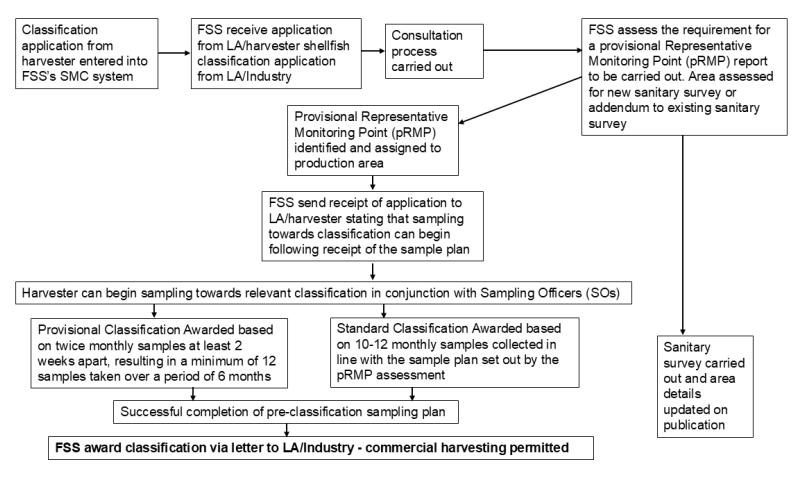
Here is a visual only chart of: Flowchart detailing the steps involved in classifying new and existing production areas
Please find more information provided in the detailed description and/or table below.
- Classification application from harvester entered into FSS’ s SMC system
- FSS receive application from LA/harvester shellfish classification application from LA/Industry
- Consultation process carried out
- FSS assess the requirement for a provisional Representative Monitoring Point (pRMP) report to be carried out. Area assessed for new sanitary survey or addendum to existing sanitary survey
- Provisional Representative Monitoring Point (pRMP) identified and assigned to production area
- FSS send receipt of application to LA/harvester stating that sampling towards classification can begin following receipt of the sample plan
- Harvester can begin sampling towards relevant classification in conjunction with Sampling Officers (SOs) towards either provisional or standard classification
- Provisional Classification Awarded based on twice monthly samples at least 2 weeks apart, resulting in a minimum of 12 samples taken over a period of 6 months
- Standard Classification Awarded based on 10-12 monthly samples collected in line with the sample plan set out by the pRMP assessment or Successful completion of pre-classification sampling plan
- FSS award classification via letter to LA/Industry - commercial harvesting permitted
- Sanitary survey carried out and area details updated on publication