
• Employees are a recognised source of Listeria monocytogenes introduction and spread in smoked-fish processing.
• Job rotation between raw and post-process areas increases transfer risk.
• Contamination can be carried on gloves, aprons and hands, especially towards the end of a shift.
• Frequent glove changing and effective handwashing with soap followed by alcohol sanitiser can reduce risk.
Employees and Hand Hygiene
In summary:
How employees spread L. monocytogenes
Staff activity is a major determinant of cross-contamination risk in smoked-fish plants. Listeria can be introduced on workers’ hands and equipment, transferred between processing zones, and amplified across a shift if control measures are not in place.
Analysis comparing hygiene practices, facility condition and management routines found that job rotation was the strongest factor associated with L. monocytogenes detection in finished product1. The study did not specify whether rotation occurred within or between shifts, but movement between raw and post-process workstations provides a clear opportunity for transfer on gloves, aprons or tools. Restricting staff movement or enforcing PPE change between zones is therefore a key risk-reduction measure.
Two studies confirmed that contamination on gloves and aprons can spread L. monocytogenes when PPE is not replaced or properly cleaned2,3. A modelling study supported this mechanism, showing that when incoming fish carried L. monocytogenes, contamination on employees’ gloves accumulated as the shift progressed. A simple intervention, such as changing gloves halfway through a shift, substantially reduced transfer to previously negative batches4.
Hand carriage studies reinforce this risk pathway. Kerr et al. found Listeria species on 12 percent of food-worker hands and L. monocytogenes on 7 percent, whereas none of the clerical controls tested positive5. The paper does not report when in the work period samples were taken or which industries were highest risk, but it demonstrates that food handling increases the likelihood of acquiring Listeria.
Why hand hygiene matters
When contamination levels were low, washing with soap effectively removed Listeria. At higher loads, washing alone was inadequate, and poor technique sometimes introduced contamination to previously clean hands5. The most reliable control was washing with warm soapy water followed by alcohol sanitiser, which reduced recoverable microorganisms to minimal levels(6).
Together, these findings show that staff can introduce, amplify and spread L. monocytogenes during processing. Frequent handwashing, scheduled glove changes, and strict zoning or PPE-change procedures are therefore critical to preventing contamination of smoked-fish products.
The importance of effective handwashing in controlling cross-contamination
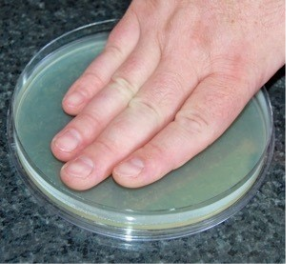
If the fingers of an unwashed human hand are pressed into a non-selective agar plate (a medium that supports the growth of many microorganisms) and incubated at 25 °C for 48 hours, the results are striking.
Figure 1: A hand pressed into an agar plate
Here is a visual only chart of: Figure 1: A hand pressed into an agar plate
The fingers of an unwashed hand are pressed onto an agar plate.
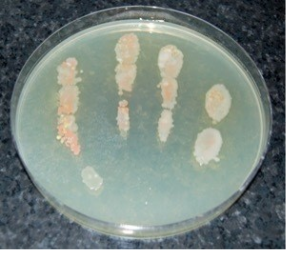
Typically, results similar to Figure 2 are observed. Unwashed human hands harbour a wide range of microorganisms, some of which may be human pathogens capable of causing foodborne illness. To minimise the risk of food contamination, food handlers must wash their hands as often as possible.
Figure 2: Microorganisms on the fingers of an unwashed hand
Here is a visual only chart of: Figure 2: Microorganisms on the fingers of an unwashed hand
If only warm water is used, there is usually little or no reduction in the number of microorganisms on the skin (Figure 3). Washing with plain water is therefore not an effective way to control microorganisms on hands in food processing environments.
Figure 3: Microorganisms on the fingers of a hand washed in only warm tap water
Here is a visual only chart of: Figure 3: Microorganisms on the fingers of a hand washed in only warm tap water
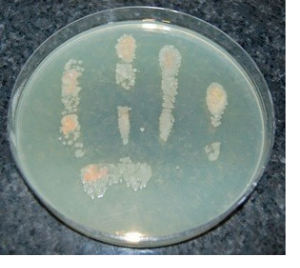
Using liquid soap with warm water produces a much greater reduction in microorganisms compared with an unwashed hand (Figure 4). Soap acts as a detergent: it removes oils from the skin surface where microorganisms tend to live. In addition, soap can dissolve the membranes that form the outer layer of some bacteria, directly killing them.
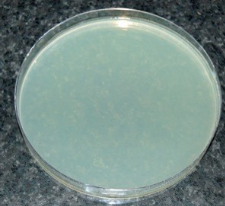
In Figure 4, the white bacterial colonies have decreased compared with Figures 1–3, showing that soap has reduced their viability. The reddish-coloured microorganisms, however, appear largely unaffected. When an alcohol gel is applied after washing with warm soapy water, very few microorganisms can be recovered from the skin surface (Figure 5)⁶.
Figure 5: Few microorganisms on the fingers of a hand washed in hot soapy water and sanitised using an alcohol gel
Here is a visual only chart of: Figure 5: Few microorganisms on the fingers of a hand washed in hot soapy water and sanitised using an alcohol gel
Together, proper and frequent washing with warm soapy water followed by alcohol gel sanitisation provides effective control of contamination from workers’ hands to food.
References:
- Rørvik, L.M., Skjerve, E., Knudsen, B.R. and Yndestad, M. (1997) Risk factors for contamination of smoked salmon with Listeria monocytogenes during processing. Int. J. Food Microbiol. 37:215-219.
- Autio, T., Hielm, S., Miettinen, M., Sjoberg, A.M., Aarnisalo, K., Bjorkroth, J., Mattila-Sandholm, T. and Korkeala, H. (1999) Sources of Listeria monocytogenes contamination in a cold-smoked rainbow trout processing plant detected by pulsed-field gel electrophoresis typing. Appl. Env. Microbiol. 65:150-155.
- Dauphin, G., Ragimbeau, C. and Malle, P. (2001) Use of PFGE typing for tracing contamination with Listeria monocytogenes in three cold-smoked salmon processing plants. Int. J. Food Microbiol. 64:51-61.
- Ivanek, R., Grohn, Y.T., Wiedmann, M. and Wells, M.T. (2004) Mathematical model of Listeria monocytogenes cross-contamination in a fish processing plant. J. Food Prot. 67:2688-2697.
- Kerr, K.G,; Birkenhead, D., Seale, K., Major, J. and Hawkey, P. M. (1993) Prevalence of Listeria spp. on the hands of food workers. J. Food Prot. 56:525-527.
- Monaghan, J. M. and Hutchison, M. L. 2016. Ineffective hand washing and the contamination of carrots after using a field latrine. Lett. Appl. Microbiol. 62:299–303.