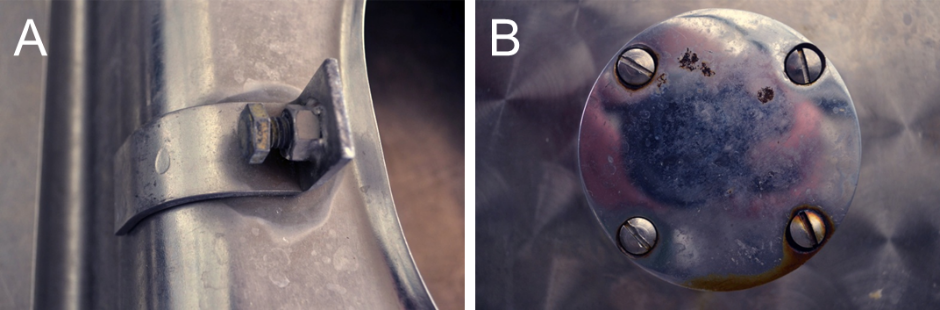
- Heat treatment is an effective method for controlling L. monocytogenes on surfaces and within equipment niches, particularly in older or complex machinery that is difficult to disassemble.
- Small components can be submerged in a hot (>80 °C) water bath containing detergent, while larger, water-sensitive equipment can be treated in an oven.
- For equipment too large for an oven, covering with a tarpaulin and applying steam (after removing or protecting electrical components) can achieve effective decontamination.
- Where heat is impractical, alternative physical treatments such as ozone or UV-C may be considered, though their effectiveness should be validated for each surface type.
- Chemical sanitation remains useful, but heat is often the most reliable option for eradicating persistent L. monocytogenes from equipment niches.
Decontamination of Equipment Using Heat
In summary:
Background
Information on the decontamination of processing equipment using heat derives largely from Tompkin and the validated modelling study of Chmieliwski and Frank1,2. Both sources confirm that while cleaning and sanitising with specialist chemicals is often sufficient, older equipment or poorly designed machinery can contain niches inaccessible to sanitisers, allowing L. monocytogenes to persist.
Such niches commonly occur in:
- Hollow or ball-bearing rollers on conveyor belts,
- Equipment support rods and metal-to-metal joints (Figure 1A),
- Worn or cracked rubber door seals, particularly in humid chillers,
- Control panels, handles, and other frequently touched fixtures,
- Persistently wet areas or corroded fittings (Figure 1B).
These locations are poorly penetrated by liquid sanitisers, and organisms can survive despite repeated chemical cleaning.
Application of Heat Treatments
When chemical treatments prove ineffective, Tompkin recommended either replacing contaminated components or applying equipment-specific heat treatments(1).
- Small equipment: Submersion in a hot water bath (>80 °C) with detergent was found to be reliably effective.
- Medium-sized or water-sensitive equipment: Movement into a product-baking oven can provide the necessary thermal exposure without immersion.
- Large industrial equipment: Where oven treatment is impractical, Tompkin advised removing or shielding electronics, covering the unit with a heat-resistant tarpaulin, and applying steam from below1. Low-cost domestic steamers (e.g. wallpaper removers) were reported as performing exceptionally well for this purpose. A target temperature of 71 °C for at least 20 minutes was recommended to achieve effective decontamination.
Evidence for Efficacy
Chmielewski and Frank combined experimental testing with predictive modelling to quantify L. monocytogenes inactivation under heat treatment2. Their model, validated against laboratory observations, predicted that exposure to 80 °C for 11.7 minutes achieved a 75% probability of total inactivation of L. monocytogenes in a five-strain biofilm.
This finding aligns closely with Tompkin’s earlier recommendations, reinforcing the view that controlled heat application is a robust and validated method for eliminating persistent L. monocytogenes contamination(1).
Figure 1: Examples of niches with the potential to contain plant-resident strains of L. monocytogenes. A) Metal-to-metal joints; B) Wet and corroded collar and screws.