
4. How relevant is FSS guidance?
This chapter addresses how food businesses and food law professionals use guidance to support compliance with food law among food businesses. It sets out how guidance is used on a day-to-day basis by food businesses to help them comply with food law requirements, as well as how food law professionals use guidance. It then considers how food businesses and food law professionals currently use FSS guidance and their perceptions of how it positively impacts their work.
Key findings:
- ‘Guidance’ often translates as the range of practical tools that food businesses use to create and follow daily or regular routines, covering temperature checks, cleaning schedules and allergen matrices.
- The extent to which businesses seek to stay up to date with changes in food safety and standards varied considerably. For several long-standing businesses, there is a sense that change over time has been limited, meaning they are not actively seeking guidance.
- Conversely, other businesses recognised the need to meet more detailed requirements around labelling, supplier traceability and in particular allergen management. Often, however, they find out about changes organically or reactively, rather than proactively.
- Food businesses familiar with FSS guidance feel it is relevant, comprehensive and easy to understand, with food law professionals generally considering it to be high quality and trusted by food businesses.
- Aspects of FSS guidance that were rated highly included free training resources, flexibility that allowed for tailoring, practical resources such as recording logs, and that it reflects the Scottish context.
- CookSafe and allergens guidance were most frequently used by food businesses, with the ability to refer to CookSafe and its templates playing a crucial role in embedding and maintaining food safety and standards in food businesses.
- Food law professionals recommend or discuss FSS guidance at most interactions with food businesses, particularly CookSafe, RetailSafe, ButcherSafe, and allergen, labelling and E. coli guidance.
4.1 Routine use of guidance for day-to-day compliance
At the start of the interviews, food businesses were asked about the challenges or risks their business faces when complying with food law requirements. Food businesses highlighted multiple factors they continuously address to maintain standards and described how they use guidance in overcoming any challenges they face when doing so.
For most food businesses, guidance means the range of practical tools they use to ensure day-to-day compliance with food safety and hygiene within their business. Guidance is used to help staff create and follow daily or regular routines, covering daily temperature checks, cleaning schedules and allergen matrices. Food businesses know it is essential to demonstrate compliance with these requirements if they want to continue to pass their inspections.
“My ring binder - everything kitchen-wise goes in it. The house rules get reviewed every year. Every year, I go back through the whole thing and read the house rules and whatever I've written in and maybe, say, if I ever need a new fridge freezer, for instance, I need to go back in and write that I've bought a new fridge freezer, why I bought a new fridge freezer, and date it. We've got the kitchen remodelled. I had to go back and change everything in the house rules for the kitchen layout. Anything that happens in the kitchen gets put in that book.
“
Food businesses typically use a range of resources, but often refer to specific templates for daily or weekly logs. These were often templates from CookSafe, but several food businesses did not refer to it as CookSafe without prompting, or were unaware that it is FSS guidance.
“My husband's got a restaurant in Dundee, and he has experience setting up a new kitchen on a few occasions, so I did ask him quite a lot. He had a big sort of chunky ring binder from the Food Standards Agency or Food Standards Scotland, something called Food Safe, I think it was called. It had loads of sections and information in it, and I think we pulled things from there. I think that's maybe where we got the all-in-one sheets.
“
Food businesses described in detail the types of processes they follow. Temperature control is a core area where they seek out and rely on guidance. Businesses described using information on safe cooking temperatures, cooling and reheating rules, and hot holding requirements for equipment such as bain-maries as part of their daily compliance routines. Fridge and freezer monitoring was widely mentioned.
Hygiene standards and cross-contamination controls were also noted as areas where guidance is regularly used. This included information on handwashing procedures, sink placement, hot water requirements, and colour-coded chopping boards and fridge segregation to prevent contamination. Kitchen layout guidance was noted as another area of interest, particularly for reducing contamination risks and meeting inspection requirements. Several businesses relied on HACCP frameworks and CookSafe for step-by-step guidance on how to ensure compliance.
“The CookSafe manual is really our sort of Bible of how to safely produce food for consumption by the public.
“
When asked what topics, issues or information about food safety and standards that businesses most need guidance on, food law professionals cited labelling requirements, allergen management, and developing HACCP procedures and their ‘house rules’ in CookSafe. They also raised general food law compliance, safe food handling, hygiene, temperature control, storage, as well as advice on record keeping and maintenance.
Many of the issues which trigger food businesses to refer to guidance were also raised by food law professionals. They detailed various issues commonly faced during inspections, such as food businesses not having food safety management systems in place, cleanliness concerns, complex labelling requirements, a lack of cross-contamination records, and shellfish compliance challenges.
More broadly, guidance relating to environmental health topics were sought or needed by food businesses. Topics included seasonal pest management, waste disposal standards and equipment safety and infrastructure standards.
Given this demand, survey results also show that food law professionals use guidance on food safety and standards to provide a range of support to food businesses. Almost all (97%) indicated they use guidance to advise businesses or to support enforcement action, while 93% use guidance during inspections and 90% use it for internal training or CPD.
4.2 Guidance about changes to legislation and standards
For several long-standing businesses, there is a sense that there have been limited changes in compliance requirements over time. This means they are not actively looking for updates to legislation or other regulations which may affect their business. While they often hear about changes organically, there is no consistent way in which food businesses find out about changes. Conversely, others reflected on how food safety needs have changed over time, noting a shift from basic hygiene and temperature standards to more detailed requirements around allergens, labelling, and supplier traceability.
As with guidance overall, food law professionals play a central role in keeping businesses updated, though a small group of businesses had used the FSS website or local authority website. Businesses described being told about changes during inspections or after an issue arises, although a small number described being proactively notified to changes by food law professionals or by FSS.
Allergen management and labelling were described as increasingly complex and constantly evolving, but essential to compliance. Dedicated support and guidance in this area is seen as increasingly necessary; businesses noted they require robust systems and clear guidance to avoid any harm to customers and/or legal action.
Businesses reflected on the changing nature and rising customer demands related to allergens, with some noting that the increasing scale of allergen management causes them concerns. These concerns were evident across many business types, notably smaller food businesses where owners or managers felt responsible for ensuring they were applying guidance correctly or could risk reputational damage.
Earlier practices relied on customers asking about allergens, whereas current legislation requires full disclosure. The need to provide detailed ingredient information, including for compound ingredients such as sauces, to comply with labelling regulations, was stressed. Natasha’s Law was frequently mentioned as a driver of change in this area, requiring clear allergen disclosure on prepacked foods.
“Before, you didn't have to label everything, down to the granular detail. Any mayonnaise that's put on, you have to then refer back to the manufacturer's ingredients as well… So that's a challenge. But before that… if somebody did have an allergy, they would ask. Now you have to be very clear about things.
“
Food businesses also recognised shifts in consumer habits, with food businesses needing to remain vigilant to the increased scope of legislation and regulations. One business reflected on an experience related to a customer suffering an allergic reaction in their premises:
“Allergies are quite a big one. I'm finding in food, especially over the past 10 years, everyone's gluten-free, dairy-free, lactose intolerant. Before it was never a thing, and now I think in the food industry it's such a big thing that you have to be careful.
“
Survey results indicate that most (87%) food law professionals find out about new or updated guidance from FSS through email alerts/newsletters from FSS, followed by 60% through colleagues/peer networks, 43% internal LA briefings.
4.3 Use and impact of FSS guidance
While there was a variable awareness of FSS and limited use of FSS guidance beyond CookSafe, the businesses familiar with FSS guidance typically described the range of resources they had used as comprehensive and easy to understand.
Food businesses highlighted the crucial role CookSafe has in maintaining food safety and standards in their establishments. CookSafe was highlighted as the key piece of food safety guidance they use, with multiple businesses describing CookSafe as their ‘bible’ that underpins their approach to food safety and noting how often they use it and refer to it to structure daily checks, record keeping, and ensure compliance. CookSafe was mentioned by many businesses regardless of their awareness of FSS, though some attributed CookSafe to local authorities or the FSA.
“[CookSafe is] our guidance to basically make sure that the kitchen is providing safe food and that it's doing everything it should be, filling in the forms it should be, like checks are taking place that should be taking place
“
Businesses highlighted the universality and flexibility of CookSafe as valuable. One noted that because food businesses across Scotland use the standard manual, this keeps food hygiene information the same for everyone and is easy for their staff, new hires and food law professionals to reference. Others appreciated being able to customise their CookSafe manual for their business. One business noted that it can add updated information to its manual to ensure it remains accurate.
“It is my bible, if I'm doing everything that I need to do as a business to the CookSafe, then I know that there's no reason why I shouldn't be at peace with my local council environmental health. If I know I'm doing everything from what they say, then I know I'm being compliant
“
When asked what they liked about CookSafe, food law professionals also reiterated its importance and commented that they liked its clarity, structured food safety management system, simple format, ease of use, and understandability. They also appreciated its practical tools such as templates, wide use and recognition, availability in multiple languages, and that it is free.
Beyond CookSafe, allergen guidance was also often noted as being used by businesses, with a few reporting using FSS training on allergen information. In these discussions, the important role of food law professionals in directing their attention to the changes and new guidance was often highlighted by food businesses.
A few businesses used FSS posters in their kitchens to remind staff of allergen information, and these posters were praised by one interviewee for their clear graphics and good visuals. The allergen information available on the FSS website was also described as helpful.
“I only really used the allergen one, but to the point I used it once, and then I continually now go back, and I use it, and it's actually become a standard - that's the one that we use because it was really good.
“
The online allergen training module on the FSS website was mentioned by a few businesses and praised for being clear, practical and flexible. Businesses found that their staff were able to complete the modules around their availability. Managers and owners appreciated that the training was free. Food law professionals also commented positively on the online allergen training. They emphasised the value of it being free, accessible through being online, and described it as helpful, comprehensive, and easy for food businesses to use and understand.
After CookSafe and allergen guidance, the most used was guidance on labelling. Businesses highlighted their awareness of the importance of accurate labelling to ensure the safety of their customers. A small number of businesses used the Eat Well Guide. One catering business used the Eat Well Guide for the community, creating a cookbook and using posters from FSS as a conversation starter about good health in community settings. Two interviewees noted they frequently referred to FSS’ cleaning products guidance.
Specialist guidance was used by a small number of food businesses. These businesses noted their awareness of specialist or technical guidance, but felt it was outside their job scope to deal with it regularly. For example, one fish restaurant manager was aware that the head chef used FSS shellfish guidance but had not used it personally. Another fish business was aware of the guidance around caught fish, but felt it was irrelevant to them as they bought and sold their fish daily rather than storing any of it. However, a few did refer to using guidance to prepare shellfish safely.
The online survey and subsequent conversations with food law professionals highlighted regular use of FSS guidance to support food businesses.
When asked how often they recommend or discuss FSS guidance with a food business, 17% of food law professionals indicated they do this at every interaction with a food business, 53% at most interactions, and 30% sometimes / as required.
Food law professionals were presented with a comprehensive list of FSS guidance and asked which they had ever recommended or discussed with food businesses. A full list presenting the usage of each guidance is in the results of the online survey questions in Annexe 1, which is provided separately. Guidance which had been recommended or discussed by at least three quarters of food law professionals included:
- CookSafe (100%)
- RetailSafe (97%)
- Online allergy training (97%)
- E.coli O157 Control of Cross Contamination Guidance (93%)
- Guidance on labelling of food sold prepacked for direct sale (93%)
- Allergy Poster (87%)
- ButcherSafe (83%)
- Food allergen labelling and information requirements Technical Guidance (77%)
- Approved Establishments – Scottish National protocol (77%)
- and Vacuum and modified atmosphere packed chilled foods guidance (77%)
A few food law professionals answering the survey highlighted that it was useful to see the full list of FSS-produced guidance that was presented in the survey, and asked for it to be emailed to them (see Q20 in online survey results in Annexe 1).
Food law professionals also expressed broadly positive views on FSS guidance. When asked how they would rate the overall quality of FSS guidance, 3% rated it as excellent, 37% very good, 47% good, 7% (two respondents) rated it as fair, 3% (one respondent) poor, and 3% unsure.
They also commented that they felt food businesses' trust in FSS guidance was high, though they recognised that this was in part because it usually comes directly from food law professionals.
Food law professionals were also asked how much they agreed or disagreed with a series of statements about FSS guidance. The results are shown in Figure 1 and highlight that FSS guidance plays an essential role in supporting the work of food law professionals, with 80% agreeing to some extent that it supports enforcement and compliance activities and 77% agreeing that it helps them to advise food businesses effectively. In terms of format, FSS guidance is seen as relevant (74%) and clearly written and easy to understand (63%)
Figure 1: Q38. Here are some ways other people have described FSS guidance. To what extent do you agree that FSS guidance [is]…?
Base: All food law professional survey respondents (n=30)
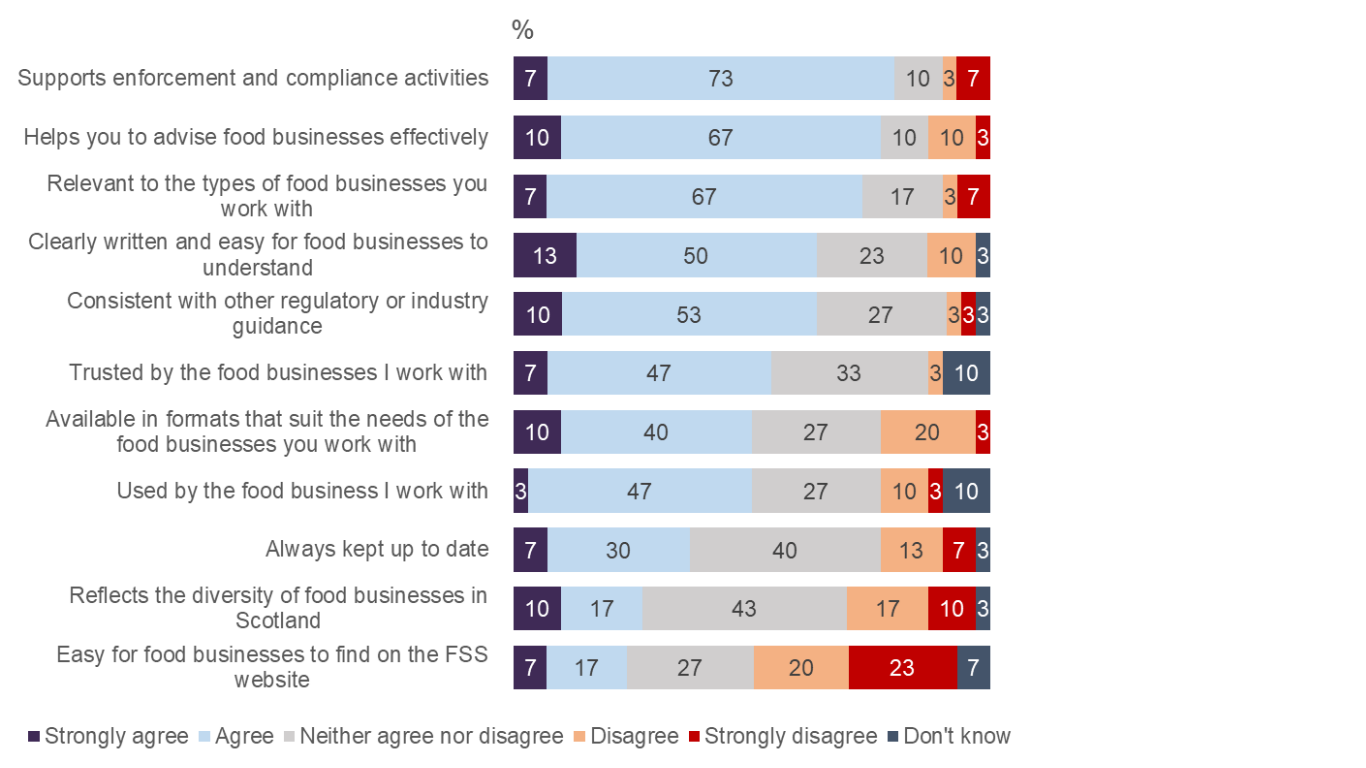
Here is a visual only chart of: Figure 1: Results of online survey question asked of food law professionals: Here are some ways other people have described FSS guidance. To what extent do you agree that FSS guidance [is]…? The figure shows that 80% agree that FSS guidance supports enforcement and compliance activities, 77% agree it helps them to advise food businesses effectively and 74% agree it is relevant to the types of food businesses they work with. At the other end of the scale, 37% agree it FSS guidance is always kept up to date, 27% agree it reflects the diversity of food businesses in Scotland and 24% agree it is easy for food businesses to find on the FSS website.
Please find more information provided in the detailed description and/or table below.
Figure 1: Results of online survey question asked of food law professionals:
Here are some ways other people have described FSS guidance. To what extent do you agree that FSS guidance [is]…?
The figure shows that 80% agree that FSS guidance supports enforcement and compliance activities, 77% agree it helps them to advise food businesses effectively and 74% agree it is relevant to the types of food businesses they work with.
At the other end of the scale, 37% agree it FSS guidance is always kept up to date, 27% agree it reflects the diversity of food businesses in Scotland and 24% agree it is easy for food businesses to find on the FSS website.
Survey comments and subsequent conversations with food law professionals also highlighted many positives of FSS guidance. In addition to the above positives, they also felt it was helpful that FSS guidance reflects the Scottish context. One noted that they felt FSS is trying to make their guidance more user-friendly. It was also noted that FSS guidance is expanded or changes over time to reflect changes in legislation and regulations, for example, labelling guidance on prepacked for direct sale food.
“It is free and tends to be written in a way that we can understand, it is easy to use whilst seated at a desk, and it is easy for us to find online and provide a link to the relevant document in our reports/emails for [food businesses], so it is easy for them to find.
“
A few stakeholders also expressed positive views on FSS’s existing guidance and the ease of finding the guidance on the FSS website.
“The tools that are there, the guidance that's provided on the Food Standards Scotland website is significantly more user-friendly than we would have found on the English counterpart website. And that could be that it's a model that's been adopted from industry. But it is easy to use. It is very easy to signpost to people. They can find it very, very quickly… I'm on the site now, and if I go into business guidance and then it goes into industry-specific guidance, I can go straight into farming, and it's there. So, I am three clicks away from finding me.
“
“There's free allergen training on the FSS website, which is great, you know, because, again, just being able to say anything is free and having that, and they get a certificate, and we've seen it. We know what content that is. That's really good. If FSS could do more of that, it would be brilliant.
“