
Chapter 4. Frequency of out of home consumption
4.1 Overall
‘Supermarkets/ convenience stores/ corner shops’ were the most frequently used OOH outlets, with 40% of respondents sourcing food “on the go” from these outlets 2-3 times in the past week and 23% reporting consumption once in the past week (Table 4). This was followed by ‘Cafés or coffee shops’ which 25% of respondentsreported using 2-3 times per week and 36% reported using once per week.
42% and 40% of respondents reported visiting ‘Quick-service restaurant/ takeaways’ and ‘Bakeries or sandwich shops’ in the last week respectively. While more than a third of respondents did not purchase from these outlet types in the past week (35% for ‘Quick-service restaurants/ takeaways’ and 42% for ‘Bakeries or sandwich shops’).
More than half of respondents reported not sourcing food from ‘Full-service restaurants’ (54%), ‘Petrol stations, cinemas or workplace canteen’ (67%), ‘Pubs or bars’ (69%), or ‘Vending machines’ (87%) in the past week and most of those who did access food at these types of outlets did so only once in the past week.
Very few respondents (less than 4%) reported frequent consumption (five or more visits in the past week) of any particular outlet type, while only 22 participants (2%) reported not using any OOH source in the past week.
Table 4. Frequency of out of home consumption in the past week across different sources among adults 16+ years living in Scotland, 2025 (n=1,012).
| OOH Outlet | Value |
| Supermarkets/ convenience stores/ corner shops | |
| Did not purchase here this week | 22% (224) |
| 1 time | 23% (236) |
| 2-3 times | 40% (403) |
| 4-5 times | 11% (115) |
| 6-7 times | 2% (22) |
| More than 7 times | 1% (12) |
| Café or coffee shop | |
| Did not purchase here this week | 32% (319) |
| 1 time | 36% (367) |
| 2-3 times | 25% (258) |
| 4-5 times | 5% (55) |
| 6-7 times | 1% (8) |
| More than 7 times | 0% (5) |
| Quick service restaurants/ takeaways | |
| Did not purchase here this week | 35% (353) |
| 1 time | 42% (424) |
| 2-3 times | 20% (204) |
| 4-5 times | 3% (26) |
| 6-7 times | 0% (3) |
| More than 7 times | 0% (2) |
| Bakery or sandwich shop | |
| Did not purchase here this week | 42% (425) |
| 1 time | 40% (409) |
| 2-3 times | 15% (147) |
| 4-5 times | 2% (25) |
| 6-7 times | 1% (6) |
| More than 7 times | 0% (0) |
| Full-service restaurants | |
| Did not purchase here this week | 54% (544) |
| 1 time | 36% (367) |
| 2-3 times | 8% (86) |
| 4-5 times | 1% (13) |
| 6-7 times | 0% (1) |
| More than 7 times | 0% (1) |
| Petrol stations, cinemas or workplace canteen | |
| Did not purchase here this week | 67% (677) |
| 1 time | 22% (225) |
| 2-3 times | 10% (98) |
| 4-5 times | 1% (10) |
| 6-7 times | 0% (0) |
| More than 7 times | 0% (2) |
| Pub or bar | |
| Did not purchase here this week | 69% (697) |
| 1 time | 24% (246) |
| 2-3 times | 6% (59) |
| 4-5 times | 0% (5) |
| 6-7 times | 0% (3) |
| More than 7 times | 0% (2) |
| Vending machine | |
| Did not purchase here this week | 87% (885) |
| 1 time | 8% (78) |
| 2-3 times | 4% (41) |
| 4-5 times | 1% (7) |
| 6-7 times | 0% (1) |
| More than 7 times | 0% (0) |
| Values are percentage (n). | |
4.2. Defining low, moderate, and high out of home use
In order to classify participants as low, moderate, or high OOH consumers, we assigned a value (Table 5) for their frequency of using each of the following eight outlets in the past week:
- Food “on the go” from supermarkets/ convenience stores/ corner shops
- Cafés or coffee shops
- Quick-service restaurants/ takeaways
- Bakeries or sandwich shops
- Full-service restaurants
- Petrol stations, cinemas or workplace canteens
- Pubs or bars
- Vending machines
Table 5. Numerical value assigned to reported frequency of out of home consumption in the past week.
| Survey Response Frequency Level | Numerical Value |
|---|---|
| Did not purchase here this week | 0 |
| 1 time | 1 |
| 2-3 times | 2.5 |
| 4-5 times | 4.5 |
| 6-7 times | 6.5 |
| More than 7 times | 8 |
For example, if a participant visited each of the eight outlets once in the past week, their overall visits would sum to 8 total visits in one week. If a participant reported visiting a ‘Full-service restaurant’ in the past week ‘2-3 times’ and visiting ‘Pubs or bars’ ‘1 time’ and did not use any other outlets, their total OOH visits would sum to 3.5.
Figure 1 shows the distribution of the number of OOH visits in the past week among participants. The x-axis represents the number of visits per week, and the y-axis represents the frequency (number of participants) within each visit category. Overall, the mean (SD) number of OOH visits (any outlet type) in the past week was 7.1 (5.3) and the median was 6. Reported visits ranged from 0 to 46 times per week.
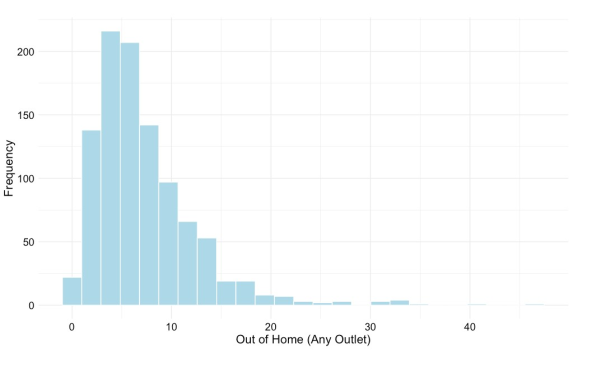
Here is a visual only chart of: Figure 1 shows the distribution of the number of OOH visits in the past week among participants. The x-axis represents the number of visits per week, and the y-axis represents the frequency (number of participants) within each visit category. Overall, the mean (SD) number of OOH visits (any outlet type) in the past week was 7.1 (5.3) and the median was 6. Reported visits ranged from 0 to 46 times per week.
Please find more information provided in the detailed description and/or table below.
Figure 1 shows the distribution of the number of OOH visits in the past week among participants. The x-axis represents the number of visits per week, and the y-axis represents the frequency (number of participants) within each visit category. Overall, the mean (SD) number of OOH visits (any outlet type) in the past week was 7.1 (5.3) and the median was 6. Reported visits ranged from 0 to 46 times per week.
We employed a data-driven definition of low, moderate, and high OOH consumption as there is no widely used or agreed definition of low, moderate, or high OOH consumption in the literature. Data were from the web questionnaire completed by participants prior to completing their dietary recalls. Participants were classified as ‘Low’ OOH consumers if they had visited any of these OOH sources four times or fewer in the last week (n=387). This included the 22 participants who reported not using any OOH source in the past week. Participants were classified as ‘Moderate’ consumers if they had visited more than four and up to seven times per week (n=318), and ‘High’ consumers if they had visited more than seven times per week (n=311).
For qualitative interviews (n=35), different cut-offs were used to maximise contrast between groups. We defined ‘High’ as consuming OOH food ten or more times in the past week. ‘Moderate’ was defined as consuming OOH food 5-9 times in the past week and ‘Low’ was defined as consuming OOH food fewer than five times in the past week.
4.3. Frequency of out of home use
‘Supermarkets/ convenience stores/ corner shops’ and ‘Cafés or coffee shops’ were the most commonly used outlets across all groups, while ‘Vending machines’ and ‘Full-service restaurants’ were the least used (Table 6). High OOH consumers reported frequent consumption (≥2 visits in the past week) across most outlet types, particularly ‘Supermarkets/ convenience stores/ corner shops’ (84%), ‘Cafés or coffee shops’ (60%), ‘Quick-service restaurants/ takeaways’ (47%), and ‘Bakeries or sandwich shops’ (42%). Moderate OOH consumers showed frequent consumption (≥2 visits in the past week) at ‘Supermarkets/ convenience stores/ corner shops’ (62%). In contrast, a majority of low OOH consumers reported no purchases across all outlet types, with 41% visiting a ‘Café or coffee shop’ once in the last week and 36% visiting ‘Supermarkets/ convenience stores/ corner shops’ and ‘Quick service restaurants/takeaways’ once in the last week.
Table 6. Frequency of out of home (OOH) outlet type used by high, moderate, and low OOH consumers among adults 16+ years living in Scotland, 2025 (n=1,012).
| OOH Outlet | Frequency of overall OOH consumption in the past week | ||
High (n=378) | Moderate (n=330) | Low (n=304) | |
| Supermarkets/ convenience stores/ corner shops | |||
| Did not purchase here this week | 5% (18) | 12% (41) | 54% (165) |
| 1 time | 11% (42) | 25% (84) | 36% (110) |
| 2 or more times | 84% (318) | 62% (205) | 10% (29) |
| Café or coffee shop | |||
| Did not purchase here this week | 13% (51) | 32% (106) | 53% (162) |
| 1 time | 27% (101) | 43% (141) | 41% (125) |
| 2 or more times | 60% (226) | 25% (83) | 6% (17) |
| Quick service restaurants/ takeaways | |||
| Did not purchase here this week | 14% (52) | 34% (111) | 63% (190) |
| 1 time | 39% (147) | 51% (169) | 36% (108) |
| 2 or more times | 47% (179) | 15% (50) | 2% (6) |
| Bakery or sandwich shop | |||
| Did not purchase here this week | 16% (62) | 42% (139) | 73% (224) |
| 1 time | 42% (157) | 52% (172) | 26% (80) |
| 2 or more times | 42% (159) | 6% (19) | 0% (0) |
| Full-service restaurants | |||
| Did not purchase here this week | 30% (114) | 58% (190) | 79% (240) |
| 1 time | 48% (183) | 37% (122) | 20% (62) |
| 2 or more times | 21% (81) | 5% (18) | 1% (2) |
| Petrol stations, cinemas or workplace canteen | |||
| Did not purchase here this week | 41% (153) | 77% (253) | 89% (271) |
| 1 time | 34% (128) | 20% (66) | 10% (31) |
| 2 or more times | 26% (97) | 3% (11) | 1% (2) |
| Pub or bar | |||
| Did not purchase here this week | 49% (185) | 76% (252) | 86% (260) |
| 1 time | 37% (138) | 21% (68) | 13% (40) |
| 2 or more times | 15% (55) | 3% (10) | 1% (4) |
| Vending machine | |||
| Did not purchase here this week | 74% (278) | 95% (313) | 97% (294) |
| 1 time | 15% (55) | 4% (14) | 3% (9) |
| 2 or more times | 12% (45) | 1% (3) | 0% (1) |
Values are percentage (n).
4.4. Comparison to the Scottish Health Survey 2024
To better inform interpretation of findings from this sample as compared to a nationally representative sample, we compared the frequency of OOH consumption based on 24-hour dietary recall data collected using Intake24 in our sample and the Scottish Health Survey (SHeS) 2024. Results are not directly comparable because SHeS only collected 2 dietary recalls whereas this survey collected 3, and therefore had greater opportunity to ‘pick up’ an OOH consumption occasion.
Of the 2,200 SHeS 2024 participants who completed at least one dietary recall using Intake24, 82% (n=1,796) completed 2 and were included in this comparison. If one assumes that had SHeS 2024 collected an additional day of dietary recall, thus capturing more OOH consumers, results of the comparison suggest that the OOH survey sample presented in this report is not necessarily a higher OOH consuming sample than the general adult population living in Scotland (Table 7). The OOH survey sample presented in this report had 26% with no OOH consumption across 3 days of recall versus 34% of the SHeS 2024 sample having no OOH consumption across 2 days of recall.
Table 7. Frequency of out of home (OOH) consumption among adults 16+ years living in Scotland based on 24-hour dietary recalls in the Scottish Health Survey (SHeS) 2024 and a national survey of OOH consumption conducted in 2025.
| Number of days OOH consumed | SHeS 2024* (n=1,796) | OOH 2025 (n=1,012) |
|---|---|---|
| 0 | 34% (622) | 26% (260) |
| 1 | 30% (497) | 32% (322) |
| 2 | 35% (677) | 26% (268) |
| 3 | N/A | 16% (162) |
Values are percentage (n).
* Values for SHeS take into account survey design (e.g., psu, strata and Intake24 sampling weights).
We also compared the classification of participants as low, moderate, or high OOH consumers based on Intake24 (e.g., 3 days of dietary recalls) to classification based on the 1-week food frequency questionnaire in the web questionnaire. Both approaches used data-driven tertiles to classify participants as low, moderate, or high OOH consumers. Results indicated that 45% of participants had perfect concordance (e.g., low OOH consumer based on both methods, moderate OOH consumer based on both, or high OOH consumer based on both). A further 42% had moderate concordance (e.g., low OOH consumer on one versus moderate on the other, or moderate OOH consumer on one versus high on the other). The remaining 13% had low concordance, meaning that they were classified as a low OOH consumer on one versus high on the other. Thus, the approach to classifying participants is generally consistent between the 1-week food frequency questionnaire and Intake24 dietary recalls.
4.5. Use of food delivery apps
Food delivery apps were used infrequently, with 66% reporting no use during the past week and 25% reporting a single order (Table 8). Among respondents who used an app for food delivery, the majority reported using apps for ready-to-eat food (78%), compared with 22% who used them for household shopping.
Table 8. Frequency of app use to order food in the past week among adults 16+ years living in Scotland, 2025 (n=1,012).
| App Use | Value | |
|---|---|---|
| An app such as Uber Eats, Deliveroo, Just Eat or other | ||
| Did not purchase here this week | 66% (663) | |
| 1 time | 25% (253) | |
| 2 or more times | 9% (96) | |
| App used for household shopping or ready-to-eat | ||
| Household shopping | 22% (76) | |
| Ready-to-eat | 78% (273) | |
| Values are percentage (n). | ||
Most participants did not use an app in the past week, however, among high OOH consumers, 18% reported purchasing food from apps two or more times in the past week (Table 9). Across all OOH frequency groups, apps were used primarily for ready-to-eat food rather than household shopping, accounting for around three-quarters or more of app use.
Table 9. Frequency of app use to order food by high, moderate, and low levels of out of home consumption among adults 16+ years living in Scotland, 2025 (n=1,012).
| App Use | Frequency of overall OOH consumption in the past week | |||
High (n=378) | Moderate (n=330) | Low (n=304) | ||
| An app such as Uber Eats, Deliveroo, Just Eat or other | ||||
| Did not purchase here this week | 49% (187) | 68% (225) | 83% (251) | |
| 1 time | 32% (121) | 25% (81) | 17% (51) | |
| 2 or more times | 19% (70) | 7% (24) | 1% (2) | |
| App used for household shopping or ready-to-eat | ||||
| Household shopping | 25% (48) | 21% (22) | 11% (6) | |
| Ready-to-eat | 75% (143) | 79% (83) | 89% (47) | |
Values are percentage (n).