
Maximising use of existing data
We will prioritise the use of existing datasets to ensure efficiency and avoid duplication. This includes drawing on datasets, such as the SHeS and NDNS data, linking with other relevant sources, and aligning with ongoing work by our partners, including SG and Public Health Scotland (PHS). Leveraging existing evidence and maximising the use of digital solutions will enable us to maintain quality and breadth while using resources effectively. Section 9 provides more detail on how we will work with others to deliver our strategy.
A focus on inequalities
A focus on inequalities will be embedded through all aspects of our work. Where possible and recognising that this is not always feasible due to data availability, all analyses will consider variations by socioeconomic position, sex, age, ethnic group and other relevant characteristics. This will support identifying where action is most needed and ensuring that recommendations support equity as well as overall population health.
Scope of the strategy
Dietary intake data will underpin dietary risk assessments, providing the primary evidence for understanding population diets and identifying areas of concern. This will be complemented, where possible, by wider evidence on biological status, the food environment and emerging issues. Figure 1 provides an overview of our overall approach, with more detail provided in Sections 8.1 – 8.4:
Figure 1: FSS approach to dietary risk assessment
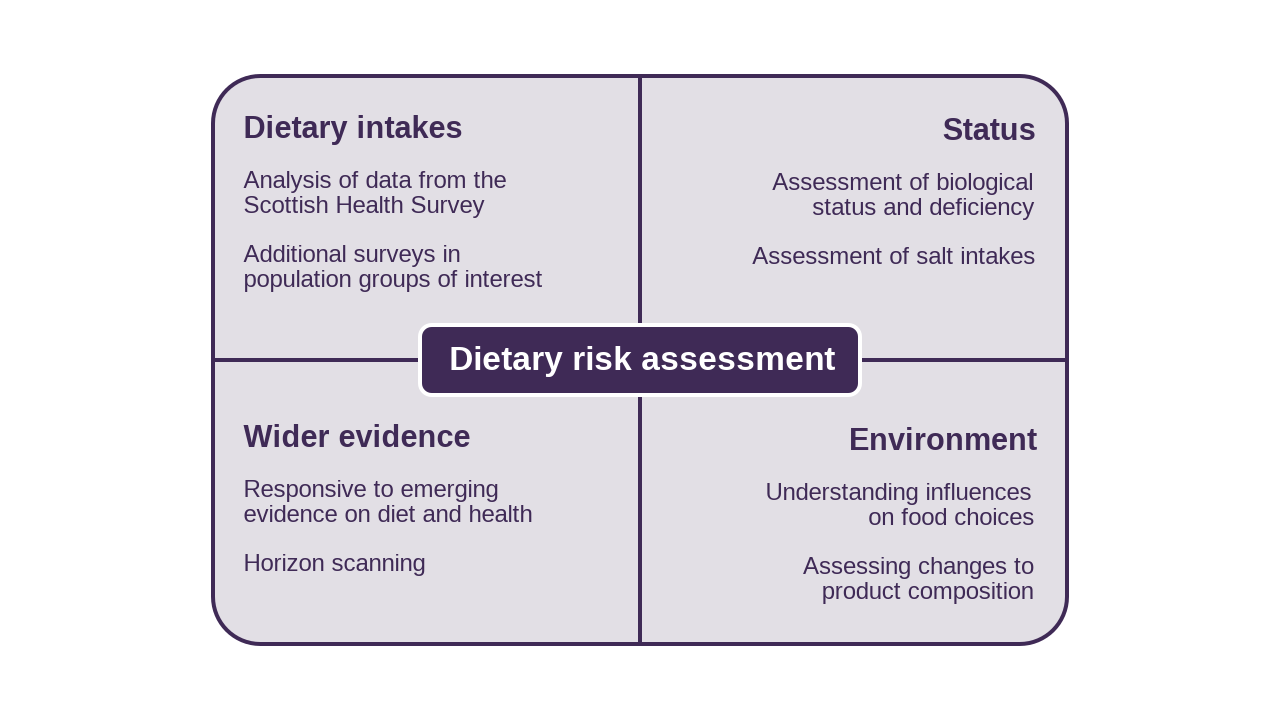
Here is a visual only chart of: Four-quadrant diagram presenting a Food Standards Scotland's approach to dietary risk assessment, with sections for Dietary intakes, Status, Wider evidence and Environment. Within the Dietary intake quadrant, Food Standards Scotland approaches are listed as Analysis of data from the Scottish Health Survey, and Additional surveys in population groups of interest. Within the Status quadrant, Food Standards Scotland approaches are listed as Assessment of biological status and deficiency, and Assessment of salt intakes. Within the Wider evidence quadrant, Food Standards Scotland approaches are listed as Responsive to emerging evidence on diet and health, and Horizon scanning. Within the Environment quadrant, Food Standards Scotland approaches are listed as Understanding influences on food choices, and Assessing changes to product composition.
Please find more information provided in the detailed description and/or table below.
Four-quadrant diagram presenting a Food Standards Scotland's approach to dietary risk assessment, with sections for Dietary intakes, Status, Wider evidence and Environment.
Within the Dietary intake quadrant, Food Standards Scotland approaches are listed as Analysis of data from the Scottish Health Survey, and Additional surveys in population groups of interest.
Within the Status quadrant, Food Standards Scotland approaches are listed as Assessment of biological status and deficiency, and Assessment of salt intakes.
Within the Wider evidence quadrant, Food Standards Scotland approaches are listed as Responsive to emerging evidence on diet and health, and Horizon scanning.
Within the Environment quadrant, Food Standards Scotland approaches are listed as Understanding influences on food choices, and Assessing changes to product composition.
Dietary intakes
Dietary intake data from the Scottish Health Survey (SHeS) will form the core of surveillance activity.
A structured reporting framework will deliver a clear, accessible, and comprehensive suite of outputs providing regular, high-level insights into progress against both food and nutrient based goals. This will build on existing SHeS reporting, enabling more detailed exploration of dietary intakes across population groups, including by socioeconomic factors such as SIMD and income, and identify key contributors to nutrients of concern. Where feasible, it will also explore opportunities to link dietary data with health outcomes collected through SHeS, such as BMI and diet-related conditions, ensuring a more holistic understanding of diet and health in Scotland.
Dietary intake data from SHeS are collected every three years. Reporting will be aligned to ensure outputs are timely and reflect the availability of new survey data.
In addition to the core reporting, we will undertake supplementary analyses to address aspects of the diet not fully captured within the Goals such as micronutrient intakes (and status where available, see section 8.2), or examinations of particular dietary patterns, and priority population groups. Topics will be agreed on an annual basis by the Public Health Nutrition Division, with input from SG, relevant stakeholders and partners such as PHS.
Dietary findings will be interpreted alongside relevant food environment data where appropriate (see section 8.3) such as purchasing patterns and progress towards reformulation.
Together, this approach provides a flexible, responsive, and comprehensive reporting structure capable of supporting policy development, evaluation, consumer and stakeholder messaging, public health nutrition action and wider prevention efforts in Scotland.
Findings will be actively communicated to policy makers, delivery partners and other key stakeholders through tailored outputs and engagement activities to support evidence-informed decision making.
Figure 2: Indicative reporting timeline
Figure 2 provides an indicative reporting timeline for dietary surveillance outputs across the Scottish Health Survey cycle.
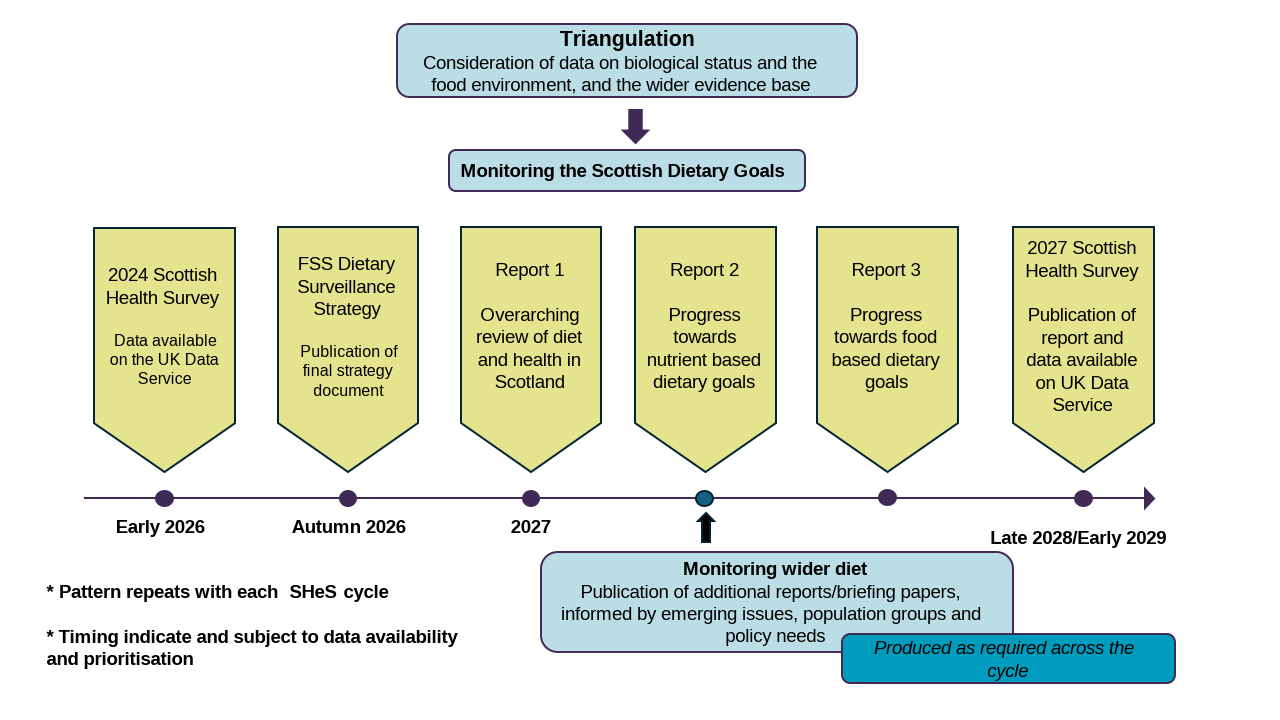
Here is a visual only chart of: Timeline diagram which an indicative reporting timeline for dietary surveillance outputs across the Scottish Health Survey cycle, illustrating how the Scottish Dietary Goals will be monitored between 2026 and 2029. At the top of the image, a text box labelled “Triangulation” states that monitoring will consider data on biological status, the food environment, and the wider evidence base. This leads to a subsequent text box, titled “Monitoring the Scottish Dietary Goals.” Along the timeline are six milestones: (1) 2024 Scottish Health Survey, with data available on the UK Data Service, in early 2026; (2) publication of the FSS Dietary Surveillance Strategy final document in autumn 2026; (3) Report 1 in 2027, an overarching review of diet and health in Scotland; (4) Report 2, covering progress towards nutrient-based dietary goals; (5) Report 3, covering progress towards food-based dietary goals; and (6) publication of the 2027 Scottish Health Survey report and data on the UK Data Service in late 2028/early 2029. A box beneath the timeline notes ongoing monitoring of the wider diet through additional reports and briefing papers informed by emerging issues, population groups and policy needs, produced as required across the cycle. Notes state that the pattern repeats with each Scottish Health Survey cycle and that timings are indicative and subject to data availability and prioritisation.
Please find more information provided in the detailed description and/or table below.
Timeline diagram which an indicative reporting timeline for dietary surveillance outputs across the Scottish Health Survey cycle, illustrating how the Scottish Dietary Goals will be monitored between 2026 and 2029. At the top of the image, a text box labelled “Triangulation” states that monitoring will consider data on biological status, the food environment, and the wider evidence base. This leads to a subsequent text box, titled “Monitoring the Scottish Dietary Goals.” Along the timeline are six milestones: (1) 2024 Scottish Health Survey, with data available on the UK Data Service, in early 2026; (2) publication of the FSS Dietary Surveillance Strategy final document in autumn 2026; (3) Report 1 in 2027, an overarching review of diet and health in Scotland; (4) Report 2, covering progress towards nutrient-based dietary goals; (5) Report 3, covering progress towards food-based dietary goals; and (6) publication of the 2027 Scottish Health Survey report and data on the UK Data Service in late 2028/early 2029. A box beneath the timeline notes ongoing monitoring of the wider diet through additional reports and briefing papers informed by emerging issues, population groups and policy needs, produced as required across the cycle. Notes state that the pattern repeats with each Scottish Health Survey cycle and that timings are indicative and subject to data availability and prioritisation.
Biological status
Biomarker data strengthen dietary risk assessment by providing biological measures of nutrient status, helping to interpret data on intakes and assess risk of deficiency. These measures help bridge the gap between reported intake and actual risk of deficiency.
Urinary sodium surveys also provide a more accurate method of assessing salt intakes than dietary surveys alone.
However, biological sample collection is resource intensive and has not been recently conducted in Scotland. FSS will explore low-cost innovations including emerging technologies to improve monitoring of micronutrient and salt/sodium intakes and status.