10. Annexes
10.1 Annex 1 – Table of product categories and additives where non-compliance has previously been identified as a concern.
These include:
- 04.2.2 Fruit and vegetables in vinegar, oil, or brine.
- 05.2 Other Confectionery including breath freshening micro-sweets.
- 05.4 Decorations, coatings and fillings, except fruit-based fillings covered by category 4.2.4.
- 14.1.4 Beverages - Flavoured Drinks.
- 15.1 Ready-to-eat savouries and snacks (Potato, cereal, flour, or starch-based snacks).
| Additive Name | Additive Name (Outside GB) | Product Category | Maximum Level Permitted (mg/l) or (mg/kg) | Additive Group, including exclusions from category | Additional Labelling Requirements | Relevant Legislation and Notes |
|---|---|---|---|---|---|---|
E129 | Red 40 | 14.1.4 Flavoured Drinks
(Excluding chocolate milk and malt products) | 100 | Group III: Food colours with combined maximum limit of 100mg/l: E 142, E 151, E 155, E 160e, E 161b | ‘Name or E number of the colour(s): May have an adverse effect on activity and attention in children’ | Conditions of Use in Product Category: Regulation (EC) No. 1333/2008 – Annex II Rows 2501-2750 Labelling: Regulation (EC) No. 1333/2008 Article 24 and Annex V
|
05.2 Other Confectionery including breath freshening microsweets (Excluding candied fruit and vegetables) | 300 | Group III: Food colours with combined maximum limit of 300mg/l: | ‘Name or E number of the colour(s): May have an adverse effect on activity and attention in children’ | Conditions of Use in Product Category: Regulation (EC) No. 1333/2008 – Annex II Rows 751-1000 Labelling: Regulation (EC) No. 1333/2008 Article 24 and Annex V | ||
| Bleached Flour | All Food Categories | Not permitted | Bleached flour is not authorised in GB, however, this has been found in some imported bakery products | |||
E 133 | Blue 1 | 14.1.4 Flavoured Drinks | 100 | Group III: Food colours with combined maximum limit of 100mg/l: E 142, E 151, E 155, E 160e, E 161b | Conditions of Use in Product Category: Regulation (EC) No. 1333/2008 – Annex II Rows 2501-2750 | |
05.2 Other Confectionery including breath freshening microsweets (Excluding candied fruit and vegetables) | 300 | Group III: Food colours with combined maximum limit of 300mg/l: E 142, E 151, E 155, E 160e, E 161b | Conditions of Use in Product Category: Regulation (EC) No. 1333/2008 – Annex II Rows 751-1000 | |||
| Brominated Vegetable Oil (BVO) | All Food Categories | Not permitted | Not authorised for use in GB but has been found in some imported drinks | |||
(BHT) E 321 | 14.1.4 Flavoured Drinks
| Not permitted | Has been found in some imported drinks | |||
Calcium Disodium Ethylene Diamine Tetra-Acetate(EDTA) E 385 | 14.1.4 Flavoured Drinks | Not permitted | Has been found in some imported drinks | |||
E 315 | 14.1.4 Flavoured Drinks | Not permitted | Has been found in some imported drinks | |||
E 127 | Red 3 | 05 Confectionary | Not permitted | Only authorised for use in cocktail cherries in GB, but has been found in breakfast cereals, coloured cake sprinkles and various confectionery. | ||
| Mineral Oil | Mineral Oil | All Food Categories | Not permitted | Not authorised in GB but has been found in some imported confectionery. | ||
E 202 | 14.1.4 Flavoured Drinks Where E210-213 Benzoic acid — benzoates have also been used as an ingredient | 250 | Maximum applies to group: E 200 – 202: Sorbic acid – potassium sorbate (SA) | Conditions of Use in Product Category: Regulation (EC) No. 1333/2008 – Annex II Rows 2751-300 | ||
14.1. 4 Flavoured Drinks (Excluding dairy-based drinks) | 300 | Maximum applies to group: E 200 – 202: Sorbic acid – potassium sorbate (SA) | Conditions of Use in Product Category: Regulation (EC) No. 1333/2008 – Annex II Rows 2751-3000 | |||
E 211
| 14.1. Flavoured Drinks (Excluding dairy-based drinks) | 150 | Maximum applies to group: E 210–213: Benzoic acid — benzoates (BA) | Conditions of Use in Product Category: Regulation (EC) No. 1333/2008 – Annex II Rows 2751-3000 | ||
E 444
| 14.1. 4 Flavoured Drinks (Only cloudy drinks) | 300 | Conditions of Use in Product Category: Regulation (EC) No. 1333/2008 – Annex II Rows 2751-3000 | |||
Sunset Yellow FCF/Orange Yellow S E 110
| Yellow 6 | 05.2 Other Confectionery including breath freshening microsweets (except candied fruit and vegetables; traditional sugar-coated nut- or cocoa-based confectionery of almond shape or host shape) | 35 | ‘Name or E number of the colour(s): May have an adverse effect on activity and attention in children’ | Conditions of Use in Product Category: Regulation (EC) No. 1333/2008 – Annex II Rows 751-1000 Labelling: Regulation (EC) No. 1333/2008 Article 24 and Annex V | |
| 05.4 Confectionary (Decorations, coatings and fillings, except fruit-based fillings) | 35 | ‘Name or E number of the colour(s): May have an adverse effect on activity and attention in children’ | Conditions of Use in Product Category: Regulation (EC) No. 1333/2008 – Annex II Rows 1001-1250 Labelling: Regulation (EC) No. 1333/2008 Article 24 and Annex V | |||
14.1.4 Flavoured Drinks (Excluding chocolate milk and malt products) | 20 | ‘Name or E number of the colour(s): May have an adverse effect on activity and attention in children’ | Conditions of Use in Product Category: Regulation (EC) No. 1333/2008 – Annex II Rows 2501-2750 Labelling: Regulation (EC) No. 1333/2008 Article 24 and Annex V | |||
| 15.1 Ready-to-eat savouries and snacks (Potato, cereal, flour, or starch-based snacks) | Not permitted | The authorisation does not cover crisps, but the colour has been found in imported crisps. | ||||
E 102
| Yellow 5 | 04.2.2 Fruit and vegetables (Fruit and vegetables in vinegar, oil, or brine) | Not permitted | The colour is authorised in GB in certain products. This does not include pickled vegetables, however, the colour has been found in some imported hot/sour pickles. | ||
05.2 Other Confectionery including breath freshening microsweets (Excluding candied fruit and vegetables) | 300 | Group III: Food colours with combined maximum limit of 300mg/l: E 142, E 151, E 155, E 160e, E 161b | ‘Name or E number of the colour(s): May have an adverse effect on activity and attention in children’ | Conditions of Use in Product Category: Regulation (EC) No. 1333/2008 – Annex II Rows 751-1000 Labelling: Regulation (EC) No. 1333/2008 Article 24 and Annex V
| ||
| 14.1. 4 Flavoured Drinks | 100 | Group III: Food colours with combined maximum limit of 100mg/l: | ‘Name or E number of the colour(s): May have an adverse effect on activity and attention in children’ | Conditions of Use in Product Category: Regulation (EC) No. 1333/2008 – Annex II Rows 2501-2750 Labelling: Regulation (EC) No. 1333/2008 Article 24 and Annex V | ||
15.1 Ready-to-eat savouries and snacks (Potato, cereal, flour, or starch-based snacks) extruded or expanded savoury snack products | 200 | Group III: Food colours with combined maximum limit of 200mg/l: E 142, E 151, E 155, E 160e, E 161b
| ‘Name or E number of the colour(s): May have an adverse effect on activity and attention in children’ | Conditions of Use in Product Category: Regulation (EC) No. 1333/2008 –Annex II Rows 3001-3250 Labelling: Regulation (EC) No. 1333/2008 Article 24 and Annex V |
10.2 Annex 2 – Example letter to FBOs on the sale of imported foods.
Subject: Sale of Imported Foods
We are writing to you to make you aware of some common issues which have been identified with certain types of imported food products you may sell. The aim is to help you understand the legal requirements and assist you in complying with these.
Where products are not formulated, labelled, or intended to be sold on the market in Great Britain (GB), they may contain unauthorised additives and/or may not comply with GB domestic and assimilated European Union (EU) food information requirements, meaning consumers could be at risk from:
- missing or inadequate allergen information.
- the inclusion of ingredients that don’t meet GB food safety requirements.
- food additives at levels that exceed the permitted maximum use level in GB.
Non-compliant products must not be placed on the market in Scotland, and we are working with FSS to tackle non-compliance to ensure such products are removed from the market and potentially destroyed. These products can be referred to as ‘Grey Market Goods’.
Supplying non-compliant food products can lead to financial, legal and reputational risks for a business, as you may be required to recall and withdraw products from the market, or in some cases risk being the subject of a criminal investigation.
The Annexes from Page 2 onwards provide further information you might find useful:
- Annex 1 provides guidance on common areas of non-compliance associated with certain imported foods and how to ensure that you comply with the legislation.
- Annex 2 provides additional information for importers.
- Annex 3 provides some examples of unauthorised use of ingredients.
- Annex 4 provides examples of what to look for on labels.
If you require any further information or do not fully understand what you need to do after reading this letter, please contact us at (LA to insert contact details).
Annex 1 – Common Contraventions and Guide to Compliance
Possible Contravention and Legal Requirement
| Guide to Compliance |
|---|---|
Products contain ingredients not authorised in Great Britain.
Offence to place on the market a food additive or any food in which such a food additive is present if the use does not comply with Regulation 1333/2008. |
|
No English labelling on products.
This is also a food safety issue as the presence of any allergens will not be clear, presenting a serious risk to consumers with food allergies.
Mandatory food information shall appear in English Article 15 of Regulation 1169/2011
|
|
No GB manufacturer or importer details on product label.
Mandatory food information includes the name or business name and address of the food business operator under whose name the food is marketed or, where they are not based in GB, the importer of the product.
Articles 8(1) and 9(1)(h) of Regulation (EU) 1169/2011
| If you have any food products on sale which only have a name and address of an overseas manufacturer on them, they will not be compliant. You should contact your supplier to obtain the compliant food information labels / stickers to put on the products before placing for sale on the market in Scotland.
If you import the products directly into GB yourself from overseas, you are responsible for ensuring the food information labels are compliant and include your full business name and address.
|
Any allergens present not emphasised on the product label.
Allergens require to be emphasised in the list of ingredients.
Article 21 of Regulation (EU) 1169/2011
| Check that any products containing the following allergens have the allergen emphasised in the ingredients list, for example in BOLD, underlined or in a different colour, etc.:
If any of these allergens are not emphasised within the ingredients list, they will not be compliant, and you should contact your supplier to obtain the compliant food information labels / stickers to put on the products before placing for sale on the market in Scotland.
An example is shown in Annex 4.
The Food Standards Scotland website has further guidance on allergens.
|
No advisory statement in relation to the presence of some food colours.
Foods containing any of the following:
require to be labelled with the following additional information: ‘name or E number of the colour(s)’: may have an adverse effect on activity and attention in children’.
Article 24 and Annex V of Regulation (EC) 1333/2008.
| Check that any products containing any of these food colours in the ingredients list have the additional required statement.
If they do not, they will not be compliant, and you should contact your supplier to obtain the compliant food information labels / stickers to put on the products before placing for sale on the market in Scotland.
Note that these food colours are known out-with GB by other names, for example:
This is another indication that the product has not been produced for the GB market.
|
Nutritional information not in the correct format.
The mandatory nutrition declaration shall include: Energy Value (kJ and kcal) and the amount (g, mg or mg) of fat, saturates, carbohydrate, sugars, protein and salt, in that order, per 100g or 100ml.
Articles 9, 30, 32 and Annex XV of Regulation (EU) 1169/2011
| Check that product labels have the nutrition information in the correct order and per 100g.
If they do not, they will not be compliant, and you should contact your supplier to obtain the compliant food information labels / stickers to put on the products before placing for sale on the market in Scotland.
An example is given in Annex 4
|
Annex 2: Additional Information for Importers
If you import food products directly into GB from overseas, you are responsible for ensuring the products meet GB food safety requirements and that the labels are compliant with food information requirements.
This could require the use of over-stickers, which are accurate and compliant with GB food information requirements, applied to each product before they are placed on the market in Scotland. In this situation you, as the importer, would be solely responsible for products meeting food labelling requirements.
The product will require to have the full name and address of the GB importer on the over-sticker label.
The address provided on the label must be a recognised and genuine address at which the responsible business can receive mail, legal documents, etc. to enable them to respond or act as necessary. The business name and address must be traceable and linked to a registered food business. An e-mail address or phone number alone is not sufficient.
Over-stickering cannot be used to conceal the presence of unauthorised ingredients. Before placing any imported products on the market, you are responsible for ensuring that any ingredients are authorised for use in GB and used in accordance with the conditions of their authorisation. This may require further liaison with the manufacturer.
Details of authorised additives can be found in the Register of Food Additives Authorisations. There is also Guidance on the use of the register.
Annex 3: Examples of Unauthorised use of Ingredients
Ingredient
| Examples of Unauthorised Use |
|---|---|
Brominated vegetable oil (BVO)
| Brominated vegetable oil (BVO) is not authorised in GB but has been found in some imported drinks.
|
Erythrosine (E 127) | Erythrosine (shown on US products as Red 3) is only authorised for use in cocktail cherries in GB, but has been found in breakfast cereals, coloured cake sprinkles and various confectionery. |
| Sunset yellow FCF (E 110) | The use of the colour is authorised in GB, but with maximum permitted levels in certain products. Fizzy drinks not intended for the GB market in Scotland have been found to contain excess levels of the colour.
The authorisation does not cover crisps, but the colour has been found in imported crisps. |
| Tartrazine (E 102) | The colour is authorised in GB in certain products. This does not include pickled vegetables, however, the colour has been found in some imported hot/sour pickles. |
Butylated hydroxytoluene (BHT) (E 321) Calcium disodium EDTA (E 385) Erythorbic acid (E 315) | These additives are not authorised for use in drinks in GB but have been found in a variety of imported soft drinks. |
| Bleached flour | Bleached flour is not authorised in GB, however, this has been found in some imported bakery products. |
| Use of mineral oil in soft candy. | Mineral oil is not authorised as a glazing agent in GB but has been found in some imported sweets. |
Annex 4: Checking Labels for Compliance
Label A: Non-compliant
- No nutrition per 100g/100ml, only per serving.
- Energy not given in kJ and kcal, in calories only.
- Order of nutritional declaration is incorrect.
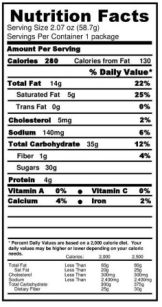
Here is a visual only chart of: • No nutrition per 100g/100ml, only per serving. • Energy not given in kJ and kcal, in calories only. • Order of nutritional declaration is incorrect.
Label B: Compliant
- Nutritional information given per 100g.
- Energy given in kJ and kcal.
- Nutritional declaration in correct order in table.
- Includes some voluntary information, such as fibre, % reference intake etc.
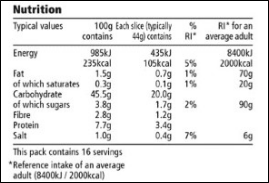
Here is a visual only chart of: • Nutritional information given per 100g. • Energy given in kJ and kcal. • Nutritional declaration in correct order in table. • Includes some voluntary information, such as fibre, % reference intake etc.
Label C: Compliant
- Nutritional information given per 100g.
- Energy given in kJ and kcal.
- Nutritional declaration in correct order in table.
- Includes some voluntary information, such as fibre, % reference intake etc.

Here is a visual only chart of: • Nutritional information given per 100g. • Energy given in kJ and kcal. • Nutritional declaration in correct order in table. • Includes some voluntary information, such as fibre, % reference intake etc.
Label D: Non-compliant
- Contains mineral oil which is not authorised for use in food in GB.
- Additives Red 40, Yellow 5, Blue 1 and Yellow 6 are not listed by their authorised name in GB.
- Colours Allura Red (Red 40), Tartrazine (Yellow 5) and Sunset Yellow FCF (Yellow 6) require an additional declaration about their effect on children which is not included.
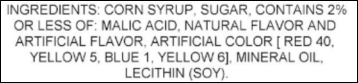
Here is a visual only chart of: Contains mineral oil which is not authorised for use in food in GB. Additives Red 40, Yellow 5, Blue 1 and Yellow 6 are not listed by their authorised name in GB. Colours Allura Red (Red 40), Tartrazine (Yellow 5) and Sunset Yellow FCF (Yellow 6) require an additional declaration about their effect on children which is not included.
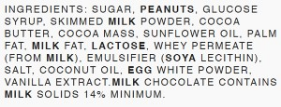
Label E: Non-compliant
- Contains allergens (milk, soy, egg, peanuts) which are not emphasised in the list of ingredients.
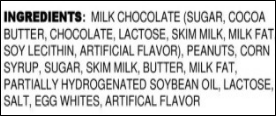
Here is a visual only chart of: Label E: Non-compliant Contains allergens (milk, soy, egg, peanuts) which are not emphasised in the list of ingredients.
Label F: Compliant
- All allergens are emphasised within the list of ingredients.