
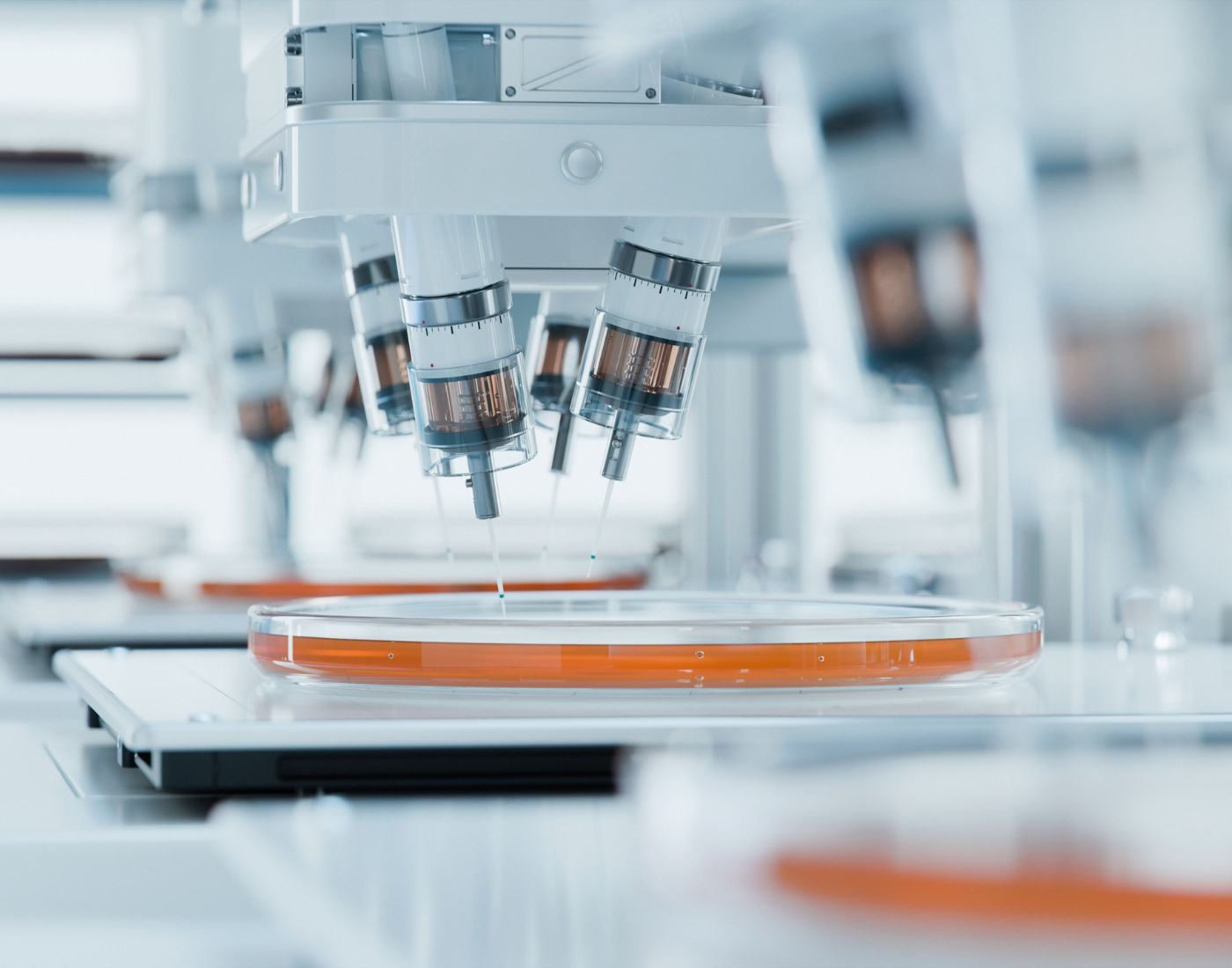
Cell-cultivated products (CCPs) cover a variety of foods that can be made using a production process without slaughter or traditional farming and agricultural practices. Cells isolated from animals or plants, including cells from meat, seafood, fat and offal, or eggs, are grown in a controlled environment, and then harvested to make a final food product.
Cell-cultivated products
Guidance for businesses on cell-cultivated products and the authorisation process
On this page:
- What is a cell-cultivated product?
- CCP status in Great Britain (GB)
- Applying for authorisation
- Business Support Service (BSS)
- Applying for authorisation under the novel food regulation
- Cell-cultivated products: classification and HACCP principles
- Technical guidance
- Supplementary guidance to applicants for assessment of CCP in food: Allergenicity and Nutrition
- Applying for authorisation under the genetic modification regulations
- Data protection
- Product safety
- Labelling
- Research on cell-cultivated products (CCPs)
- Novel food tasting trials
- Cell-Cultivated Products Sandbox Programme
- Workshop summaries
What is a cell-cultivated product?
Are cell-cultivated products the same as lab-grown meat?
Cell-cultivated products produced from animal cells are sometimes referred to as lab-grown meat (other names include cultured, cultivated, cell-cultured or cell-based). However, according to the definition of meat and products of animal origin included in Annex 1 of Regulation 853/2004, cell-cultivated products are not defined as meat. Instead, they are considered to be products of animal origin.
Cell-cultivated products status in Great Britain (GB)
Cell-cultivated products must be authorised before they can be placed on the market in GB. This is to ensure they have been through a rigorous and independent safety assessment. Because of the variety of products and complex production techniques involved, different regulations may apply to the process of their authorisation. They will need to comply with all the regulations applicable to all food on the market, such as hygiene rules or general food law.
Applying for authorisation
To place your cell-cultivated product on the GB market you must apply for authorisation using our regulated product application service. You must ensure that you choose the correct regulatory route for the assessment of your product.
Considering the methods that are used to create CCPs, we anticipate that most applications will be assessed under the novel food regulations. Novel food regulations apply to foods with no history of consumption in the United Kingdom (UK) or the European Union (EU) before 15 May 1997.
In some cases, CCP applications may be assessed under the Genetically Modified Organism (GMO) Regulation. If genetic modification has taken place during the process, please contact us to discuss your application. Further information on making an application under the GMO regime can be found below.
Improving your cell cultivated product application
This guidance outlines key requirements and common issues to support cell cultivated product applications and minimise requests for further information.
Business Support Service (BSS) for cell-cultivated products
We have a Business Support Service (BSS) for cell-cultivated products that is designed to support companies wishing to submit applications for cell-cultivated products to the GB market authorisation service.
It supports the applicant throughout the life of the application, offering both pre- and post-submission support.
Applying for authorisation under the novel food regulation
Applications for authorisation of CCPs are required for products considered novel under the novel food regulation (Regulation 2015/2283).
Read our novel foods authorisation guidance to find out how to apply for authorisation of your product as a novel food.
You can check the products already authorised for the use in Great Britain in the register of novel food authorisations.
Cell-cultivated products supplementary guidance
Through the cell-cultivated products sandbox programme, we are producing supplementary technical guidance on a range of topics relevant to these products. This supplementary guidance will help companies apply existing food regulations to these new products and assist them in completing their regulated product applications.
Cell-cultivated products: classification and HACCP principles
This guidance should be used by those developing cell-cultivated products produced using animal cells. These are products of animal origin, so businesses must apply existing food safety regulations during the production process. It contains references to relevant legislation that applies and what it means for food businesses.
Further guidance expanding on additional hygiene-related topics will be developed and published through the course of the programme.
Cell-cultivated products: food business hygiene requirements
Guidance on applying general food law and hygiene regulations to cell-cultivated products.
Cell-cultivated products: Regulatory authorisation guidance
A guide to the regulated products framework. This guidance explains how food regulations apply to cell-cultivated products. It's for anyone involved in producing these products.
Technical guidance
This guidance should be used to support the development of cell cultivated product dossiers supporting applications for novel food authorisation. This tailored guidance should be read in addition to the detailed guidance and application requirements are set out in Regulation (EC) 2017/2469 and guidance previously developed by EFSA. The 2016 EFSA guidance remains relevant as our approach to dossier assessment is based on EU processes. You should follow the parts that relate to the development of dossiers only and not the application process:
These guidance documents should be used to support prospective cell-cultivated product companies in the development of novel food dossiers, identifying key safety hazards that should be considered in their risk assessment, and providing an overview of the data requirements to demonstrate that these have been effectively mitigated.
This guidance may be further developed as the techniques and technologies of cell-cultivated product production are further refined.
The main aim of Regulation 178/2002, also referred to as 'general food law', is to protect human health and consumers’ interests in relation to food.
Supplementary guidance to applicants for assessment of Cell Cultivated Products (CCP) in food: Allergenicity and Nutrition
This guidance is the first piece of supplemental technical guidance for CCPs to have been published by the Sandbox programme. Future guidance on the topics of cell identity, production, microbiology, toxicology and growth media composition is underway and will be published through 2026.
Supplementary guidance to applicants for the assessment of cell cultivated products in food: identity, production and microbiology
This supplemental guidance aims to better guide companies on how to make products in a safe way and how they can demonstrate this to us. The FSS and FSA are using the knowledge learnt from the CCP sandbox programme, in addition to expert elicitation and literature reviews, to publish supplemental guidance documents that provide clarity to businesses on the path to market.
Cell-cultivated products: assessing growth media and toxicology
This document outlines the scientific requirements for evaluating growth media components and toxicological hazards of cell-cultivated products when seeking market authorisation as novel foods in Great Britain (GB).
Applying for authorisation under the genetic modification regulations
GMO regulations specifically apply to the modification of an organism's genetic material (DNA) in a way that does not occur naturally by mating and/or natural recombination. Both of these regulations are designed to ensure the food is safe for human consumption.
If a cell-cultivated product is produced using genetic modification, please contact us to discuss which regulatory regime it should fall under. Read our Genetically modified organisms authorisation guidance to find out how to apply for authorisation of your product as a GM food.
You can check the list of GMOs authorised for import and use in food and feed in GB in our register of authorised GMOs.
Data protection
You may request that any confidential data supporting your application is not used without your permission by other businesses for five years from the date of authorisation.
Product safety
All regulated products, regardless of regime, undergo rigorous safety assessments.
All food businesses must comply with food safety law. With some exceptions, it applies to all stages of production, processing, and distribution of food and feed.
To place safe food on the market you must:
- ensure traceability of food
- present food appropriately
- provide suitable food information
- withdraw or recall unsafe food
- ensure food and feed imported into, and exported from, GB comply with food law
You can find more information in our Advice for new businesses guide.
Labelling
You must provide certain information with food products placed on the market to comply with the labelling rules. This includes products’ ingredients, including allergens, and their durability (a use-by or a best-before date). You can find specific labelling requirements in our Labelling and composition standards guide.
Regulation 1169/2011 on the provision of food information to consumers brings together rules on general food labelling and nutrition labelling into one piece of legislation.
FSS reserves the right under Article 9 of the novel food regulations to require additional specific labelling requirements if we consider it to be in consumers’ best interests.
If a product is assessed under the GMO regime, you must label it as ‘genetically modified’.
Research on cell-cultivated products (CCPs)
We set high standards of food safety. Our research demonstrates our commitment to identifying how best to regulate new and innovative food production methods.
Research reports:
In March 2023, FSS and the FSA commissioned a report to identify the hazards associated with cell-cultivated products production processes. The purpose was to inform our risk assessment process for authorising these products.
This report is a synthesis of desk research, based on thorough review of the academic and non-academic literature and of the alternative proteins start-up scene, and presents an analysis of the emerging market for alternative proteins, the potential implications and the potential policy responses that FSS might need to consider.
3D printing, also called additive manufacturing, represents a range of technologies that create 3D objects through a layer-by-layer deposition process using digital image files. This research report looks at the 3D printing technologies in the food system for food production and packaging
An evidence review was also undertaken in 2025 to examine consumer responses to cell-cultivated products (meat, seafood, dairy and plants).
This 2025 report focuses on best practice for cell banking techniques used in cell-cultivated products.
This 2025 report focuses on microbial safety issues in meat and how these apply to cell-cultivated products
In April 2023, the Food and Agriculture Organisation of the United Nations (FAO) and the World Health Organisation (WHO) released a report compiling and evaluating all evidence to date on food safety aspects of cell-based food.
Novel food tasting trials
Tasting trials of unauthorised novel foods may be permitted if the intention behind them is to conduct research to develop the novel food. FSS recommends, as best practice, taste trials are guided by advice published by the Advisory Committee on Novel Foods and Processes (ACNFP). Companies may communicate the fact they have conducted a taste trial through media activity where such publicity is ancillary to the main purpose of the trial as research and development.
If the intention of a tasting trial is to publicise a product or a company brand, then the tasting may amount to the unlawful placing on the market of an unauthorised novel food.
If you conduct a taste trial in the UK, you should refer to the recently updated novel food taste trial guidance to ensure the trial does not amount to an unlawful placing on the market of an unauthorised novel food.
Novel food taste trials supplementary information
This supplementary guidance has been developed in response to feedback from industry and should be read in conjunction with the FSA and FSS’s published guidance on the conduct of taste trials involving novel foods or foods produced by novel processes(opens in a new window).
Cell-Cultivated Products Sandbox Programme
The Food Standards Agency (FSA), alongside FSS, have been awarded £1.6 million by the Department for Science, Innovation and Technology to better understand how cell-cultivated products are made and make an informed assessment of their safety. This research is part of a bigger programme sometimes referred to as a ‘regulatory sandbox’. The sandbox is a dialogue programme where the FSA and FSS will work with industry, academic bodies, and other experts to gather knowledge about these products to inform our regulatory approach. This programme began in February 2025 and will run until February 2027.
We will explore the risks and hazards, how they can be managed, and what tests companies need to carry out to ensure their safety. We will also use this knowledge to decide how existing legislation applies to these innovative products. Insight from industry will be an important part of this process, helping us understand practical realities and technical approaches. Alongside this, we will draw on other sources of evidence such as scientific research, regulatory expertise and consumer perspectives. We will use the learning from all these sources to produce clear guidance [link to Sandbox guidance] for companies wishing to sell these new foods in Great Britain about how to produce safe food, what data to include in their applications to the FSA and FSS, and how existing food regulation will apply to these products.
Current sandbox participants are outlined below (please note, some changes have occurred to the participant lists since the sandbox was launched in March 2025 due to company changes):
- BlueNalu
- Gourmey
- Hoxton Farms
- Mosa Meat
- Roslin Technologies
- Vital Meat
- Vow
- National Alternative Protein Innovation Centre (NAPIC)
- Cellular Agriculture Manufacturing Hub (CARMA)
- Bezos Centre for Sustainable Protein at Imperial College London
- Alternative Proteins Association (APA)
- Good Food Institute (GFI)
Workshop summaries
As part of the Cell-Cultivated Products (CCP) Sandbox programme, we are running monthly workshops with industry participants, each one covering a certain area of production. Workshop summaries highlighting the key topics, challenges, and opportunities discussed during each session are published regularly. In conjunction with GFI Europe, we will be hosting regular webinars to share learnings from the programme with wider industry
This advice is for guidance purposes and is not definitive. If you have any questions on the application process, please contact the Regulated Products Team: LabellingStandardsandRegulatedProducts@fss.scot
Disclaimer: This web page is intended for information purposes only. It does not guarantee your product will be assessed under a particular regulatory route. We reserve the right to make that decision.
If you have any questions on CCPs more generally, please contact the CCP Sandbox team ccpsandbox@food.gov.uk