
About FSS
FSS was established on 1 April 2015 as Scotland’s public sector food body, to protect the heath and wellbeing of consumers through three objectives set under the Food (Scotland) Act 2025:
- To protect the public from risks to health which may arise in connection with the consumption of food
- To improve the extent to which members of the public have diets which are conducive to good health
- To protect the other interests of consumers in relation to food
We work independently of government and industry to provide advice which is impartial and based on robust science and data.
Our remit covers all aspects of the food chain which can impact on public health – aiming to protect consumers from food safety risks and promote healthy eating.
We work closely with the Scottish Government, local authorities, the Food Standards Agency, UK government, other devolved administrations, and industry partners to maintain high food safety and public health standards.
Our strategy for 2026 -2031 defines our vision, strategic priorities and values as an organisation.
Our Vision and Values
Our vision and how we aim to achieve it:
A safe, authentic and healthier food environment that Scotland can trust.
We will deliver our strategy through the following set of values. These will underpin the approaches we will take to attain our mission and achieve our outcomes and vision for Scotland’s food environment.
Our Values:
Consumer and health focussed: We keep public health and consumer protection at the heart of what we do. We ensure our actions are targeted, recognising the diversity of people in Scotland and striving to reduce health inequalities.
Evidence based: We ensure our work is underpinned by robust science and data and an up to date understanding of the issues that matter most to consumers in Scotland.
Fair, proportionate and trusted: We promote compliance with food law by regulating fairly, firmly and proportionately; establishing trust by ensuring regulatory objectives are transparent and our actions are consistent and timely.
Independent: We preserve our independence, working at arm’s length from government and industry. We influence UK policy development through robust risk analysis, recommending decisions which are in the best interests of consumers in Scotland.
Inclusive, collaborative and open: We respect the rights of every individual, organisation and business to have a say in the matters that affect them and work collaboratively to achieve the greatest benefit for the people of Scotland. We ensure transparency in our decision making, advice and recommendations, by publishing our evidence base and enabling those impacted to understand the issues.
People Strategy
Our People Strategy is now embedded, and good progress has been made to date with high level outcomes and strategic objectives. Our people are our greatest asset, we rely on well trained, skilled and motivated individuals and teams working collaboratively to achieve results. The People Strategy is a living document, framed around four core “pillars” with equality, diversity and inclusion flowing through each. The People Plan for 2026-2031 is currently being drafted and will align with our new FSS Corporate Strategy 2026-2031.
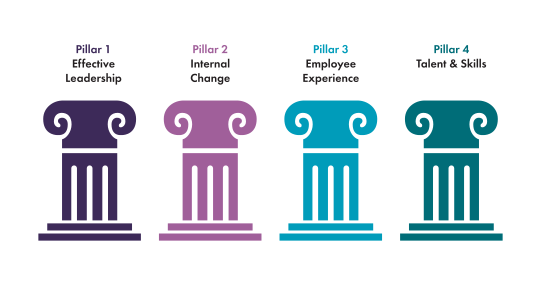
Here is a visual only chart of: Four columns in different colours. Pillar 1 is effective leadership, pillar 2 is internal change, pillar 3 is employee experience and pillar 4 is talent and skills.
Please find more information provided in the detailed description and/or table below.
Four columns in different colours. Pillar 1 is effective leadership, pillar 2 is internal change, pillar 3 is employee experience and pillar 4 is talent and skills.
Our legal duties for equality
The Equality Act 2010 provides the legislative framework for promoting fairness and preventing discrimination within the UK and aims to advance equality opportunities for all. It protects individuals against unfair treatment based on nine protected characteristics:
- Age
- Disability
- Gender reassignment
- Marriage and civil partnership
- Pregnancy and maternity
- Race
- Religion or belief
- Sex
- Sexual orientation
The Equality Act 2010 and the Equality Act (Specific Duties) (Scotland) Regulations 2012 set out a single equality duty and statutory specific duties for listed public bodies in Scotland. Listed organisations, including Food Standards Scotland, must meet these duties to ensure positive and real change for people with protected characteristics.
The general equality data
The general equality duty requires us, in the normal course of our work, to take account of the need to:
- eliminate unlawful discrimination, harassment, victimisation and other prohibited conduct;
- advance equality of opportunity between people who share a relevant protected characteristic and those who do not;
- foster good relations between people who share a protected characteristic and those who do not.
The Equality Act explains that the second need (advancing for equality of opportunity) involves having due regards to the need to:
- Remove or minimise disadvantage suffered by people due to their protected characteristics;
- Take steps to meet the needs of people with certain protected characteristics where these are different to the needs of other people;
- Encourage people with certain protected characteristics to participate in public life or other activities where their participation is disproportionately low.
Specific statutory duties in Scotland
The public sector equality duty requires public bodies to have due regard to the need to eliminate discrimination, advance equality of opportunity and foster good relations between different people when carrying out their activities. It also covers marriage and civil partnerships, but only with regard to eliminating unlawful discrimination in employment.
Public authorities subject to the specific equality duties are required to:
- report on mainstreaming the equality duty
- publish equality outcomes and report progress
- assess and review policies and practices
- gather and use employee information
- publish information on board diversity and succession planning
- publish gender pay gap information
- publish statements on equal pay
- consider award criteria and conditions in relation to public procurement
- publish required information in a manner that is accessible.
The Scottish Specific Duties Regulations came into force on 27 May 2012.
Equal pay statement
FSS is an equal opportunities employer. All staff should be treated equally irrespective of their sex, marital/civil partnership status, age, race, ethnic origin, sexual orientation, disability, religion or belief, working pattern, employment status, gender identity (transgender), caring responsibility, or trade union membership, and receive equal pay for doing equal work or work of equal value. FSS operate a pay and reward system which is transparent, based on objective criteria and free from bias.
All FSS staff are on the Scottish Government Main (SGM) bargaining unit terms and conditions of employment. FSS staff are paid in accordance with SGM pay grades and SGM employment policies. Any pay bargaining is conducted as part of the wider SGM group.
The Scottish Government aims to avoid unfair discrimination in its pay and reward system, to reward fairly the skills, experience and potential of all staff and act as a model employer for other organisations in Scotland. This equal pay policy statement has been agreed with the Council of Scottish Government Unions. Equal pay policy applies at every level of the Scottish Government irrespective of working pattern and work continues to ensure greater balance across grades.
Scope of report
This is the main Equality Mainstreaming Report 2026 produced by FSS. It will set out our plans for how we will embed equality across the organisation to meet both the general and specific duties outlined earlier. The report will set out a summary of our workforce data and monitoring information on employment activities. It will also look at how delivery of our functions impacts on those with protected characteristics. The report sets out equality outcomes which we will work towards and how we will continue to embed equality across the organisation to meet both the general and specific duties as outlined.
Employment information - our workforce
Our workforce consists of a diverse range of highly skilled staff working across a broad range of functions these include Official Veterinarians and Meat Hygiene Inspectors (MHIs) who work in Operational areas in a variety of Food Business Operators across Scotland. We also employ Feed Delivery Specialists, Scientific Advisors, Nutrition Specialists, Policy staff, Audit Assessors, Local Authority Delivery staff, Marketing and Communications staff, Food Crime specialists, Corporate Services personnel including those working in Health and Safety, IT, Human Resources, Finance and Administration.
As of 31 December 2025, 287 staff are employed at Food Standards Scotland.
| 2018 | 2020 | 2022 | 2023 | 2024 | 2025 | |
|---|---|---|---|---|---|---|
| Number of staff employed* | 176 | 222 | 306 | 307 | 294 | 287 |
*Note: This is the headcount figure as at 31 March for each year, excluding 2025 which is at 31 December as reported by the Scottish Government MI Team and due to requirement for early publication of report during pre-election period.
**Note: These figures relate to employees and does not include agency temps/contingency staff currently working within FSS.